01. Edit your form online
Type text, add images, blackout confidential details, add comments, highlights and more.

Type text, add images, blackout confidential details, add comments, highlights and more.

Draw your signature, type it, upload its image, or use your mobile device as a signature pad.

Send it via email, link, or fax. You can also download it, export it or print it out.
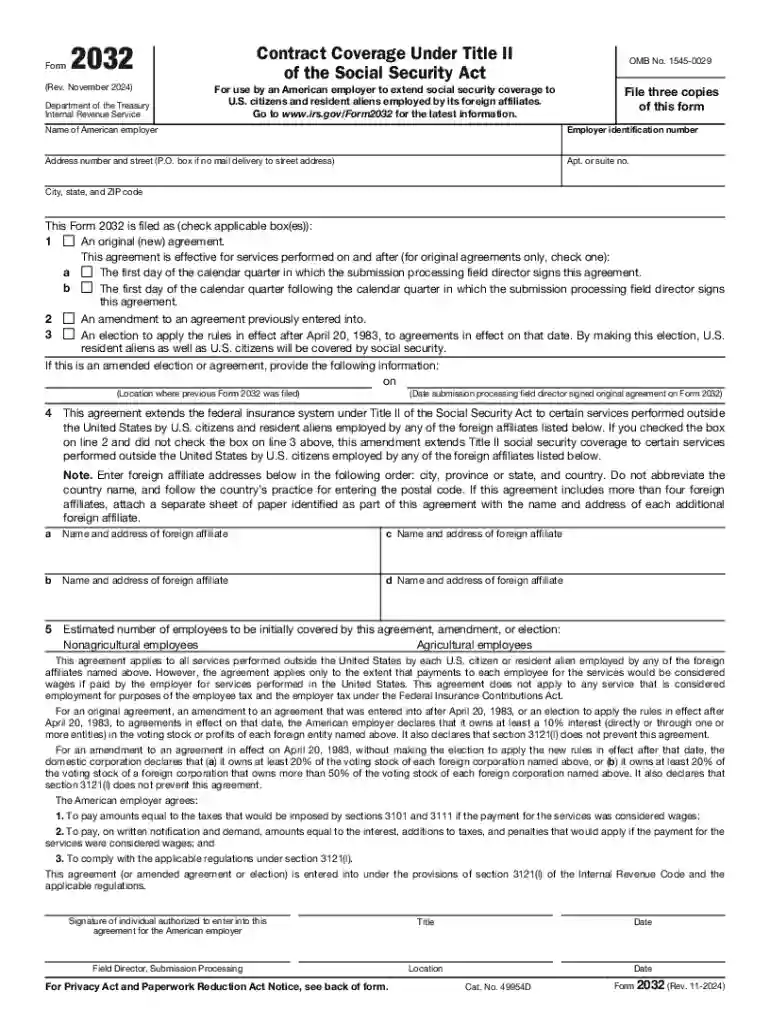
Form 2032, known as Contract Coverage Under Title II of the Social Security Act, is a crucial document for American employers who want to extend Social Security coverage to U.S. citizens and resident aliens working for foreign affiliates. This form establishes agreements or amendments to the existing agreements, ensuring that employees' contributions and benefits align with updated rules. Employers must provide detailed information about themselves, the foreign affiliates, and the employees covered by this arrangement. This document solidifies employer responsibilities for tax compliance and regulatory adherence.


U.S. Employers: Primarily, U.S.-based employers who have foreign affiliates outside the United States are eligible to fill out Form 2032. These organizations seek to ensure their employees stationed abroad remain covered by U.S. Social Security benefits.
Affiliated Foreign Entities: The foreign entity must be recognized as an affiliate of the U.S. employer. This can include subsidiaries, branches, or any type of legal entity where the U.S. company maintains significant influence or control.
Collection of Employer Information: Begin by collecting essential company data, including the employer's identification number, legal entity name, and primary business address.
Detailing Foreign Affiliate Information: Document the foreign affiliate's particulars, such as its legal name, location, and nature of business activities. Describe the relationship between the U.S. employer and the affiliate.
Listing Employee Details: Include comprehensive data on employees being covered, such as names, social security numbers, and job titles. Indicate their employment terms and affiliations.
Agreement Documentation: Specify whether the form is indicating a new agreement, amending an existing one, or electing to apply updated coverage rules.
Signature and Submission: Ensure the form is signed by an authorized representative of the U.S. employer. Submit the completed form through the designated channels stipulated by the IRS, such as mail or electronic submission platforms.
Accurate Representation: All information provided must be true and accurate to prevent legal complications or form rejection.
Periodic Updates: Employers must be mindful of updating agreements whenever there is a significant change in employment circumstances or affiliate status.
Financial Penalties: Failure to comply with these guidelines might result in financial penalties imposed by the IRS, including late fees and accumulated interest on overdue taxes.
Revocation of Agreements: The IRS may revoke agreements made under Form 2032 if compliance standards are consistently breached.
Real-Time Processing: Using IRS-approved electronic platforms accelerates processing times, providing faster confirmation and feedback.
Reduced Paperwork: Digital submission minimizes the paper trail, reducing potential filing errors and enhancing record-keeping.
Postal Delays: Mailing physical copies can be subjected to postal delays, extending the time taken for processing and approval.
Confirmation Challenges: Verifying receipt and processing of mailed forms may require follow-up actions.
Incorrect Coverage Claim: Employers incorrectly applying Form 2032 may face penalties, including back payment of employee benefits not covered.
Legal Repercussions: Misuse or fraudulent claims might expose employers to legal actions under U.S. tax and labor laws.
Through these comprehensive insights into Form 2032, American employers can strategically extend social security coverage abroad, ensuring legal compliance and continuous benefit protection for their global workforce.
We've got more versions of the About Form 2032, Contract Coverage Under Title II of the form. Select the right About Form 2032, Contract Coverage Under Title II of the version from the list and start editing it straight away!
At DocHub, your data security is our priority. We follow HIPAA, SOC2, GDPR, and other standards, so you can work on your documents with confidence.