
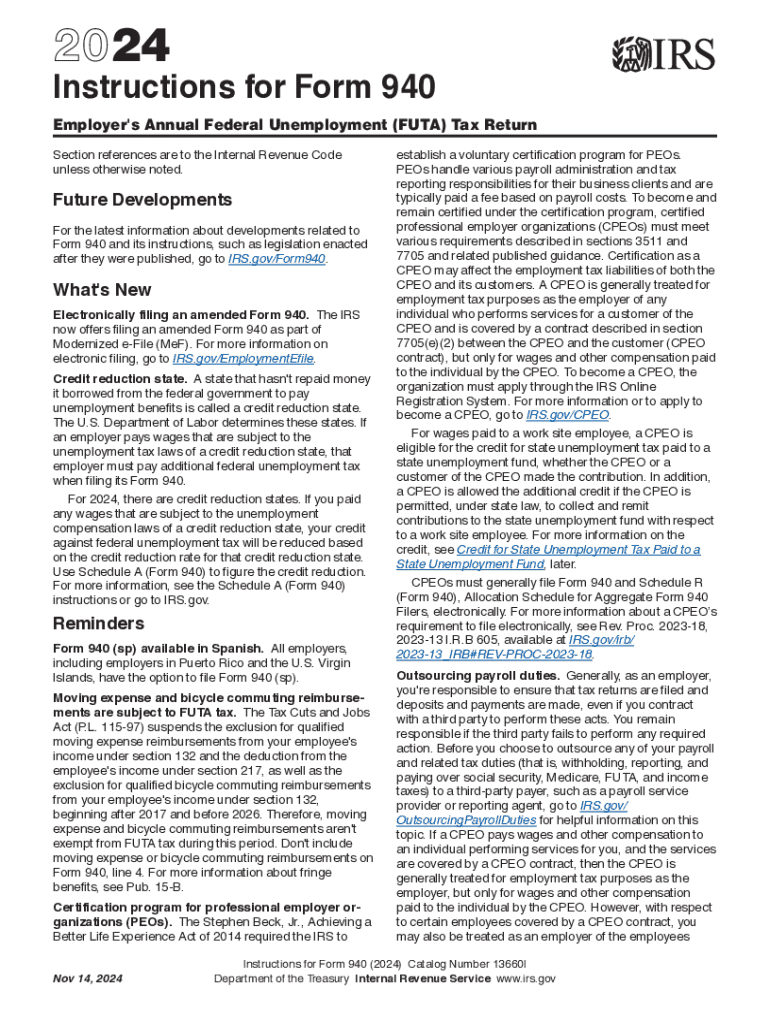







Definition and Purpose of Form 940
Form 940, known as the Employer's Annual Federal Unemployment (FUTA) Tax Return, is a critical component of U.S. tax compliance for employers. It mandates that employers report annual Federal Unemployment Tax Act (FUTA) liabilities. This form is essential to fund unemployment compensation for workers who have lost their jobs. Employers must understand this form to ensure compliance and avoid penalties.
Key Elements of Form 940
- Employer Information: Include details such as the employer's name, address, and Employer Identification Number (EIN).
- Tax Calculations: Calculate the total FUTA tax liability after considering any state unemployment taxes paid.
- Adjustments for Credit Reduction States: Specific adjustments are required if your business operates in a state designated as a credit reduction state by the IRS.
- Payment Details: Ensure accurate reporting of any deposits made throughout the year and calculate the final amount due.
Steps to Complete Form 940
Completing Form 940 involves several critical steps:
- Gather Employer Information: Collect all necessary identification information about your business to ensure accurate reporting.
- Calculate Tax Liability: Determine your total FUTA tax liability based on employee wages and allowable credits.
- Compile Required Documentation: Accumulate records of wages paid, unemployment taxes paid to states, and any previous FUTA tax deposits.
- Consider State-Specific Adjustments: If operating in a credit reduction state, calculate the additional taxes due.
- Complete and Review the Form: Carefully fill out each section of the form and review for accuracy before submission.
- Submit the Form by the Deadline: Ensure timely submission to avoid penalties, using the appropriate method (online or mail).
How to Use the Instructions for Form 940
The instructions for Form 940 provide detailed guidance to help employers complete and file their FUTA tax returns correctly. This document elucidates complex topics, offering examples and step-by-step instructions for calculating taxes and addressing credit reduction state scenarios.
Detailed Sections in the Instructions
- Filing Requirements: Who must file and exemptions.
- Interpreting Credits: How to correctly apply state unemployment tax credits.
- Form Completion Examples: Visual examples to guide filling out the form accurately.
- Frequent Questions: Address common issues and provide solutions.
Typical Users of Form 940
Form 940 is primarily used by business owners and payroll professionals responsible for payroll and tax compliance within organizations. It is applicable to various business entities, including corporations, LLCs, and partnerships that meet Federal Unemployment Tax Act requirements. Understanding how to complete Form 940 is crucial for businesses of all sizes.
Business Entity Types Benefiting Most
- Corporations: Large organizations with extensive payroll operations.
- Small Businesses: Smaller firms where owners manage payroll compliance directly.
- Nonprofits Hiring Employees: Entities with employee payrolls needing to comply with federal tax laws.
Required Documents for Form 940
To accurately complete Form 940, employers must keep detailed records and documentation:
- Employee Wage Records: Comprehensive accounts of all employee wages paid throughout the tax year.
- State Unemployment Contributions: Documentation of taxes paid to state unemployment offices.
- Previous Year’s FUTA Deposits: Records of any quarterly deposits made towards the year’s tax liability.
IRS Guidelines and Filing Deadlines
The IRS stipulates clear deadlines and guidelines for filing Form 940. Typically, the form is due by January 31st of the following tax year. However, if full FUTA tax payment has been made by the deadline, an extension for filing until February 10th is available.
Penalties for Non-Compliance
Failing to file Form 940 timely or inaccurately reporting liabilities can result in significant penalties and interest on outstanding tax amounts. It's essential for employers to comply with all IRS regulations to avoid such penalties.
Form Submission Methods
Employers have multiple options for submitting Form 940:
- Online Submission: Preferred for speed and efficiency through the IRS e-file system.
- Paper Filing: Submission by mail for those who opt not to use electronic methods.
- Assistance from Tax Software: Tools like TurboTax or QuickBooks can assist in form completion to ensure precision and timeliness.
Digital vs. Paper Version Considerations
Choosing between digital and paper submissions depends on employer preference and access to necessary resources for electronic filing. The digital version offers quicker processing times and instant acknowledgment of receipt.




