




01. Edit your form online
Type text, add images, blackout confidential details, add comments, highlights and more.

Type text, add images, blackout confidential details, add comments, highlights and more.

Draw your signature, type it, upload its image, or use your mobile device as a signature pad.

Send it via email, link, or fax. You can also download it, export it or print it out.
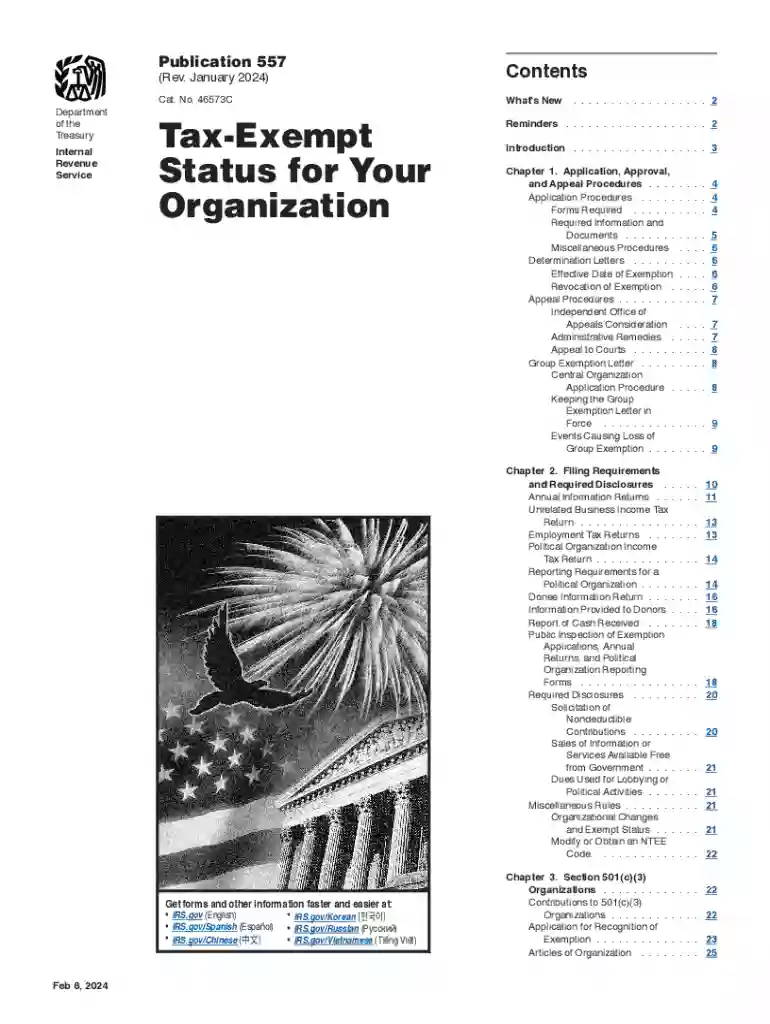
IRS Publication 557, titled "Tax-Exempt Status for Your Organization," is an essential document provided by the Internal Revenue Service (IRS). It offers comprehensive guidance on obtaining and maintaining tax-exempt status under section 501(c)(3) of the Internal Revenue Code. This publication is an invaluable resource for organizations aiming to understand the intricacies of qualifying as a tax-exempt entity, covering legal requirements, application procedures, and compliance obligations.
Organizations including charities, churches, educational institutions, and other nonprofit entities rely on this publication to navigate the process of achieving and preserving their tax-exempt status. It addresses various scenarios, explanations of legal terminologies, and examples of qualified organizations, making it a crucial tool for both new and existing tax-exempt entities.
IRS Publication 557 contains several critical components that guide users through the application process for tax-exempt status:
Eligibility Criteria: It outlines eligibility requirements for various types of organizations, ensuring they understand the basic qualifications needed for tax-exempt status.
Application Procedures: Provides step-by-step instructions for submitting Form 1023 or Form 1023-EZ, the application forms for recognition of exemption under section 501(c)(3).
Annual Filing Requirements: Details the filing obligations that tax-exempt organizations must adhere to, such as submitting Form 990, Form 990-EZ, or Form 990-N, depending on their size and financial activities.
Compliance Obligations: Explains the conditions and criteria that organizations must consistently meet to avoid jeopardizing their tax-exempt status.
To effectively utilize IRS Publication 557, organizations should start by thoroughly reviewing each section relevant to their type and operational structure. The document serves as a guide through:
Evaluating Eligibility: Determine if the organization meets the criteria specified for tax-exempt status by consulting the eligibility requirements.
Following Application Instructions: Use the detailed guidelines provided for completing and submitting the appropriate application forms.
Understanding Ongoing Requirements: Familiarize themselves with the reporting and operational standards that must be maintained.
Seeking Clarifications: Refer to the examples and legal definitions provided throughout the publication to clarify any uncertainties about the form and its standards.
Completing the application process to obtain tax-exempt status involves several key stages:
Preparation: Gather essential organizational documents such as articles of incorporation, bylaws, and financial records.
Selecting the Correct Form: Choose between Form 1023 and Form 1023-EZ based on the organization's size and complexity.
Drafting the Application: Accurately fill out the selected form, providing detailed and precise answers aligned with the publication's guidelines.
Reviewing Data: Before submission, carefully review the form for errors or omissions, ensuring compliance with all IRS instructions.
Submitting the Application: Send the completed application to the IRS either electronically through Pay.gov (for Form 1023-EZ) or by mail (for Form 1023), as specified in the publication.
This publication is chiefly used by individuals and entities involved in establishing and managing nonprofit organizations. Common users include:
Founders of New Nonprofit Entities: Those setting up new nonprofits seeking to obtain tax-exempt status.
Legal and Financial Advisors: Professionals guiding clients through the tax-exempt application process and compliance requirements.
Current Tax-Exempt Organizations: Entities wishing to review updated IRS guidelines to maintain compliance and avoid penalties.
Attorneys and Accountants: Specialists providing strategic advice to nonprofit organizations.
Understanding specific legal terms and definitions as outlined in IRS Publication 557 is crucial for users. These include:
Exempt Purpose: The reason for which tax-exemption is granted, such as religious, educational, or charitable activities.
Unrelated Business Income: Income derived from activities unrelated to an organization's exempt purpose, potentially subject to taxation.
Private Benefit/Private Inurement: The prohibited distribution of an organization's earnings to individuals for personal gain.
Public Charity vs. Private Foundation: Differentiating between classifications of tax-exempt entities based on public support.
The IRS outlines specific guidelines within Publication 557 to assist organizations in maintaining compliance. These include:
Operational Tests: Ensuring that the organization's activities are exclusively in pursuit of its exempt purpose.
Lobbying Activities: Restrictions on the extent to which a tax-exempt organization can engage in political lobbying.
Public Disclosure Requirements: The obligation to make certain documents, like annual returns, available to the public.
By adhering to these guidelines, organizations can secure their tax-exempt status while avoiding common pitfalls and noncompliance risks.
IRS Publication 557 emphasizes the importance of complying with filing deadlines to avoid penalties and ensure effective tax-exempt status:
Form 990 Series Deadlines: Annual returns must be filed by the 15th day of the 5th month after the end of the organization's accounting period.
Renewal Submissions: Regularly update and revalidate tax-exempt status through the required submissions to IRS.
Understanding and adhering to these deadlines ensures compliance and successful maintenance of tax-exempt status.
Failure to adhere to the guidelines and filing requirements set forth in IRS Publication 557 can result in significant penalties, including:
Revocation of Tax-Exempt Status: Organizations may lose their tax-exempt status and face back taxes and penalties.
Fines and Fees: Monetary penalties can be imposed for late submissions or inaccuracies in required filings.
Increased Scrutiny: Noncompliance may trigger audits and other repercussions from the IRS.
Organizations need to exercise due diligence to avoid these consequences by following the publication’s stipulated requirements rigorously.
We've got more versions of the What Is IRS Publication 557?: Internal Revenue Service form. Select the right What Is IRS Publication 557?: Internal Revenue Service version from the list and start editing it straight away!
At DocHub, your data security is our priority. We follow HIPAA, SOC2, GDPR, and other standards, so you can work on your documents with confidence.




More information about qualifying for exemption under section 501(c)(3) as an exempt organization can be found in Publication 557, Tax-Exempt Status For YourRead more
Mar 1, 2021 Future developments. The IRS has created a page on IRS.gov for information about Publica- tion 557, at IRS.gov/pub557. Information about.Read more


