



8959-2026

Get Form
8959 Preview on Page 1

Here's how it works

01. Edit your form online
Type text, add images, blackout confidential details, add comments, highlights and more.

02. Sign it in a few clicks
Draw your signature, type it, upload its image, or use your mobile device as a signature pad.

03. Share your form with others
Send it via email, link, or fax. You can also download it, export it or print it out.

How to use or fill out 8959 with our platform

Form edit decoration
9.5
Ease of Setup
DocHub User Ratings on G2
9.0
Ease of Use
DocHub User Ratings on G2
  1. Click ‘Get Form’ to open it in the editor.
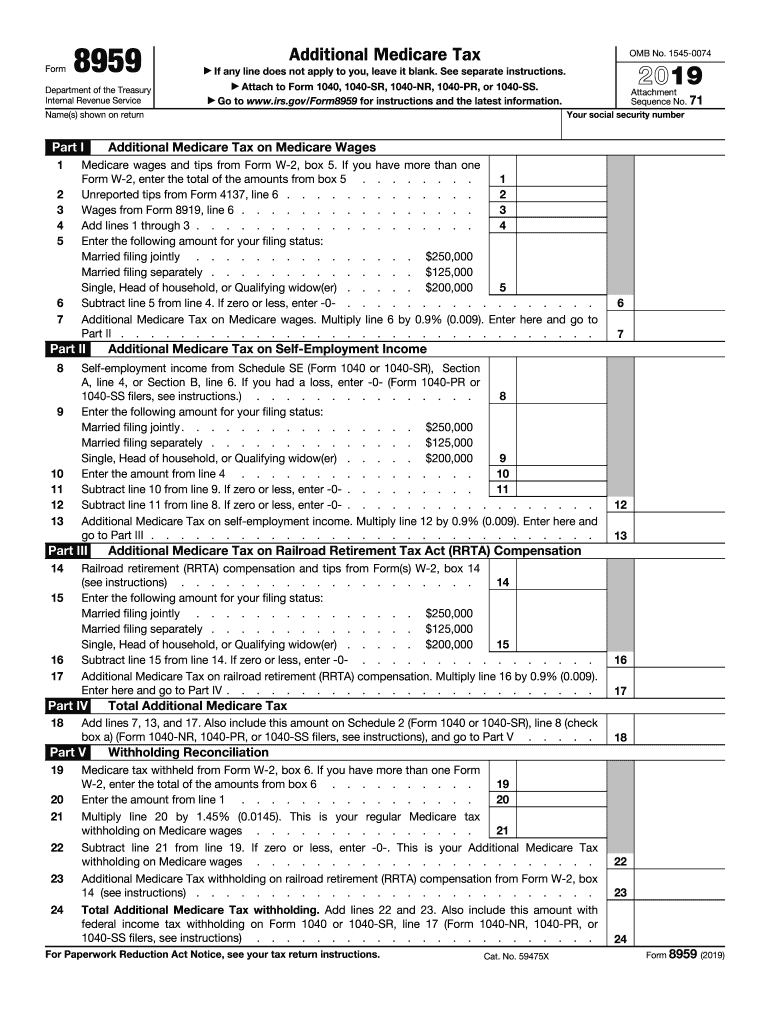
  2. Begin by entering your name(s) as shown on your tax return in the designated field at the top of the form.
  3. In Part I, complete lines 1 through 13 by providing details about your Medicare wages and any unreported tips. Ensure you total these amounts accurately.
  4. Proceed to line 14, where you will enter the threshold amount based on your filing status: $250,000 for married filing jointly, $125,000 for married filing separately, or $200,000 for single or head of household.
  5. Continue filling out Part IV and V by calculating any additional Medicare tax owed based on your self-employment income and RRTA compensation. Follow the instructions carefully for each calculation.

Start using our platform today to fill out Form 8959 easily and for free!

See more 8959 versions

We've got more versions of the 8959 form. Select the right 8959 version from the list and start editing it straight away!
Versions Form popularity Fillable & printable
2023 4.4 Satisfied (46 Votes)
2022 4.2 Satisfied (35 Votes)
2021 4.8 Satisfied (103 Votes)
2020 4.2 Satisfied (66 Votes)
2019 4.4 Satisfied (109 Votes)
2018 4.3 Satisfied (129 Votes)
2017 4.4 Satisfied (36 Votes)
2016 4.2 Satisfied (108 Votes)
2014 4.4 Satisfied (312 Votes)
2013 4.2 Satisfied (64 Votes)
be ready to get more

Complete this form in 5 minutes or less

Get form

Got questions?

We have answers to the most popular questions from our customers. If you can't find an answer to your question, please contact us.
Contact us
The short answer is no, you cannot opt out of paying the Medicare tax (or the Social Security tax), Paying both the Medicare tax and the Social Security tax is mandatory for workers in the United States.
Additional Medicare tax applies to an individuals Medicare wages that exceed a threshold amount based on the taxpayers filing status. Employers are responsible for withholding the 0.9% Additional Medicare tax on an individuals wages paid in excess of $200000 in a calendar year, without regard to filing status.
Additional Medicare Tax withholding applies only to wages paid to an employee that are in excess of $200,000 in a calendar year. Withholding rules for this tax are different than the income tax withholding rules for supplemental wages in excess of $1,000,000 as explained in Publication 15, section 7. Example.
Use Form 8919 to figure and report your share of the uncollected social security and Medicare taxes due on your compensation if you were an employee but were treated as an independent contractor by your employer. By filing this form, your social security earnings will be credited to your social security record.
This tax directly supports Medicare Part A, which offers hospital insurance to seniors and individuals with eligible disabilities. It is mandatory, impacting nearly everyone who earns an income in the United States, including self-employed workers who cover both shares.
be ready to get more

Complete this form in 5 minutes or less

Get form

People also ask

Excess Medicare withholding occurs when Box 6 is more than 1.45% of Box 5 on your Form W-2 (with the exception of those subject to the Additional Medicare Tax of 0.9%; see Questions and Answers for the Additional Medicare Tax for more information).
Use Form 8959 to figure the amount of Additional Medicare Tax you owe and the amount of Additional Medicare Tax withheld by your employer, if any. You will carry the amounts to one of the following returns. Form 1040. Form 1040-SR.
You should file form 8959 if one or more conditions are met as follows: Medicare wages and tips are greater than $200,000. Retirement income (RRTA) compensation is greater than $200,000. Medicare wages, tips, and self-employment income are greater than threshold amount for your filing status (see table below).

Related links

