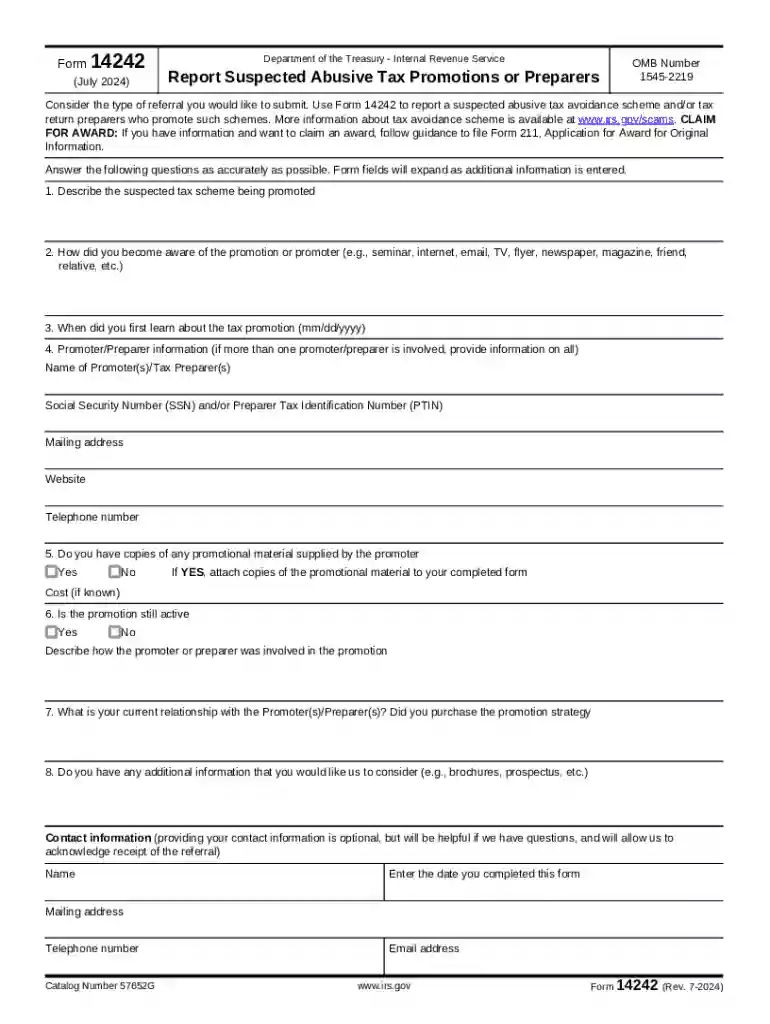
Form 14242 (Rev 7-2024) Report Suspected Abusive Tax Promotions or Preparers-2026

Get Form
form 14242 Preview on Page 1

Here's how it works

01. Edit your form 14242 online
Type text, add images, blackout confidential details, add comments, highlights and more.

02. Sign it in a few clicks
Draw your signature, type it, upload its image, or use your mobile device as a signature pad.

03. Share your form with others
Send irs form 14242 via email, link, or fax. You can also download it, export it or print it out.

Definition and Purpose of Form 14242

Form 14242, officially titled "Report Suspected Abusive Tax Promotions or Preparers," is an essential tool designed by the IRS to encourage individuals to report instances of tax fraud and abusive tax schemes. The form serves as a mechanism for collecting detailed information from the public about activities that might compromise the integrity of the tax system. Understanding the purpose of this form is crucial, as it helps individuals discern when and how to use it effectively.

  • Abusive Tax Promotions: Defined as schemes that entail misleading methods to evade taxes or facilitate tax evasion.
  • Suspicious Tax Preparers: Refers to tax professionals or companies suspected of engaging in fraudulent preparation activities.

With these definitions, Form 14242 helps the IRS identify trends in fraudulent activities and take corrective action to protect taxpayers and the tax system.

Steps to Complete Form 14242

Completing Form 14242 involves several steps that ensure all relevant information is accurately captured. Follow these detailed instructions to properly fill out the form:

  1. Personal Information: Enter your name, address, and contact information on the designated fields to ensure anonymity when desired.
  2. Scheme Description: Provide a detailed account of the suspected abusive promotion or preparer. Use additional sheets if necessary to maintain clarity.
  3. Documentation: Attach any promotional materials or evidence that can support your claims, such as flyers, emails, or digital advertisements.
  4. Witness Statement: Explain how you became aware of the scheme and any personal involvement or observation that lends credibility to the report.
  5. Promoter Information: Include as much information as possible about the individuals or entities you suspect, such as names, addresses, and business details.
  6. Award Claim: If applicable, indicate your intent to claim an award for your original information under applicable IRS guidelines.

Ensuring that each section is thoroughly completed will facilitate a comprehensive submission, enabling the IRS to process your report efficiently.

How to Obtain Form 14242

Accessing Form 14242 is straightforward and can be done through various methods:

  • IRS Website: Download the form directly from the IRS's official website, ensuring you have the most current version, Rev 7-2024.
  • Local IRS Office: Visit your nearest IRS office to obtain a physical copy if digital access is not feasible.
  • Request by Mail: Contact the IRS to have a copy mailed to your address, which is an option for those who prefer hard copies.

Availability in different formats ensures accessibility for different preferences and needs.

Why Use Form 14242

Reporting suspected tax fraud is a civic responsibility that helps maintain fairness and integrity in the tax system. By using Form 14242, individuals contribute to:

  • Stopping Fraud: Identifying and preventing fraudulent activities that could result in significant financial losses for the government and taxpayers.
  • Ensuring Compliance: Encouraging ethical behavior among tax preparers and promoters by holding them accountable for their actions.
  • Protecting Yourself: Safeguarding your own compliance and tax interests by distancing yourself from potentially illegal activities.

The use of this form signifies a proactive step towards contributing to a fair tax environment.

Legal Use of Form 14242

Form 14242 is governed by specific legal guidelines that ensure confidential and lawful reporting of fraud:

  • Privacy Protection: The form outlines privacy considerations, ensuring that the information provided is used solely for investigative purposes.
  • Voluntary Submission: Reporting is entirely voluntary, although providing comprehensive information can strengthen potential investigations.
  • Legal Liability: Informants are protected from legal action by those reported, assuming the submission is made in good faith.

Understanding these legal parameters protects individuals who submit the form and ensures the information is used appropriately.

Key Elements of Form 14242

Several critical elements must be addressed when completing Form 14242 to ensure its effectiveness and legitimacy:

  • Authenticity: Accurate and true information about the suspected activity is essential for the investigation process.
  • Specificity: Detailed descriptions and tangible evidence (e.g., documents, recordings) enhance the report's credibility.
  • Completeness: Fill out all required sections of the form to avoid delays in processing and potential disregard due to incomplete reports.

Adhering to these elements ensures that submissions are taken seriously and processed efficiently by the IRS.

IRS Guidelines on Form 14242

The IRS provides specific guidelines outlining how to submit and follow up on Form 14242:

  • Submission Methods: Forms can be submitted via fax or mail, as indicated in the instructions, to ensure secure transmission.
  • Follow-Up Procedures: The IRS may contact you for further details or clarification, emphasizing the need for accessible contact information.
  • Confidentiality Assurance: Submitted forms are handled with strict confidentiality, aligning with federal privacy standards.

Familiarizing yourself with these procedural norms guarantees your report is managed according to IRS protocols.

Important Terms Related to Form 14242

Understanding terms specific to Form 14242 provides clarity in reporting and assists in effective communication with IRS representatives:

  • Tax Evasion: The illegal non-payment or underpayment of taxes.
  • Promoter: An entity or individual that advocates for specific tax schemes or prepares tax documentation.
  • Fraudulent Activity: Any misleading conduct intended to result in financial gain through illegal or unethical means.

These terms form the foundation for accurately identifying and describing scenarios for IRS review.

be ready to get more

Complete this form in 5 minutes or less

Get form

Got questions?

We have answers to the most popular questions from our customers. If you can't find an answer to your question, please contact us.
Contact us
(We never share this information with the person or business you are reporting.) This information is not required to process your report, but would be helpful if we need to contact you for any additional information. Use Form 3949-A to report alleged tax law violations by an individual, a business, or both.
Always verify any contact information through the official IRS website. Any website or email address should end in . gov. Legitimate communication from the IRS is all business.
Official IRS email addresses look like this: employee.name@irs.gov. Be sure you reply to the actual email address of the IRS employee communicating with you, not to the automated notification email stating the employee has sent you a protected message.
The IRS Return Preparer Program focuses on enhancing compliance in the return- preparer community by investigating and referring criminal activity by return preparers to the Department of Justice for prosecution and/or asserting appropriate civil penalties against unscrupulous return preparers.
The IRS doesnt initiate contact with taxpayers by email, text messages or social media channels to request personal or financial information.

Security and compliance

At DocHub, your data security is our priority. We follow HIPAA, SOC2, GDPR, and other standards, so you can work on your documents with confidence.
Learn more
ccpa2
pci-dss
gdpr-compliance
hipaa
soc-compliance
be ready to get more

Complete this form in 5 minutes or less

Get form

People also ask

Some scammers set up phony Web sites. Generally, the IRS does not send unsolicited e-mails to taxpayers. Further, the IRS does not discuss tax account information with taxpayers via e-mail or use e-mail to solicit sensitive financial and personal information from taxpayers.
Use Form 14157 to file a complaint against a tax return preparer or tax preparation business. Tax professionals can use this form to report events that impact their PTIN or business.