01. Edit your form online
Type text, add images, blackout confidential details, add comments, highlights and more.

Type text, add images, blackout confidential details, add comments, highlights and more.

Draw your signature, type it, upload its image, or use your mobile device as a signature pad.

Send it via email, link, or fax. You can also download it, export it or print it out.
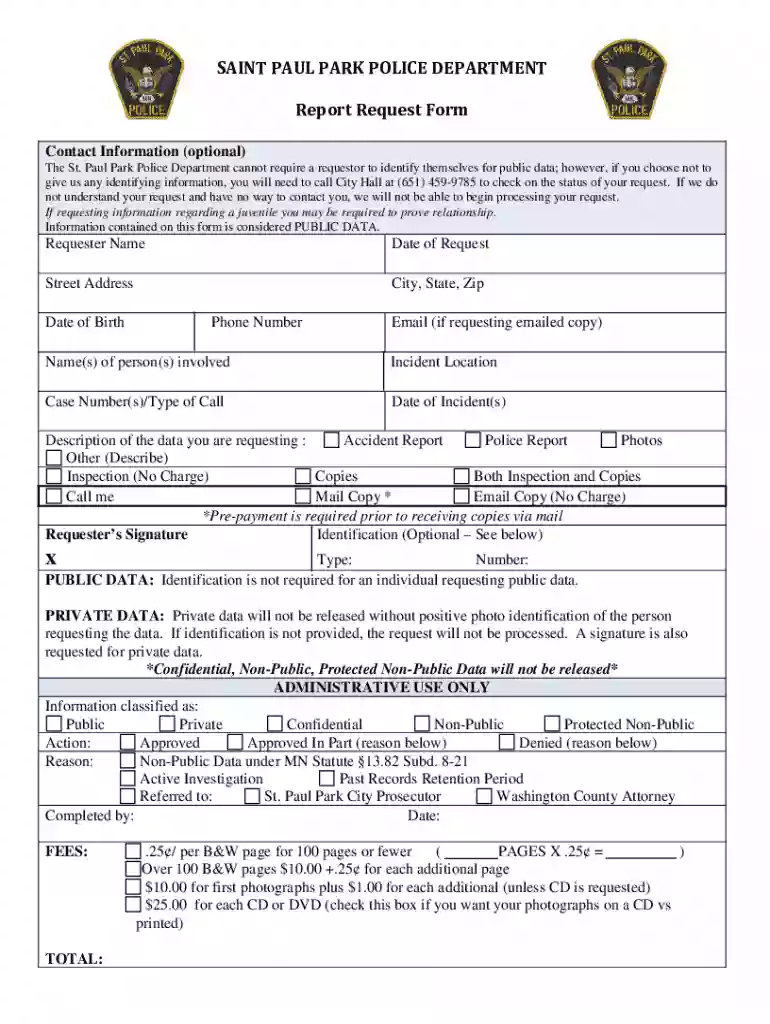
The "Form CenterRequest for Police Data" is a specialized form used to request access to public police records such as accident reports, incident logs, or other official documents kept by police departments. Typically used by individuals needing access to public data, it helps facilitate transparency by allowing citizens to obtain information on various police activities. The form serves a dual purpose: it not only ensures that requests are made in a structured manner but also helps the police department manage and track these requests efficiently.
A key aspect of the form is its role in distinguishing between public and private data. Public data refers to information that is generally accessible by the public, such as logs of public activities and certain reports. Conversely, private data is restricted and requires appropriate identification or authorization for access. The form guides applicants on what constitutes public or private data, ensuring they understand the type of information that can be released to them.
Using the "Form CenterRequest for Police Data" efficiently requires understanding its structure and requirements. First, individuals should clearly define the type of data they need. This could include specifying the report type, incident date, or involved parties. Accurately completing each section is crucial to prevent delays.
To begin, users should gather essential details, such as the location and date of the incident. The form typically includes sections for personal information, incident specifics, and the type of data requested. Ensure all fields are completed accurately:
Personal Information: Provide your name, contact details, and any additional information that could aid in processing your request.
Incident Specifics: Detail the incident or report type you are requesting, including dates and locations, to help the police department identify the correct records.
Data Type: Specify whether you are requesting public or private data, understanding that identification might be required for private data.
The completed form can usually be submitted via different channels such as online portals, mail, or in-person at the designated police department office. Each submission method requires adherence to specific guidelines or formats set by the department.
Successfully completing the form involves a step-by-step process designed to collect comprehensive details necessary for fulfilling the data request.
Read Instructions Carefully: Before you start, review any provided guidance to understand what information is required and how it should be presented.
Gather Required Information: Ensure you have all necessary details, including any identification if private data is requested.
Fill Out Personal Details: Enter your personal information accurately to avoid issues during processing.
Specify Data Required: Clearly outline what reports or data you are requesting, ensuring you understand the distinction between public and private data.
Submit Identification if Needed: For private data requests, prepare the necessary ID or authorization documents for submission.
Choose Submission Method: Decide whether you will submit the form online, via mail, or in person, and prepare any necessary accompanying documents.
Understanding the core components of the form ensures each section is completed with precision, increasing the likelihood of a successful request.
Utilizing this form responsibly is vital. The form is intended for legitimate requests pertaining to activities that have public significance. Misuse, such as requesting data for pejorative or unwarranted personal scrutiny, is prohibited and can lead to penalties.
Certain data types may be legally restricted or redacted based on confidentiality, ongoing investigations, or privacy concerns. Law enforcement agencies hold the right to deny requests that do not comply with legal standards.
The form is generally used by a diverse group seeking information on police activities for personal, legal, or research purposes.


Each state can have variations in how these forms are processed and what data is classified as public or private. Therefore, individuals should be aware of their state's specific regulations, particularly concerning data sensitivity and privacy protections. For instance, some states may have more stringent guidelines on what constitutes private data, often necessitating additional authorization or limiting requests to certain individuals or entities.
Consider a case where a family requests a police report after an accident involving a loved one. They would complete the form with relevant details, submit it, and receive the requested data, aiding their understanding of the event. Alternatively, a journalist investigating local crime trends might use the form to obtain multiple reports over a defined period, facilitating their analysis and reporting.
We've got more versions of the Form CenterRequest for Police Data form. Select the right Form CenterRequest for Police Data version from the list and start editing it straight away!
At DocHub, your data security is our priority. We follow HIPAA, SOC2, GDPR, and other standards, so you can work on your documents with confidence.