




01. Edit your form 6251 online
Type text, add images, blackout confidential details, add comments, highlights and more.

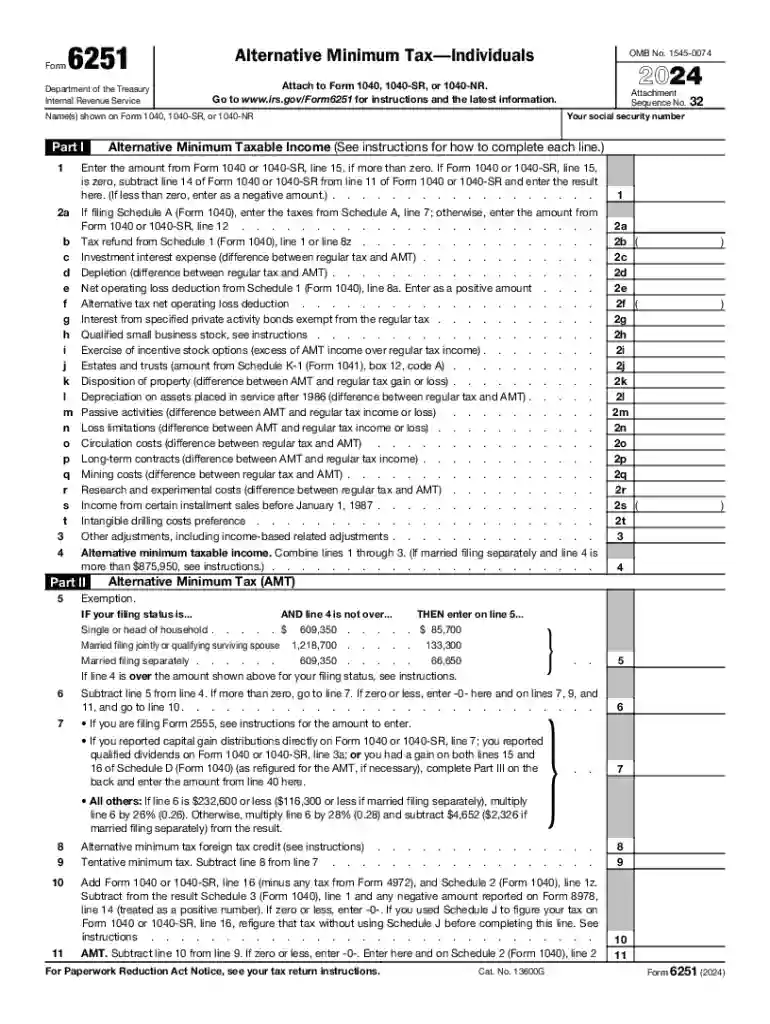
Type text, add images, blackout confidential details, add comments, highlights and more.

Draw your signature, type it, upload its image, or use your mobile device as a signature pad.

Send 2024 irs form 6251 via email, link, or fax. You can also download it, export it or print it out.
Form 6251, titled "Alternative Minimum Tax - Individuals," is used by taxpayers in the U.S. to determine if they owe the Alternative Minimum Tax (AMT). The AMT is an additional tax designed to ensure that high-income individuals pay a minimum level of tax by limiting benefits from certain exclusions and deductions. This form calculates the taxpayer's Alternative Minimum Taxable Income (AMTI) by considering specific adjustments and preferences that may not apply under regular tax computations.
To use Form 6 effectively, individuals must start with their regular taxable income as reported on their federal income tax return. They then follow detailed instructions on the form to make necessary modifications to income and deduction figures. These adjustments account for items like incentive stock options and certain business expenses, which are calculated differently for AMT purposes. The goal is to derive the AMTI, against which the AMT exemption amount is applied, before determining the final AMT liability.
Calculate Alternative Minimum Taxable Income (AMTI):
Determine AMT Exemption:
Calculate Tentative Minimum Tax:
Determine AMT Liability:
Consider an individual with adjustments due to incentive stock options and preferred deductions. Their calculations will typically involve:
Form 6251 should be filed concurrently with an individual's federal tax return, typically due on April 15th. Extensions may be granted, shifting the deadline to October 15th, though payment of actual taxes still occurs by April 15 to avoid penalties.
The form is important for high-income individuals or those with substantial deductions that may trigger AMT compliance. This includes taxpayers with:
To accurately complete Form 6251, individuals typically require:
Failing to file Form 6251 when required can result in penalties and interest on any unpaid taxes. If the IRS determines that the AMT should have applied to the taxpayer, adjustments will be made retroactively, leading to increased liability and add-on charges for late payment.
Form 6251 can be filed both electronically and in paper format. Electronic filing is preferred for its quick processing and reduced error margin. Many tax filing software solutions like TurboTax efficiently integrate the AMT calculations, ensuring compliance and simplifying submission.
We've got more versions of the form 6251 form. Select the right form 6251 version from the list and start editing it straight away!
| Versions | Form popularity | Fillable & printable |
|---|---|---|
| 2025 | 4.7 Satisfied (21 Votes) | |
| 2024 | 4.6 Satisfied (28 Votes) | |
| 2023 | 4.2 Satisfied (35 Votes) | |
| 2022 | 4.9 Satisfied (43 Votes) | |
| 2021 | 4.8 Satisfied (114 Votes) | |
| 2020 | 4.3 Satisfied (110 Votes) | |
| 2019 | 4.3 Satisfied (81 Votes) | |
| 2018 | 4.4 Satisfied (244 Votes) | |
| 2017 | 4.3 Satisfied (69 Votes) | |
| 2016 | 4.4 Satisfied (1646 Votes) | |
| 2015 | 4.4 Satisfied (72 Votes) | |
| 2014 | 4.2 Satisfied (21 Votes) |
At DocHub, your data security is our priority. We follow HIPAA, SOC2, GDPR, and other standards, so you can work on your documents with confidence.





Use Form 6251 to figure the amount, if any, of your alternative minimum tax (AMT). The AMT is a separate tax that is imposed in addition to your regular tax. ItRead more
Aug 18, 2025 Form 6251, Alternative Minimum Tax - Individuals: More detailed information about the AMT for individual taxpayers


