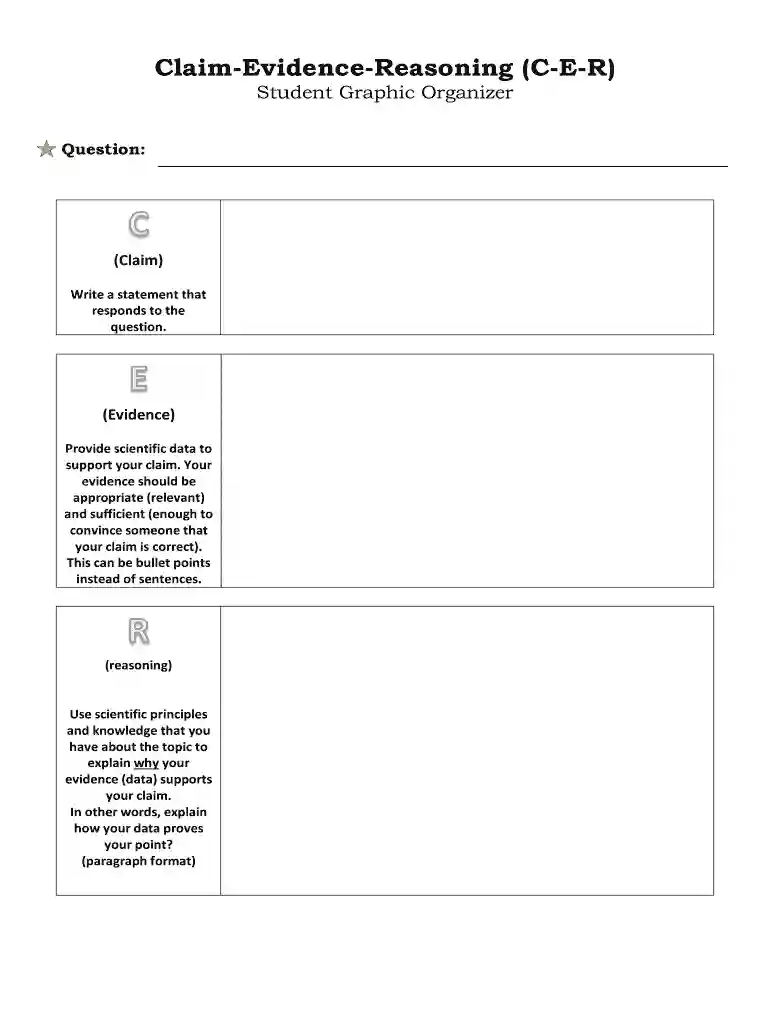
Cer template 2026

Get Form
cer template Preview on Page 1

Here's how it works

01. Edit your cer template online
Type text, add images, blackout confidential details, add comments, highlights and more.

02. Sign it in a few clicks
Draw your signature, type it, upload its image, or use your mobile device as a signature pad.

03. Share your form with others
Send cer via email, link, or fax. You can also download it, export it or print it out.

Definition and Meaning of the CER Template

The Claim-Evidence-Reasoning (CER) template is a structured approach for writing and communicating scientific reasoning. It serves as an educational tool, facilitating students and researchers in articulating claims and supporting them with appropriate evidence and reasoning. The CER format is particularly useful in science education, where students learn to defend their hypotheses and conclusions with logical arguments.

  • Claim: The assertion or position taken based on evidence. It clearly states the opinion or belief regarding a specific topic or question.
  • Evidence: The supporting data, facts, or information used to substantiate the claim. Evidence can be gathered from experiments, research, or literature.
  • Reasoning: The explanation that connects the claim to the evidence, demonstrating why the evidence supports the claim. This often involves applying scientific principles or theories.

Importance in Education

Using the CER template enhances critical thinking and allows students to develop analytical skills. It encourages them to engage deeply with subject matter, requiring them to evaluate information and articulate their understanding comprehensively. By employing this structure, students can effectively communicate their findings in a clear and logical manner, making it valuable for both academic and practical applications.

Key Elements of the CER Template

Understanding the essential components of the CER template is crucial for effective execution. Each element plays a significant role in constructing a robust argument.

Components Breakdown

  1. Claim: This is a definitive statement that answers a question or addresses a problem.

    • Example: "Climate change is significantly affecting marine biodiversity."
  2. Evidence: Concrete data or facts that substantiate the claim.

    • Example: "Recent studies indicate a 40% decline in fish populations in coral reef ecosystems over the last decade due to changing sea temperatures."
  3. Reasoning: Logical connections that explain how the evidence supports the claim.

    • Example: "The increase in water temperature affects coral health, leading to decreased fish habitats and food sources, thus threatening marine biodiversity."

Structured Format

When constructing a CER argument, it is vital to maintain a clear and logical structure:

  • Start with your claim.
  • Provide at least two pieces of evidence that support your claim.
  • Clearly articulate your reasoning, linking the evidence back to the claim.

How to Use the CER Template Effectively

Utilizing the CER template requires a systematic approach to ensure clarity and coherence in the presentation of ideas. Follow these steps for effective application:

Step-by-Step Guide

  1. Identify the Question: Start by clarifying the specific question or problem your claim will address.

    • Example: "What impact does climate change have on marine life?"
  2. Formulate Your Claim: Develop a concise statement that reflects your position or assertion regarding the question.

  3. Gather Evidence: Research and compile relevant data, statistics, or findings that back up your claim.

    • Utilize scientific studies, articles, and reliable sources to support your evidence.
  4. Explain Your Reasoning: Detail how your evidence correlates with the claim. Discuss the significance of your findings and how they contribute to the understanding of the issue at hand.

  5. Review and Revise: Once your CER is drafted, review it for clarity and logical flow. Ensure that the connection between the claim, evidence, and reasoning is explicit and compelling.

Examples of Using the CER Template in Practice

Understanding practical applications of the CER template can enhance comprehension and usability. Here are several illustrative scenarios across various fields.

Scientific Research

In a science classroom, students might use the CER template to analyze the effects of pollution on plant growth:

  • Claim: "Increased pollution levels negatively impact plant growth."
  • Evidence: "A recent study showed that plants exposed to high levels of carbon monoxide exhibited a 30% reduction in growth rate compared to those in cleaner air."
  • Reasoning: "This reduction in growth occurs because carbon monoxide inhibits the photosynthesis process, leading to less energy production for the plants."

Argumentative Essays

In writing a persuasive essay, a student might employ the CER template to support an argument regarding renewable energy:

  • Claim: "Switching to renewable energy sources is essential for sustainability."
  • Evidence: "Research shows that countries investing in wind and solar energy have reduced their carbon emissions by 25% over the past five years."
  • Reasoning: "By transitioning to renewable resources, we not only reduce our carbon footprint but also promote long-term environmental health and economic stability."

Steps to Complete the CER Template

Completing the CER template involves a structured process to ensure clarity and effectiveness in presenting arguments.

Detailed Process Steps

  1. Define Your Topic: Start by identifying the topic or question you are addressing.
  2. Develop Your Claim: Write down your claim in one to two sentences that directly addresses the topic.
  3. Collect Evidence:
    • Research credible sources.
    • Note down key statistics, quotes, or findings that support your claim.
  4. Construct Your Reasoning:
    • Explain how your evidence links back to your claim.
    • Use logic and reasoning to justify your evidence's relevance to your claim.
  5. Finalize and Edit: Revise your statements for grammatical accuracy and logical coherence. Ensure each section transitions smoothly into the next.

Through these steps, the CER template can be structured in a way that effectively communicates critical scientific arguments and reasoning. Utilizing this format empowers educators and students alike to foster a deeper understanding of science and critical thinking.

be ready to get more

Complete this form in 5 minutes or less

Get form

Got questions?

We have answers to the most popular questions from our customers. If you can't find an answer to your question, please contact us.
Contact us
Here is an example of a CER: Claim: Increasing the temperature of a substance will cause the substance to expand. Evidence: When a substance is heated, the molecules that make up the substance gain energy and start to move around more. This increased movement takes up more space, causing the substance to expand.
CER stands for claim, evidence, reasoning. A CER paragraph is a paragraph that begins with a claim statement or argument. Next, evidence to support the claim is provided. Last, reasoning is provided to explain how the evidence supports the claim.
CER format is a structured way of presenting scientific arguments. The claim states the main idea or conclusion, evidence supports the claim with data or observations, and reasoning explains how the evidence supports the claim.
According to the Claim, Evidence, Reasoning (CER) model, an explanation consists of: A claim that answers the question. Evidence from students data. Reasoning that involves a rule or scientific principle that describes why the evidence supports the claim.

Security and compliance

At DocHub, your data security is our priority. We follow HIPAA, SOC2, GDPR, and other standards, so you can work on your documents with confidence.

Learn more
be ready to get more

Complete this form in 5 minutes or less

Get form