01. Edit your form online
Type text, add images, blackout confidential details, add comments, highlights and more.

Type text, add images, blackout confidential details, add comments, highlights and more.

Draw your signature, type it, upload its image, or use your mobile device as a signature pad.

Send it via email, link, or fax. You can also download it, export it or print it out.
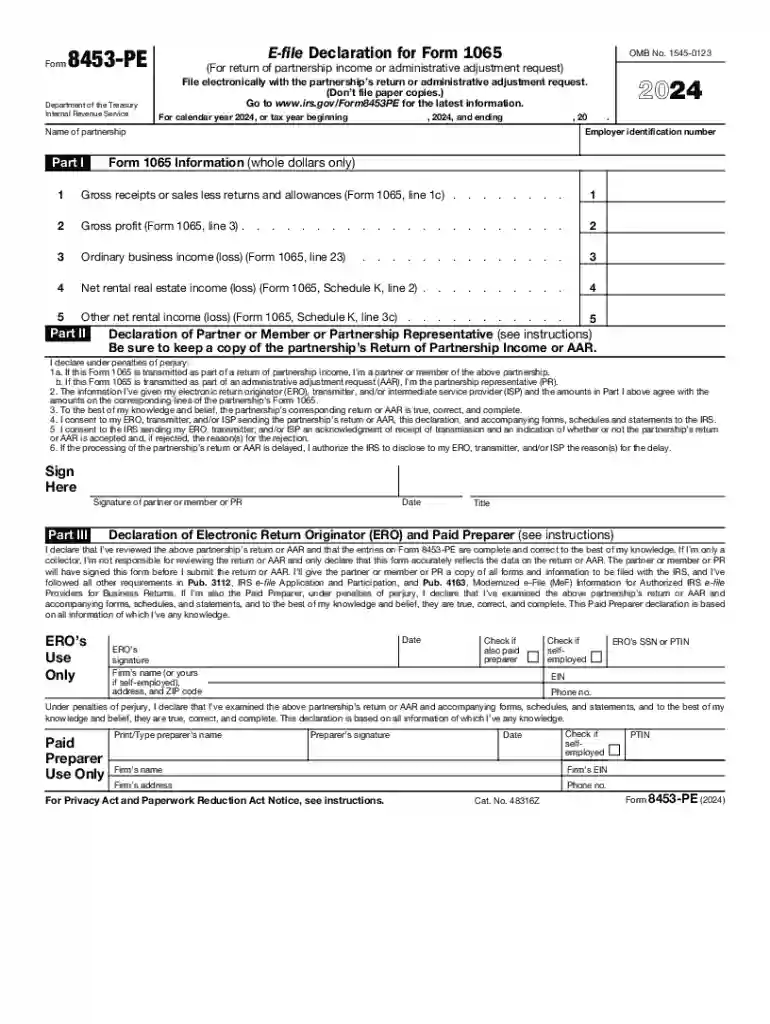
Form 8453-PE is pivotal for partnerships looking to electronically file Form 1065, the U.S. Return of Partnership Income. This document acts as a declaration, signifying that the data transmitted is a true representation of the partnership’s affairs. It validates the electronic submission, ensuring authenticity and compliance with IRS standards. By using the Form 8453-PE, partnerships authorize electronic return originators (EROs) or intermediate service providers (ISPs) to undertake the transmission of their returns. This process aligns with federal electronic filing mandates and optimizes the accuracy and efficiency of tax submissions.
Completing the Form 8453-PE accurately determines acceptance by the IRS, so each step requires attention to detail to avoid delays or rejections.
Each section of Form 8453-PE serves a distinct purpose, enhancing transparency and compliance in the e-filing process.
Form 8453-PE can be filed electronically through authorized IRS channels. While physical submission is technically possible, electronic filing is preferred due to its speed and convenience. Selecting a trusted ERO or ISP helps facilitate precision in submission and error mitigation. Moreover, electronic filing helps expedite processing, reducing the waiting period for official IRS confirmation of receipt.
Typically, partnerships must file Form 8453-PE as soon as they complete Form 1065. The standard deadline corresponds with the Form 1065 submission deadline, usually March 15 for calendar-year partnerships. Late submissions may incur penalties, emphasizing the importance of timeliness. Ensuring all documentation is in order before the deadline is critical to avoid unnecessary fines or complications.
Partnerships should compile several key documents for accurate submission:
Preparation of these documents not only aids in the e-filing process but also ensures readiness for potential IRS audits or inquiries.
Partnerships of various structures, including limited liability companies (LLCs) filing as partnerships and general partnerships, primarily utilize Form 8453-PE. These entities often have complex fiscal interactions needing detailed and precise reporting. Consequently, partnerships engaging in varied economic activities must ensure meticulous form preparation to accurately represent their financial and operational realities to the IRS.
Form 8453-PE carries significant legal weight as it verifies the authenticity and accuracy of submitted information. An improperly completed form can lead to legal repercussions, including audits, fines, or penalties. Moreover, it affirms the partnership’s compliance with IRS rules, enhancing credibility and trustworthiness in fiscal reporting. Understanding the legal obligations linked with Form 8453-PE aids partnerships in mitigating potential risks associated with tax filings and declarations.
Failure to submit Form 8453-PE on time or providing incorrect information can result in penalties. The IRS may impose fines based on the severity of non-compliance or discrepancies found during assessments. Partnerships must therefore ensure accuracy and promptness in filing to avoid costly repercussions. Being organized and attentive to detail throughout the filing process is crucial for maintaining compliance and minimizing risk exposure.
We've got more versions of the About Form 8453-PE, U S Partnership Declaration for an form. Select the right About Form 8453-PE, U S Partnership Declaration for an version from the list and start editing it straight away!
At DocHub, your data security is our priority. We follow HIPAA, SOC2, GDPR, and other standards, so you can work on your documents with confidence.