Tax Brief: Form 990, Schedule M - Noncash Contributions 2026

Get Form
schedule m Preview on Page 1

Here's how it works

01. Edit your schedule m online
Type text, add images, blackout confidential details, add comments, highlights and more.

02. Sign it in a few clicks
Draw your signature, type it, upload its image, or use your mobile device as a signature pad.

03. Share your form with others
Send 990 schedule m via email, link, or fax. You can also download it, export it or print it out.

Definition and Meaning of Schedule M (Form 990)

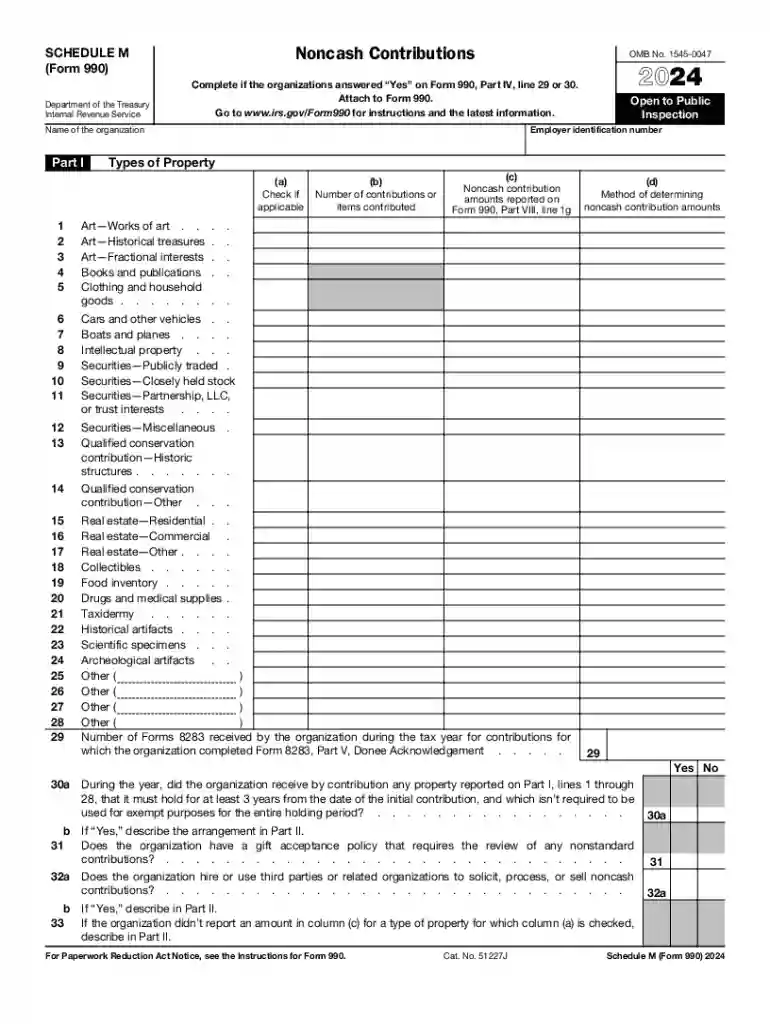
Schedule M, a component of Form 990, is utilized by tax-exempt organizations to report noncash contributions they receive during the fiscal year. These contributions can encompass a wide array of property types, including art, vehicles, real estate, and intellectual property. This schedule mandates a detailed account of the number of contributions, their valuations, and any specific terms or agreements tied to the donations.

Types of Noncash Contributions

  • Art and Cultural Items: Includes paintings, sculptures, and other artistic donations.
  • Vehicles: Cars, boats, and other transport means given to the organization.
  • Real Estate: Property assets that are donated in part or full.
  • Intellectual Property: Patents, copyrights, or trademarks transferred to the organization.

Importance of Thorough Reporting

Accurate reporting on Schedule M is crucial to prevent issues with the IRS, as incorrect or incomplete information can lead to misunderstandings or penalties.

How to Use Schedule M (Form 990)

Organizations must use Schedule M to provide a comprehensive account of the noncash contributions received. This involves detailing the type and number of donations, describing them adequately, and correctly valuing each item based on IRS guidelines.

Step-by-Step Instructions

  1. Gather Documentation: Collect all necessary documents that delineate the noncash contributions.
  2. Categorize Donations: Assign each donation to the appropriate category such as art, real estate, etc.
  3. Determine Value: Follow IRS methods to evaluate the fair market value of each item.
  4. Complete Sections: Fill in each section of Schedule M accurately with the collected data.

Key Elements of Schedule M

Schedule M consists of various parts that organizations must complete:

  • Part I: Details types of contributed property.
  • Part II: Requirements for organizations receiving high-value properties.
  • Part III: General information about submission and variations specific to certain contributions.

Crucial Details to Include

  • Number of Items: Exact count of each type of property received.
  • Fair Market Value: The determined market value using IRS-approved methods.
  • Specific Conditions: Any restrictions or special conditions attached to certain donations.

Filing Deadlines and Important Dates

Organizations must adhere to filing deadlines to maintain compliance.

Filing Timeline

  • Standard return filing deadline is the 15th day of the 5th month following the organization’s fiscal year-end.
  • Extensions can be requested, granting an additional six months.

Consequences of Missing Deadlines

  • Potential penalties and fines.
  • Increased scrutiny by the IRS.

IRS Guidelines for Valuing Contributions

The IRS provides specific guidelines for valuing noncash contributions on Schedule M:

  • Fair Market Value: Determine using comparable sales data or professional appraisals.
  • Qualified Appraisals: Required for certain high-value items.
  • Documentation: Maintain thorough records and appraisals as evidence.

Penalties for Non-Compliance

Failing to properly complete Schedule M can result in:

  • Monetary Penalties: Fines for inaccuracies or omitted information.
  • Increased Audits: Greater chance of an IRS audit due to discrepancies in reporting.

Software Compatibility for Form 990

Software solutions can assist in efficiently completing Schedule M:

  • TurboTax and QuickBooks: These platforms support Form 990 for tax-exempt entities.
  • Custom Tax Software: Available for larger organizations needing tailored solutions.

Benefits of Using Tax Software

  • Streamlined Data Entry: Reduces manual errors with direct import options.
  • Compliance Checks: Automated audits ensure all required fields are completed.

Examples of Using Schedule M

Nonprofit organizations commonly use Schedule M for diverse fundraising endeavors:

  • Art Galleries: Reporting art donations to showcase in exhibitions.
  • Automobile Donation Programs: Car donations that contribute financially through resale.
  • Property Donation Initiatives: Receiving and utilising real estate for operational spaces.

Case Studies

  • Educational Institutions: Using equipment donations for enhancing educational resources.
  • Environmental Charities: Real estate donations for conservation projects.

These examples underscore the utility of Schedule M in facilitating transparency and accountability for various types of nonprofit transactions.

be ready to get more

Complete this form in 5 minutes or less

Get form

Got questions?

We have answers to the most popular questions from our customers. If you can't find an answer to your question, please contact us.
Contact us
The first distinction to understand is that Form 990 is required by federal law to be publicly disclosed, but audited financial statements are not. Note, individual states may require public disclosure of the financial statements, Form 990, or both.
If your organization received any in-kind contributions for the tax year, it must report them on Form 990 Part VIII (Statement of Revenue), line 1g.
Nontaxable benefits are benefits specifically excluded from taxation under the Internal Revenue Code.
Contributions reportable on Schedule B (Form 990) are contributions, grants, bequests, devises, and gifts of money or property, whether or not for charitable purposes. For example, political contributions to section 527 political organizations are included.
Your Form 990 should include your organizations mission statement, all financial data, a summary of activities, specifics of your nonprofits governing body, and your organizations accomplishments from the prior year.

Security and compliance

At DocHub, your data security is our priority. We follow HIPAA, SOC2, GDPR, and other standards, so you can work on your documents with confidence.

Learn more
ccpa2
pci-dss
gdpr-compliance
hipaa
soc-compliance

People also ask

Schedule M, Noncash Contributions, is used by tax-exempt organizations to report non-cash contributions received during the tax year. Understanding Schedule M is crucial for organizations to accurately report their financial activities and maintain compliance with IRS regulations.
Report amounts received as voluntary contributions; for example, payments, or the part of any payment, for which the payer (donor) does not receive full retail value (fair market value) from the recipient (donee) organization.
Line 22. Depreciation, depletion, and amortization. Include any depreciation or amortization of leasehold improvements and intangible assets. An organization isnt required to use the Modified Accelerated Cost Recovery System (MACRS) to compute depreciation reported on Form 990.

2024 m form