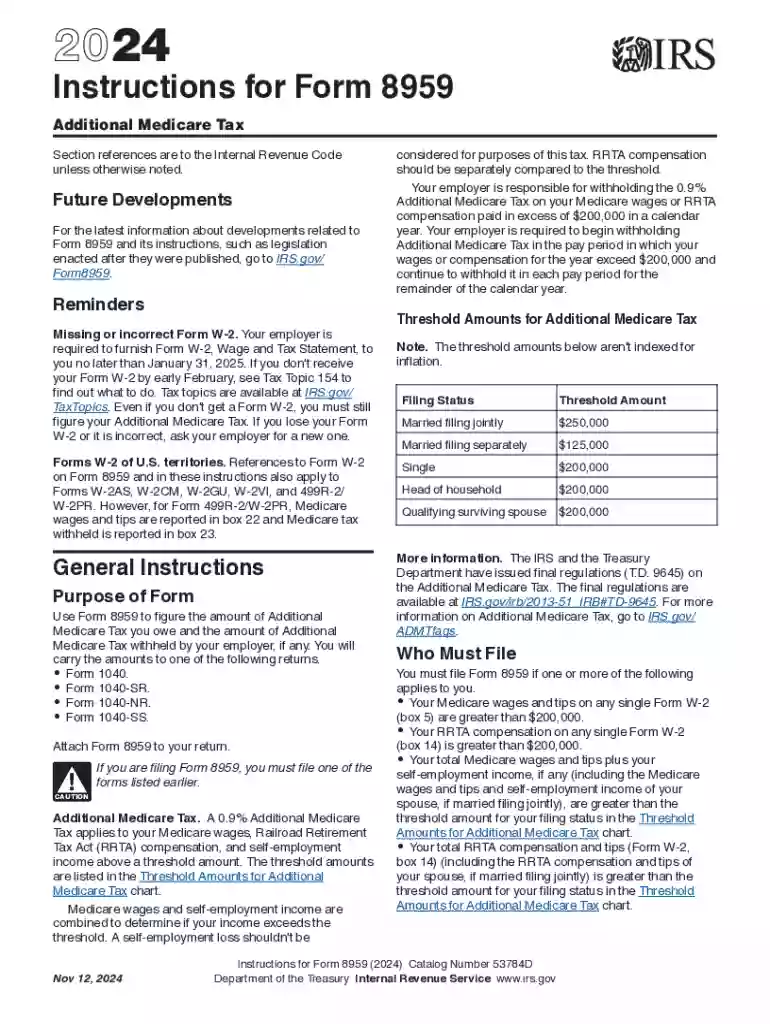
Free IRS Additional Medicare Tax Form 8959 Instructions-2026

Get Form
form 8959 instructions Preview on Page 1

Here's how it works

01. Edit your form 8959 instructions online
Type text, add images, blackout confidential details, add comments, highlights and more.

02. Sign it in a few clicks
Draw your signature, type it, upload its image, or use your mobile device as a signature pad.

03. Share your form with others
Send form 8959 pdf via email, link, or fax. You can also download it, export it or print it out.

Definition and Purpose of Form 8959

Form 8959 is utilized by individuals to calculate the Additional Medicare Tax they owe when their income exceeds specific thresholds. This tax applies to wages, self-employment income, and other taxable compensation like Railroad Retirement Tax Act wages. The form serves to determine the precise amount of tax due, beyond regular Medicare contributions, based on individual income brackets.

Key Elements of Form 8959

  • Thresholds: Individuals are subject to the Additional Medicare Tax if their income surpasses certain limits based on filing status—single, head of household, or married filing jointly or separately.
  • Income Types: The form covers various income sources, including wages, tips, and net earnings from self-employment.
  • Tax Rate: The Additional Medicare Tax is 0.9% on income exceeding the thresholds.

How to Use Form 8959

To use Form 8959 effectively, follow these guidelines:

  1. Review Income Types: Identify all sources of income subject to the Additional Medicare Tax.
  2. Determine Filing Status: Establish your filing status to apply the appropriate income threshold.
  3. Calculate Tax: Use the form to compute the 0.9% tax rate on income exceeding the threshold.

Steps to Complete Form 8959

  1. Gather Financial Documents: Collect all W-2 and 1099 forms to ensure accurate reporting of income.
  2. Complete Part I: Input wages and self-employment income to determine threshold applicability.
  3. Calculate Total Taxes: In Part II, calculate total Additional Medicare Tax owed.
  4. Finalize and File: Verify calculations and include Form 8959 with your annual tax return.

Eligibility Criteria for Form 8959

Eligibility for using Form 8959 generally involves:

  • High Income Earners: Individuals whose income exceeds the IRS-specified thresholds based on their filing status.
  • Self-Employed Individuals: Those with net earnings subject to Medicare Tax contributions.
decoration image ratings of Dochub

Examples and Scenarios

Scenario 1: Single Filers

A single filer earning $220,000 will use Form 8959 to calculate the Additional Medicare Tax owed on income over the $200,000 threshold. Only the $20,000 exceeding the threshold is subject to the tax.

Scenario 2: Married Filing Jointly

For a married couple with a combined income of $300,000, each spouse earning $150,000 will consider their share against the $250,000 threshold, resulting in additional tax on the $50,000 excess.

IRS Guidelines and Filing Instructions

  • IRS Instructions: Always refer to the latest IRS guidelines for Form 8959 to ensure compliance.
  • Withholding Adjustments: Update withholding if necessary to cover the Additional Medicare Tax and avoid underpayment penalties.

Filing Deadlines and Important Dates

  • Annual Deadline: April 15 is the typical due date for filing Form 8959 along with federal tax returns, though extensions to October 15 may be available.
  • Estimated Payments: Consider quarterly estimated tax payments to cover the Additional Medicare Tax for high incomes.

Form Submission Methods

  • Electronic Filing: Most taxpayers file Form 8959 electronically through tax preparation software.
  • Paper Filing: Forms may also be submitted by mail, though processing can be slower than electronic submissions.

Conclusion

Form 8959 is crucial for accurately reporting the Additional Medicare Tax for high-income taxpayers. Proper completion involves understanding thresholds, eligible income, and using appropriate steps to finalize calculations, ensuring compliance with IRS regulations.

be ready to get more

Complete this form in 5 minutes or less

Get form

Got questions?

We have answers to the most popular questions from our customers. If you can't find an answer to your question, please contact us.
Contact us
Youll need to file Form 8959 if: Your wages, self-employment income, or railroad compensation exceeds the thresholds. You and your spouse file jointly, and your combined income exceeds $250,000. Youre self-employed and owe both the employer and employee portions of Medicare taxes on income above the threshold.
The IRS also issued updated Questions and Answers for the Additional Medicare Tax. Employers are responsible for withholding and reporting the 0.9 percent Additional Medicare Tax, which became effective in 2013.
Form 8959 is used to calculate how much additional Medicare tax you may owe, depending on the type of income you earn. You should file Form 8959 if your Medicare or RRTA wages exceed $200,000 for single filers or $250,000 for joint filers.
What is the additional Medicare tax for 2025? The additional Medicare tax of 0.9% applies only to higher wage earners. It is paid in addition to the standard Medicare tax. An employee will pay 1.45% standard Medicare tax, plus the 0.9% additional Medicare tax, for a total of 2.35% of their income.

Security and compliance

At DocHub, your data security is our priority. We follow HIPAA, SOC2, GDPR, and other standards, so you can work on your documents with confidence.


Learn more
ccpa2
pci-dss
gdpr-compliance
hipaa
soc-compliance