




01. Edit your form offer to purchase real estate online
Type text, add images, blackout confidential details, add comments, highlights and more.

Type text, add images, blackout confidential details, add comments, highlights and more.

Draw your signature, type it, upload its image, or use your mobile device as a signature pad.

Send form 656 offer in compromise via email, link, or fax. You can also download it, export it or print it out.
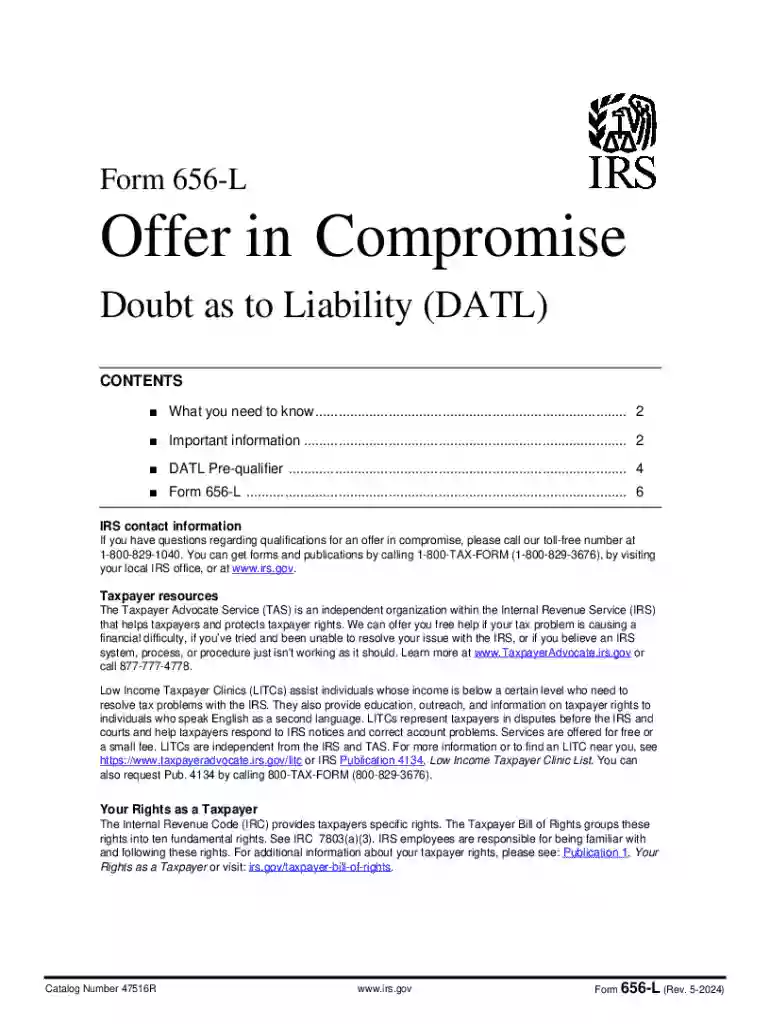
Form 656-L, known as the Offer in Compromise (OIC) based on Doubt as to Liability (DATL), is a tax form used to contest the validity of a taxpayer's owed tax amount to the IRS. Unlike offers based on the taxpayer’s ability to pay, DATL focuses on questioning the legitimacy of the tax liability itself. Taxpayers can propose an alternative settlement, reflecting what they deem a fair tax liability. This form serves both individual taxpayers and business entities seeking to resolve tax disputes on questionable debts.
To qualify for submitting Form 656-L, taxpayers must believe their tax liability is incorrect due to specific errors or misinterpretations related to their financial obligations. Common eligibility grounds include:
Taxpayers must also be current with filing requirements, meaning all necessary returns for the current year are filed, even if they cannot pay in full. Proof of the claim, such as documentation supporting the supposed errors, is crucial for the IRS to consider the application.


The critical elements to complete on Form 656-L include:
Taxpayers are advised to ensure accuracy in each section to prevent further delays or rejections.
When submitting Form 656-L, several documents are typically required to corroborate the taxpayer’s claims. These generally include:
These documents substantiate the taxpayer's circumstances, potentially increasing the offer's credibility and likeliness of acceptance by the IRS.
Upon receiving Form 656-L, the IRS reviews the application, assessing whether errors exist that justify altering the taxpayer’s obligation. Several factors dictate the decision timeframe, including:
Acceptance depends on proving the owed tax is inaccurate. If the IRS agrees, they adjust the liability to reflect the negotiated settlement. If not, the taxpayer may receive a detailed explanation, potentially with appeal options.
The IRS scrupulously adheres to its internal guidelines when processing Form 656-L. These guidelines ensure the taxpayer inquiry is legitimate, the documentation is sufficient, and the challenge to the alleged erroneous tax is validly reasoned. Legal use of Form 656-L focuses explicitly on doubt concerning the assessed tax’s correctness. It is inappropriate for situations merely involving inability to pay or disagreements over tax policy.
Common examples where Form 656-L is applicable include:
These scenarios often illustrate a fundamental misunderstanding or oversight in the financial records or tax calculation, making Form 656-L a viable dispute tool.
Failure to comply with the necessary steps, incorrect filing, or submission of fraudulent information can result in:
Meticulous completion and honest representation on Form 656-L help alleviate these severe consequences, maintaining a professional dialogue with the IRS and enhancing the potential for a favorable outcome.
We've got more versions of the form offer to purchase real estate form. Select the right form offer to purchase real estate version from the list and start editing it straight away!
At DocHub, your data security is our priority. We follow HIPAA, SOC2, GDPR, and other standards, so you can work on your documents with confidence.



An accepted OIC will conclusively settle all tax liabilities listed on the Form 656, Offer in Compromise. Neither the taxpayer nor the government can re-open aRead more
See Form 656, Offer in Compromise, and Form 656-L, Offer in Compromise (Doubt as to Liability), which includes necessary forms and instructions. Unresolved Tax


