01. Edit your form online
Type text, add images, blackout confidential details, add comments, highlights and more.

Type text, add images, blackout confidential details, add comments, highlights and more.

Draw your signature, type it, upload its image, or use your mobile device as a signature pad.

Send it via email, link, or fax. You can also download it, export it or print it out.
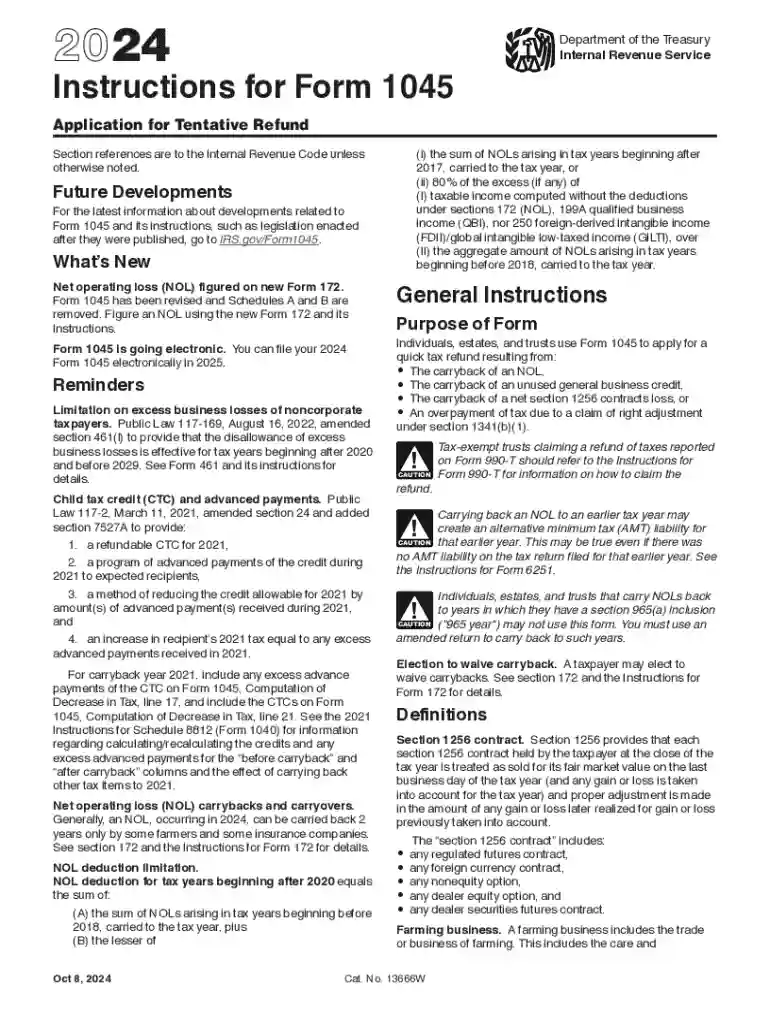
IRS Form 1045, formally known as the Application for Tentative Refund, is a document used by individuals, estates, and trusts to apply for a quick tax refund. This refund arises from the carryback of net operating losses (NOLs), unused general business credits, or overpayments. By allowing taxpayers to apply for refunds based on past losses or credits, the IRS Form 1045 aids in balancing income fluctuations over different tax years. Understanding its purpose is essential for leveraging past financial situations to enhance current year cash flow.
Eligibility to file Form 1045 primarily hinges on meeting certain conditions related to the carryback of net operating losses or unused credits. Taxpayers seeking a refund due to a carryback of a net operating loss, unused business credits, or certain types of overpayment are eligible to file this form. It is critical to check the specific year’s rules and thresholds, which can vary based on legislative updates, to ensure eligibility. Ineligible candidates might face rejected applications, thus wasting valuable time and resources.


To ensure proper processing, all relevant documents must accompany Form 1045 submission. These include copies of prior year tax returns, financial statements demonstrating the carryback amounts, and completed Form 172. Additionally, supporting documentation like business credit certifications or proof of income adjustments may be necessary. Failure to include required documentation can result in application disallowance or request for additional information, delaying potential refunds.
Adhering to IRS guidelines when submitting Form 1045 is crucial for compliance and to avoid delays. The IRS stipulates specific instructions regarding calculations, documentation, and submission deadlines. Ensure forms and attachments are correctly completed, reflecting precise carryback amounts. Any discrepancies between reported amounts and IRS calculations can trigger audits or rejection. Reviewing the most recent IRS guidelines prior to filing is recommended to conform with current requirements.
Timeliness is a key aspect when filing Form 1045. Typically, the form must be filed within one year following the end of the tax year for which the carryback or credit is being claimed. Missing these deadlines can void the opportunity to claim tentative refunds, resulting in lost financial advantages. Mark important IRS deadlines on calendars and set reminders to ensure timely submissions and maximize potential refunds.
The application process begins with preparing and submitting Form 1045 along with all supporting documentation. Approval time varies, but the IRS often aims for a rapid response, generally within 90 days, to provide tentative refunds. However, delays might occur due to errors or omitting essential information. Tracking the application status after submission helps ensure a smooth process and allows prompt resolution of any issues that might arise.
Taxpayers should be aware that non-compliance related to inaccurate reporting or fraud could result in penalties. These might include fines and interest on unpaid taxes if carrybacks are disallowed. To avoid such penalties, ensure all information is accurate and substantiated with valid documentation. Consulting a tax professional may be beneficial when dealing with complex carrybacks or refunds to ensure adherence to IRS mandates.
IRS Form 1045 can be submitted in both digital and paper formats. Digital submissions allow for quicker processing and error checks; however, paper submissions might still be required if electronic options are not available. The choice between digital and paper should consider factors such as convenience, accessibility, and the timeliness of processing anticipated refund claims.
Certain states have unique rules regarding the carryback of net operating losses or credits, which can affect how IRS Form 1045 is utilized. Taxpayers should consult state tax laws to understand if state-level forms or additional documentation is necessary to claim refunds at both federal and state levels. Divergent state policies might necessitate different procedural steps or affect the overall effectiveness of the refund application.
We've got more versions of the IRS Form 1045 walkthrough (Application for Tentative Refund) form. Select the right IRS Form 1045 walkthrough (Application for Tentative Refund) version from the list and start editing it straight away!
| Versions | Form popularity | Fillable & printable |
|---|---|---|
| 2025 | 4.6 Satisfied (34 Votes) | |
| 2024 | 4.3 Satisfied (31 Votes) | |
| 2023 | 4.5 Satisfied (48 Votes) | |
| 2021 | 4.9 Satisfied (54 Votes) | |
| 2020 | 4.8 Satisfied (66 Votes) | |
| 2020 | 4.2 Satisfied (62 Votes) | |
| 2020 | 4.2 Satisfied (132 Votes) | |
| 2018 | 4.3 Satisfied (178 Votes) | |
| 2017 | 4.3 Satisfied (184 Votes) | |
| 2016 | 4.4 Satisfied (61 Votes) | |
| 2015 | 4.4 Satisfied (231 Votes) | |
| 2013 | 4 Satisfied (39 Votes) |
At DocHub, your data security is our priority. We follow HIPAA, SOC2, GDPR, and other standards, so you can work on your documents with confidence.