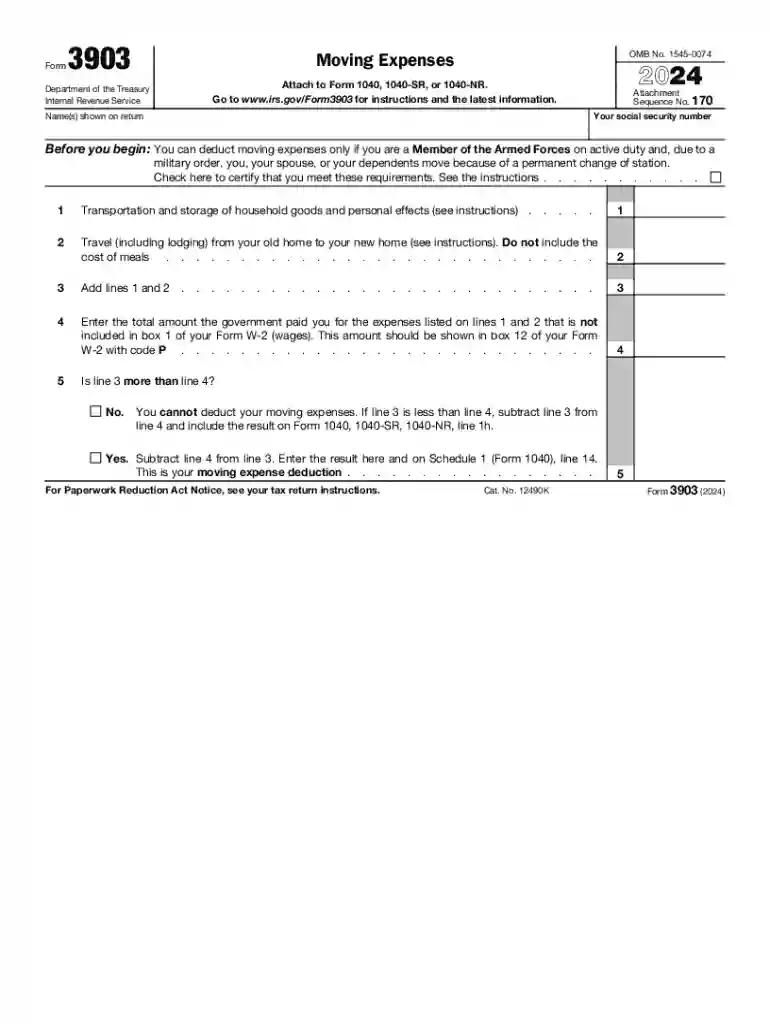
2024 Form 3903 Moving Expenses-2026

Get Form
list of deductible moving expenses Preview on Page 1

Here's how it works

01. Edit your list of deductible moving expenses online
Type text, add images, blackout confidential details, add comments, highlights and more.

02. Sign it in a few clicks
Draw your signature, type it, upload its image, or use your mobile device as a signature pad.

03. Share your form with others
Send what moving expenses are tax deductible via email, link, or fax. You can also download it, export it or print it out.

Definition and Purpose of 2024 Form 3903 Moving Expenses

Form 3903 is designed for use by active-duty members of the Armed Forces who have incurred moving expenses due to a permanent change of station (PCS). The primary purpose of this form is to allow eligible individuals to deduct specific moving-related costs that have not been reimbursed by the government. It serves as a crucial tool for military personnel to reclaim certain out-of-pocket expenses associated with their relocation.

Key Components of the Form

  • Transportation Costs: Includes the cost of moving household goods, personal effects, and other transportation expenses directly related to the move.
  • Storage Expenses: Covers costs associated with storing household goods and personal effects as part of the move.
  • Travel Costs: Allows for deductions related to travel expenses incurred during the move, such as mileage for driving between the old and new residence.

How to Use the 2024 Form 3903 Moving Expenses

Users should start by reviewing their moving expenses to determine which costs are eligible for deduction on Form 3903. The form outlines specific categories to ensure that taxpayers only deduct allowable expenses. When filling out the form, it's important to have all relevant receipts and financial documentation on hand to accurately report costs.

Step-by-Step Instructions

  1. Review Eligibility: Confirm active-duty status and that the move is due to a PCS.
  2. Gather Documentation: Collect receipts for transportation, storage, and travel expenses.
  3. Complete the Form: Accurately fill out Form 3903, ensuring all deductible expenses are entered in the correct sections.
  4. Submit with Tax Return: Attach Form 3903 to your annual tax return to claim the moving expense deduction.

Eligibility Criteria for 2024 Form 3903 Moving Expenses

Eligibility for using Form 3903 is primarily restricted to active-duty military personnel who are relocating due to a permanent change of station. The form specifically caters to those who have not received full reimbursement for their moving expenses from the government. It is essential to note that civilian moves do not qualify for this deduction under current tax laws.


decoration image ratings of Dochub

Eligibility Requirements

  • Active Duty Status: Only active-duty members undergoing a PCS qualify.
  • Unreimbursed Expenses: Only expenses not covered by military funding can be deducted.
  • Qualifying Moves: The move must be directly related to a permanent change of station ordered by military command.

Key Elements of the 2024 Form 3903 Moving Expenses

The essential elements on Form 3903 help ensure that taxpayers correctly capture and report eligible moving expenses. These key components facilitate the deduction process by breaking down expenses into clear, understandable categories.

Main Sections

  • Personal Information: Basic details of the taxpayer, including name and Social Security number.
  • Expense Details: Sections for listing transportation and storage costs, travel expenses, and any relevant reimbursements.
  • Summary and Totals: Calculate the total deductible moving expenses after accounting for government reimbursements.

IRS Guidelines for Filing 2024 Form 3903

The IRS provides specific instructions for completing and filing Form 3903 to ensure compliance and accurate deduction claims. Understanding these guidelines is critical for error-free submission and maximizing allowable deductions.

Detailed IRS Instruction Elements

  • Expense Limitations: Inform taxpayers about any limitations or ceilings on deductible moving expenses.
  • Reimbursement Adjustment: Guidance on how to account for partial government reimbursements that affect net deductible expenses.
  • Recordkeeping Recommendations: The IRS advises keeping thorough records of all related expenses and documentation for at least three years.

Required Documents for 2024 Form 3903

To accurately complete and substantiate claims on Form 3903, taxpayers need a collection of documents that verify their moving expenses and eligibility.

Essential Documentation

  • Receipts and Invoices: For all transportation, storage, and travel expenses.
  • Military Orders: Proof of PCS, including a copy of official orders.
  • Reimbursement Statements: Documents reflecting any government reimbursements received for moving expenses.

Common Examples and Scenarios

Understanding common examples where Form 3903 applies can help potential filers determine if their situation qualifies for deductions.

Practical Scenarios

  • Transfer to New Base: An active-duty service member relocates to a different base, using personal funds to cover part of the moving expenses.
  • Off-Base Housing Change: A move from one off-base residence to another necessitated by base transfer orders.

Digital vs. Paper Versions of 2024 Form 3903

Taxpayers have the option of filing Form 3903 electronically or using a traditional paper format. Each method has its advantages depending on the filer's preference and the tools available.

Comparison of Formats

  • Digital Filing: Allows for integration with tax preparation software, making it easier to submit and track. Offers faster processing times and typically results in quicker refund processing.
  • Paper Filing: Preferred by those who prefer manual preparation or lack access to electronic filing systems. Longer processing times should be expected.

Selecting between digital and paper versions depends on personal preferences or access to digital tools.

be ready to get more

Complete this form in 5 minutes or less

Get form

Got questions?

We have answers to the most popular questions from our customers. If you can't find an answer to your question, please contact us.
Contact us
You can deduct the expenses of moving your household goods and personal effects, including expenses for hauling a trailer, packing, crating, in-transit storage, and insurance. You cant deduct expenses for moving furniture or other goods you bought on the way from your old home to your new home.
For tax years beginning after 2017, you can no longer deduct moving expenses unless you are a member of the Armed Forces on active duty and, due to a military order, you move because of a permanent change of station.
Form 3903 can be completed for the amount of moving expenses paid by the taxpayer. If a moving expense deduction is computed, it will be reported on Schedule 1 (Form 1040) Additional Income and Adjustments to Income, on Line 14.
Moving and transferring expenses are defined as the reasonable costs of moving household goods and personal effects to a new residence.
Use Form 3903 to figure your moving expense deduction for a move related to the start of work at a new principal place of work (workplace). If the new workplace is outside the United States or its possessions, you must be a U.S. citizen or resident alien to deduct your expenses.

Security and compliance

At DocHub, your data security is our priority. We follow HIPAA, SOC2, GDPR, and other standards, so you can work on your documents with confidence.


Learn more
ccpa2
pci-dss
gdpr-compliance
hipaa
soc-compliance
be ready to get more

Complete this form in 5 minutes or less

Get form

People also ask

Shipping and storage costs for packing and moving your household goods and personal effects go on line 1 of Form 3903. Travel, lodging, and gas costs go on line 2. Reimbursements from your employer for any moving expenses are reported on line 4.
The following expenses qualify as moving expenses as long as the employee meets the other tests: Moving the employees household goods and personal effects (including in-transit storage expenses), and. Travel for the employee and his family (including lodging but not meals) from the employees old home to his new home.

moving expenses deductible