
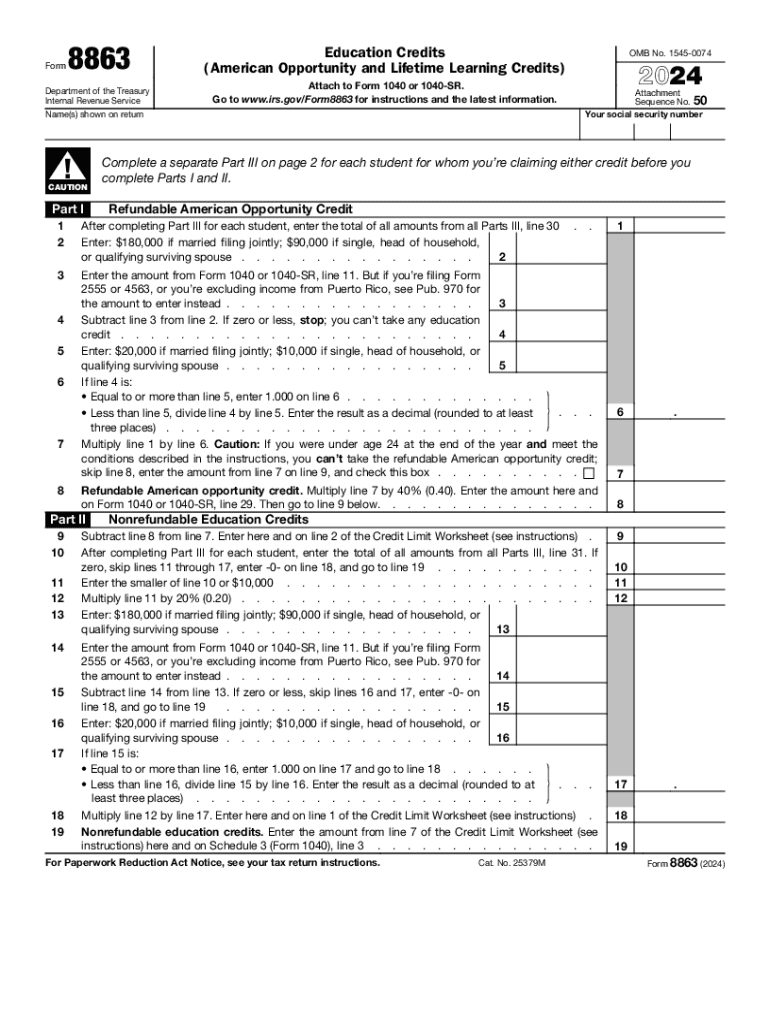







Definition and Purpose of Form 8863
Form 8863, titled "Education Credits (American Opportunity and Lifetime Learning Credits)," is a critical tool used by taxpayers in the U.S. to claim education-related tax credits on their federal income tax returns. The form serves to reduce the amount of taxes owed by applying eligible education expenses against tax obligations. It specifically addresses two credits: the American Opportunity Credit, which is aimed at undergraduate students in their first four years of post-secondary education, and the Lifetime Learning Credit, which applies to both undergraduate and graduate-level courses, as well as courses to acquire or improve job skills.
How to Use Form 8863
To use Form 8863 effectively, taxpayers must gather detailed records of their qualified education expenses. These expenses typically include tuition, certain fees, and course materials. The use of Form 8863 involves:
-
Gathering necessary documentation: Collect Form 1098-T from the educational institution, which reports the amount billed for tuition and related expenses during the tax year.
-
Completing the student and institution information section: Include details such as the student's name, the educational institution's name, and relevant tax identifications.
-
Entering qualified expenses: Calculate and include the amounts spent on eligible education expenses, ensuring all amounts align with those reflected on accompanying documentation.
Taxpayers should carefully follow IRS guidelines to accurately complete the form, which can significantly impact the credits claimed.
Steps to Complete Form 8863
Following the steps to complete Form 8863 ensures a thorough submission:
-
Start with Part I: Determine refundable credits by completing the "American Opportunity Credit" calculations, including any refundable portions.
-
Proceed to Part II: Calculate nonrefundable credits related to both the American Opportunity and Lifetime Learning Credits.
-
Ensure accuracy in Part III: Record student and institution information ensuring this matches provided IRS documentation.
-
Submit with Form 1040 or 1040-SR: Attach the completed Form 8863 to your federal tax return.
Using calculated entries allows taxpayers to maximize potential savings efficiently.
Eligibility Criteria for Form 8863
Eligibility for Form 8863 depends on various factors associated with education credits:
-
American Opportunity Credit: Eligible if the student is pursuing a degree or recognized credential, on at least a half-time basis, at an eligible institution. The student should not have completed the first four years of post-secondary education.
-
Lifetime Learning Credit: Available for all years of postsecondary education and courses to acquire or improve job skills.
Taxpayers should verify that each student named meets the specific criteria for the credits to ensure proper compliance and maximize credit benefits.


IRS Guidelines for Form 8863
The IRS provides structured guidance for completing Form 8863, which includes:
-
Income Limitations: Credits phase out for taxpayers with modified adjusted gross income (MAGI) above a certain threshold, varying annually.
-
Credit Limitations: Maximum amounts for credits, such as up to $2,500 per student for the American Opportunity Credit and up to $2,000 for Lifetime Learning Credit per tax return.
Staying informed on IRS updates for Form 8863 will ensure compliance with current tax laws.
Required Documents for Form 8863
Preparation for filing requires specific documentation:
-
Form 1098-T: Issued by the educational institution to report tuition expenses.
-
Receipts for course-related materials: Include books, supplies, and required equipment for courses.
Maintaining organized records will aid in accurate documentation of expenses and support credit claims during IRS reviews.
Filing Deadlines and Important Dates
The deadline for submitting Form 8863 aligns with the tax filing deadline set by the IRS, typically on April 15. If this date falls on a weekend or holiday, filings are due on the next business day. Taxpayers intending to claim education credits should plan ahead to ensure all documentation is prepared before submission.
Form Submission Methods
Form 8863 can be submitted through various methods:
-
Online e-filing: Considered the most efficient method, providing instant confirmation of submission.
-
Mail: Traditional method requiring early submission to avoid postal delays.
-
In-person: Available at IRS assistance centers for direct questions during submission.
Choosing the appropriate method can depend on individual preferences and access to resources.




