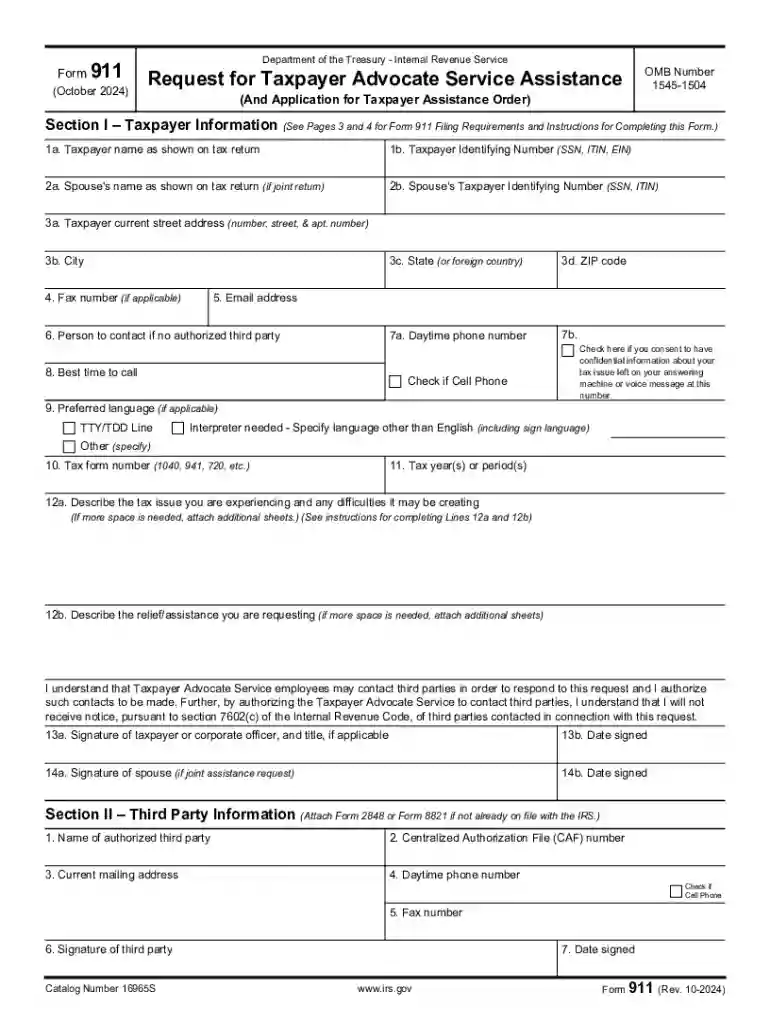
Form911 (Rev 10-2024) Request for Taxpayer Advocate Service Assistance (And Application for Taxpayer-2026

Get Form
irs form 911 Preview on Page 1

Here's how it works

01. Edit your irs form 911 online
Type text, add images, blackout confidential details, add comments, highlights and more.

02. Sign it in a few clicks
Draw your signature, type it, upload its image, or use your mobile device as a signature pad.

03. Share your form with others
Send form 911 via email, link, or fax. You can also download it, export it or print it out.

Definition & Meaning

Form 911, formally known as "Form 911 (Rev 10-2024) Request for Taxpayer Advocate Service Assistance (And Application for Taxpayer," is a pivotal document used by individuals facing unresolved tax issues. It serves as a formal request for intervention by the Taxpayer Advocate Service (TAS), an independent arm of the IRS committed to assisting taxpayers experiencing hardships. This form captures essential taxpayer information, delineates the unresolved tax issue, and articulates specific relief or assistance needed. The form's core purpose is to ensure that taxpayers receive guidance and support when traditional IRS channels prove insufficient in resolving their concerns.

How to Use Form 911

Using Form 911 requires careful attention to detail to effectively communicate the nature of your tax issue and seek appropriate help. To start, collect all pertinent information regarding your tax situation, including correspondence with the IRS, notices received, and documentation relevant to your case. The next steps are:

  1. Fill Out Personal Information:

    • Enter your name, address, and taxpayer identification number.
    • Include any secondary contact details if applicable.
  2. Specify the Tax Issue:

    • Clearly describe the problem you're encountering with your taxes.
    • Provide details on previous attempts to resolve the issue with the IRS.
  3. Request Specific Assistance:

    • Indicate the type of assistance or resolution you seek from TAS.
    • Justify your request by explaining the impact of the issue on your financial situation or any undue burden it imposes.

Steps to Complete Form 911

Completing Form 911 accurately enhances the chances of obtaining timely assistance. Follow these detailed steps:

  1. Gather Required Information:

    • Compile previous IRS correspondence, relevant tax returns, and any IRS communication.
  2. Download and Print the Form:

    • Obtain the form from the IRS website or request it to be sent to your address.
  3. Complete Each Section:

    • Provide detailed answers in each section, ensuring accuracy in your information to avoid delays.
  4. Attach Supporting Documentation:

    • Include copies of any relevant documents that support your case.
  5. Review and Submit:

    • Double-check all entries for completeness and accuracy.
    • Submit the form through your preferred method: online, mail, or in-person at a TAS office.

Eligibility Criteria

Before submitting Form 911, ensure you meet the eligibility criteria:

  • You’ve experienced a significant delay in resolving your tax issue through standard IRS procedures.
  • You are facing a financial hardship or an immediate adverse action by the IRS.
  • Your issue is causing economic harm, privacy concerns, or a systemic problem that may indicate broader IRS process failures.
decoration image ratings of Dochub

Important Terms Related to Form 911

Understanding key terms related to Form 911 helps in effectively filling out the form:

  • Taxpayer Advocate Service (TAS): A body within the IRS that assists taxpayers in resolving issues not addressed through regular IRS channels.
  • Economic Harm: Financial distress that affects one's ability to meet basic living expenses.
  • Systemic Issue: A persistent problem with IRS processes affecting multiple taxpayers.

Filing Deadlines / Important Dates

While there isn't a strict deadline for filing Form 911, timeliness is crucial in certain situations:

  • IRS Notices: Respond promptly if the IRS has issued a notice with response deadlines to avoid enforceable actions.
  • Financial Hardship: Submit the form as soon as you encounter economic harm or notice undue IRS actions impacting your financial stability.

Examples of Using Form 911

Form 911 can be crucial in various circumstances. Here are some scenarios:

  • Unresolved Tax Refunds: A taxpayer awaiting a significant tax refund with no IRS resolution after repeated inquiries.
  • Incorrect Levies: When the IRS incorrectly levies a bank account and urgent correction is required to prevent financial harm.
  • Communication Gaps: Cases where no satisfactory response is received after several attempts to contact IRS representatives.

Form Submission Methods

When submitting Form 911, taxpayers have multiple options:

  1. Online Submission:

    • Use the IRS’s online platform for a quicker response.
  2. Mail Submission:

    • Send via certified mail with a return receipt for documentation.
  3. In-Person Submission:

    • Deliver the form to a local TAS office to seek immediate assistance and clarification if needed.

IRS Guidelines

The IRS provides guidelines to streamline the completion and submission of Form 911:

  • Ensure all sections are completed, and the form is signed.
  • Double-check that all supporting documents are attached before submission.
  • Keep copies of all documents, including the completed Form 911, for personal records.
be ready to get more

Complete this form in 5 minutes or less

Get form

Got questions?

We have answers to the most popular questions from our customers. If you can't find an answer to your question, please contact us.
Contact us
Our History. Congress created the Taxpayer Advocate Service (TAS) to help individual and business taxpayers resolve problems that havent been resolved through normal IRS channels. We also address large-scale, systemic issues that affect groups of taxpayers.
To get your IRS tax forms from 2024, visit the IRS website and use the Get Transcript tool. You can request a tax return transcript or wage and income transcript, which includes information like your Adjusted Gross Amount (AGA). Alternatively, call the IRS or submit Form 4506-T to receive copies by mail.
If you receive a letter from the IRS and you think its , dont throw it away because its real. Its part of the IRS Identity Theft Program and they select about one in three people randomly and ask them to prove their identity. The problem is, the letter looks amateurish and might be passed off as a .
Lets take a closer look at the most common reasons for receiving an IRS letter. #1. You Have Unpaid Taxes. #2. Adjustments to Your Tax Return. #3. Verification of Identity. #4. Delays or Adjustments to Refunds. #5. Audit Notification. #6. Confirmation of Requests or Changes. #7. Notification of Collection Actions.
Call the Taxpayer Advocates toll-free telephone number, 877-777-4778. Call the general IRS toll-free number 800-829-1040 and ask for Taxpayer Advocate assistance. Write or FAX Addresses and FAX numbers for Taxpayer Advocate offices are listed in Publication 1546, The Taxpayer Advocate Service of the IRS PDF.

Security and compliance

At DocHub, your data security is our priority. We follow HIPAA, SOC2, GDPR, and other standards, so you can work on your documents with confidence.

Learn more
ccpa2
pci-dss
gdpr-compliance
hipaa
soc-compliance
be ready to get more

Complete this form in 5 minutes or less

Get form

People also ask

Most IRS letters and notices are about federal tax returns or tax accounts. Each notice deals with a specific issue and includes any steps the taxpayer needs to take. A notice may reference changes to a taxpayers account, taxes owed, a payment request or a specific issue on a tax return.
It may be about a specific issue on your federal tax return or account, or may tell you about changes to your account, ask you for more information, or request a payment. You can handle most of this correspondence without calling or visiting an IRS office if you follow the instructions in the document.
The Taxpayer Advocate Service is an independent organization within the IRS whose employees assist taxpayers who are experiencing economic harm, who are seeking help in resolving tax problems that have not been resolved through normal channels, or who believe that an IRS system or procedure is not working as it should.

taxpayer assistance