




01. Edit your irs form 433 f printable online
Type text, add images, blackout confidential details, add comments, highlights and more.

Type text, add images, blackout confidential details, add comments, highlights and more.

Draw your signature, type it, upload its image, or use your mobile device as a signature pad.

Send form 433 a oic via email, link, or fax. You can also download it, export it or print it out.
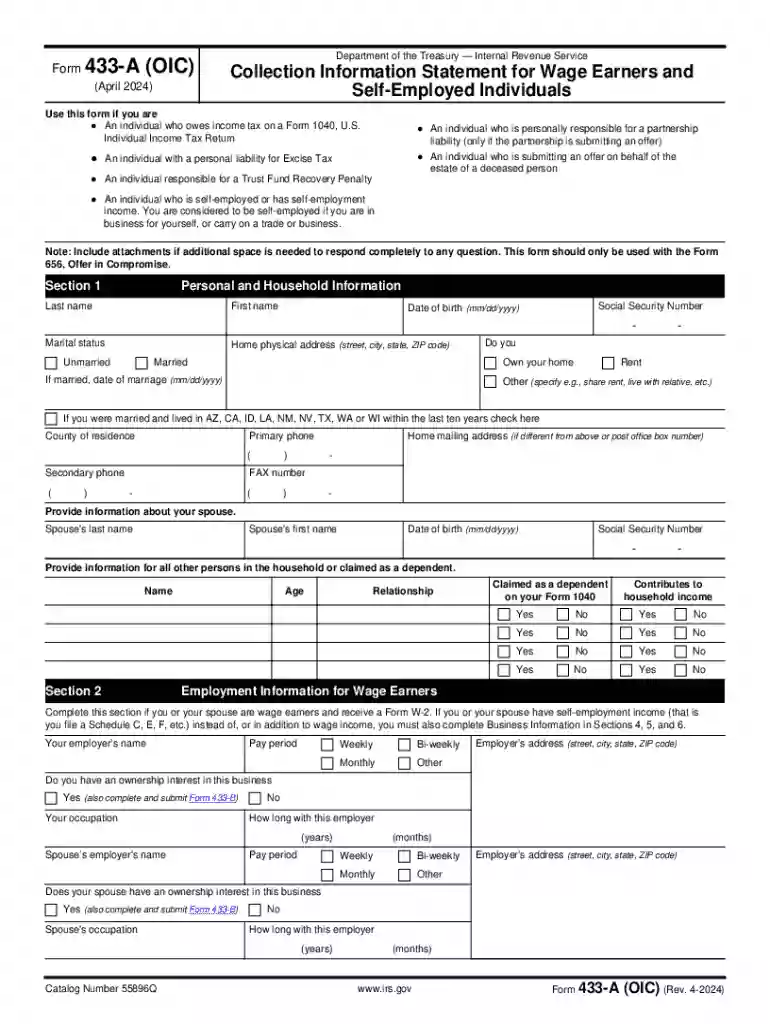
Form 433-A (OIC), also known as the Collection Information Statement for Wage Earners and Self-Employed Individuals, is issued by the Internal Revenue Service (IRS). Its primary purpose is to collect comprehensive financial information from individuals who owe taxes and are seeking an Offer in Compromise (OIC) to settle their tax liabilities for less than the full amount owed. The form aids the IRS in evaluating the taxpayer’s ability to pay, ensuring that the offer meets the criteria for acceptance.
You can acquire Form 433-A (OIC) through the IRS website, where it is available for download. Alternatively, the form can be requested directly from the IRS by calling their helpline. Tax professionals and some tax preparation software may also provide access to this form. Ensuring you have the latest version, including any revisions, is crucial to accurately presenting your financial situation.
This form is commonly used by wage earners and self-employed individuals who have outstanding tax liabilities that they are unable to pay in full. The form is crucial for those considering an Offer in Compromise as a solution to their tax debts. Taxpayers who own partnerships or are liable for trust fund recovery penalties may also be required to complete this form as part of their resolution process.
The IRS provides specific guidelines for completing Form 433-A (OIC), including the necessity of accurate and honest reporting of all income, assets, and liabilities. The guidelines detail which supporting documents are required to accompany the form, such as pay stubs, bank statements, and other financial records. The IRS requires that offers are realistic and considers the taxpayer's potential to pay over a reasonable time frame.
When submitting Form 433-A (OIC), it is important to include various supporting documents, such as:
Failure to accurately complete Form 433-A (OIC) or provide the required documentation can lead to the rejection of the offer in compromise. Additionally, intentional misrepresentation or failure to disclose assets can result in penalties or further legal action by the IRS. It is crucial to adhere to all filing instructions to avoid delays or denials of the offer.
Form 433-A (OIC) can be submitted to the IRS either by mail or electronically, depending on the available methods. When mailing, it is recommended to use certified mail with a return receipt to confirm delivery. Certain tax professionals may also submit the form on behalf of their clients through authorized IRS e-file providers.
Form 433-A (OIC) is specifically tailored for wage earners and self-employed individuals aiming for an offer in compromise. However, there are other versions like Form 433-B (OIC) for businesses. It's essential to choose the correct form based on your personal or business circumstances to ensure the IRS receives the appropriate financial disclosures.
We've got more versions of the irs form 433 f printable form. Select the right irs form 433 f printable version from the list and start editing it straight away!
| Versions | Form popularity | Fillable & printable |
|---|---|---|
| 2025 | 4.7 Satisfied (24 Votes) | |
| 2024 | 4.8 Satisfied (60 Votes) | |
| 2023 | 4.8 Satisfied (43 Votes) | |
| 2022 | 4.5 Satisfied (57 Votes) | |
| 2021 | 4.9 Satisfied (41 Votes) | |
| 2020 | 4.3 Satisfied (130 Votes) | |
| 2019 | 4.3 Satisfied (241 Votes) | |
| 2018 | 4.3 Satisfied (138 Votes) | |
| 2014 | 4.4 Satisfied (1237 Votes) | |
| 2012 | 4.3 Satisfied (61 Votes) |
At DocHub, your data security is our priority. We follow HIPAA, SOC2, GDPR, and other standards, so you can work on your documents with confidence.



You may click on the column headings in the table below first choose the organization from the menu below, then click the Report Date column
by EA Morse 2024 This outline reflects developments reported through November 26, 2024. Form 433-A concerning collection information. Taxpayers representative updated the Form


