Wisconsin, Sch CC: Request for a Closing Certificate for 2026

Get Form
Wisconsin, Sch CC: Request for a Closing Certificate for Preview on Page 1

Here's how it works

01. Edit your form online
Type text, add images, blackout confidential details, add comments, highlights and more.

02. Sign it in a few clicks
Draw your signature, type it, upload its image, or use your mobile device as a signature pad.

03. Share your form with others
Send it via email, link, or fax. You can also download it, export it or print it out.

Definition and Purpose of the Wisconsin Schedule CC Form

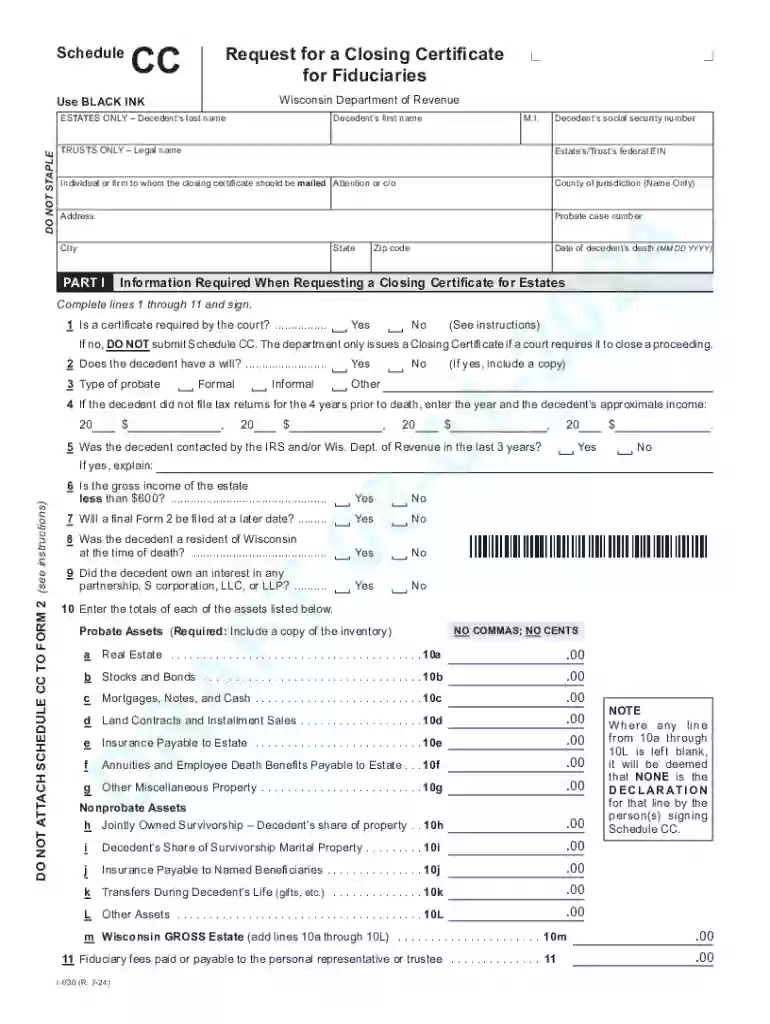
The Wisconsin Schedule CC form, also known as the Request for a Closing Certificate for estates and trusts, is a statutory document issued by the Wisconsin Department of Revenue. This form is critical in the settlement process of a decedent's estate or trust, serving as a formal request to obtain a closing certificate. The closing certificate confirms that all state taxes related to the estate or trust have been settled. The document is integral in preventing the reopening of estates for past tax liabilities.

Key Usage Scenarios

  • Estate Settlement: Used by fiduciaries managing a decedent’s estate for ensuring tax obligations are cleared.
  • Trust Management: Essential for trustees to confirm that tax dues are settled before the final distribution of assets to beneficiaries.

Estates are often subjected to complex tax situations where the closure of financial obligations is mandatory. By securing a closing certificate, fiduciaries are assured that they have fulfilled their compulsory duties.

Steps to Complete the Wisconsin Schedule CC Form

The completion of the Wisconsin Schedule CC Form involves several important steps, each demanding careful attention.

  1. Gather Necessary Information: Start by collecting essential data about the estate or trust, including the decedent's or grantor's details and the probate case number.
  2. Tax Filings: Ensure all relevant tax filings for the estate or trust are up-to-date.
  3. Asset Inventory: Prepare a comprehensive list of the estate's or trust's assets.
  4. Fill Out the Form: Accurately enter the collected information in the respective sections of the form.
  5. Submit the Form: Forward the completed form, along with any required documentation, to the Wisconsin Department of Revenue.

Errors in these steps can lead to delays or rejections, so accuracy is essential.

Required Documents

When submitting the Wisconsin Schedule CC form, including the following documents can streamline the approval process:

  • Certification of Fiduciary Authority: Proof of your role as executor or trustee.
  • Final Tax Returns: Copies of filed estate or trust tax returns.
  • Death Certificate: A certified copy for decedent estates.
  • Probate Court Orders: If applicable, any court orders that might influence the closure of the estate.

Precise documentation assists in avoiding complications during the review phase.

Filing Methods and Legal Requirements

Submission Methods

  • Online: Submit via the Wisconsin Department of Revenue's online portal for a quicker process.
  • Mail: Traditional mailing is another option, though processing times may vary.
  • In-Person: Directly submit it at the Department's office if personal consultation is preferred.

Legal Considerations

Ensure compliance with all legal requirements when filing, as neglect can result in penalties.

  • Verification of Information: Double-check form entries for accuracy to avoid errors in processing.
  • Consultation with a Legal Advisor: Recommended to understand any intricacies based on your unique situation.

Eligibility Criteria for Filing

Eligibility for filing the Wisconsin Schedule CC form is contingent on specific criteria:

  • Fiduciaries of Estates: Typically, executors and administrators who manage estate assets.
  • Trustees: Those overseeing trust operations.

Understand your eligibility to prevent unnecessary disturbances in acquiring a closing certificate.


decoration image ratings of Dochub

Important Dates and Deadlines

Keeping track of significant dates related to the form is imperative:

  • Filing Deadline: Typically aligned with final tax return deadlines.
  • Response Timeframe: Duration within which you can expect a response from the Department of Revenue, usually several weeks after submission.

Delays can impede estate or trust closure, making date adherence vital.

Potential Penalties for Non-Compliance

Failure to comply with obligations related to the Wisconsin Schedule CC form can result in:

  • Financial Penalties: Accruing from unpaid taxes due to non-submission.
  • Legal Repercussions: Possible reopening of the estate for unresolved liabilities.

It is crucial to understand these penalties as they can significantly affect the estate or trust's financial health.

Software Compatibility and Digital Options

For ease of completion, consider digital tools:

  • Document Management Software: Platforms like DocHub aid in form completion and secure digital submissions.
  • Tax Software: Integrate with programs such as TurboTax or QuickBooks for organized financial data handling.

Software usage ensures accuracy and efficiency in managing estate or trust documentation.

State-Specific Rules and Variations

Wisconsin-specific regulations govern the Schedule CC form processes:

  • Unique Forms and Instructions: State-mandated layouts and guidelines must be followed.
  • Local Tax Laws: Understanding subtle nuances can aid compliance.

Being informed about state-specific differences can assist in the filing process.

Examples of Using the Wisconsin Schedule CC Form

Case Example 1: Estate Closure

A deceased individual's executor uses the form to clear estate taxes before distributing assets to beneficiaries, ensuring no tax liabilities remain.

Case Example 2: Trust Termination

The trustee employs the form to confirm all tax payments for a dissolving trust, thus allowing smooth distribution and termination processes.

These examples underline the form's importance in estate planning and management.

By understanding these elements of the Wisconsin Schedule CC form, fiduciaries and trustees can effectively manage the closure of estates or trusts, ensuring financial peace and compliance with state laws.

be ready to get more

Complete this form in 5 minutes or less

Get form

Got questions?

We have answers to the most popular questions from our customers. If you can't find an answer to your question, please contact us.
Contact us
The department will issue a Closing Certificate for Fiduciaries to an estate only in cases where a Wisconsin Probate Court requires a certificate to close a proceeding. The Closing Certificate may be issued in the year prior to the final year of the estate to expedite the closing of the estate.
Wisconsin does not impose an inheritance tax. This means that heirs in Wisconsin do not owe state tax on the assets they inherit. In 1992, Wisconsin repealed its inheritance tax. Before that, the state imposed both inheritance and gift taxes.
(1m), a noncharitable irrevocable trust may be modified or terminated, with or without court approval, upon consent of the settlor and all beneficiaries, even if the modification or termination is inconsistent with a material purpose of the trust.
Need a new Wisconsin withholding number as the result of a change in business entity You must notify the department of the last date of withholding using one of the following methods: Complete Close Account (under I want to) in My Tax Account. Email DORWithholdingTax@wisconsin.gov, or. Call (608) 266-2776.
Theres normally no Inheritance Tax to pay if either: the value of your estate is below the 325,000 threshold. you leave everything above the 325,000 threshold to your spouse, civil partner, a charity or a community amateur sports club.

Security and compliance

At DocHub, your data security is our priority. We follow HIPAA, SOC2, GDPR, and other standards, so you can work on your documents with confidence.
Learn more
ccpa2
pci-dss
gdpr-compliance
hipaa
soc-compliance

People also ask

Wisconsin does not levy an inheritance tax or an estate tax. However, if you are inheriting property from another state, that state may have an estate tax that applies. You will also likely have to file some taxes on behalf of the deceased. If the estate is large enough, it might be subject to the federal estate tax.
In 2025, the first $13,990,000 of an estate is exempt from federal estate taxes, up from $13,610,000 in 2024. Estate taxes are based on the size of the estate. Its a progressive tax, just like the federal income tax system. This means that the larger the estate, the higher the tax rate it is subject to.
Wisconsin Inheritance and Gift Tax There is no gift tax in Wisconsin either. The federal gift tax has an annual exemption of $19,000 in 2025. If you give more than $19,000 to any one person in a year, you have to report the gift to the IRS.

Related links