




01. Edit your form online
Type text, add images, blackout confidential details, add comments, highlights and more.

Type text, add images, blackout confidential details, add comments, highlights and more.

Draw your signature, type it, upload its image, or use your mobile device as a signature pad.

Send it via email, link, or fax. You can also download it, export it or print it out.
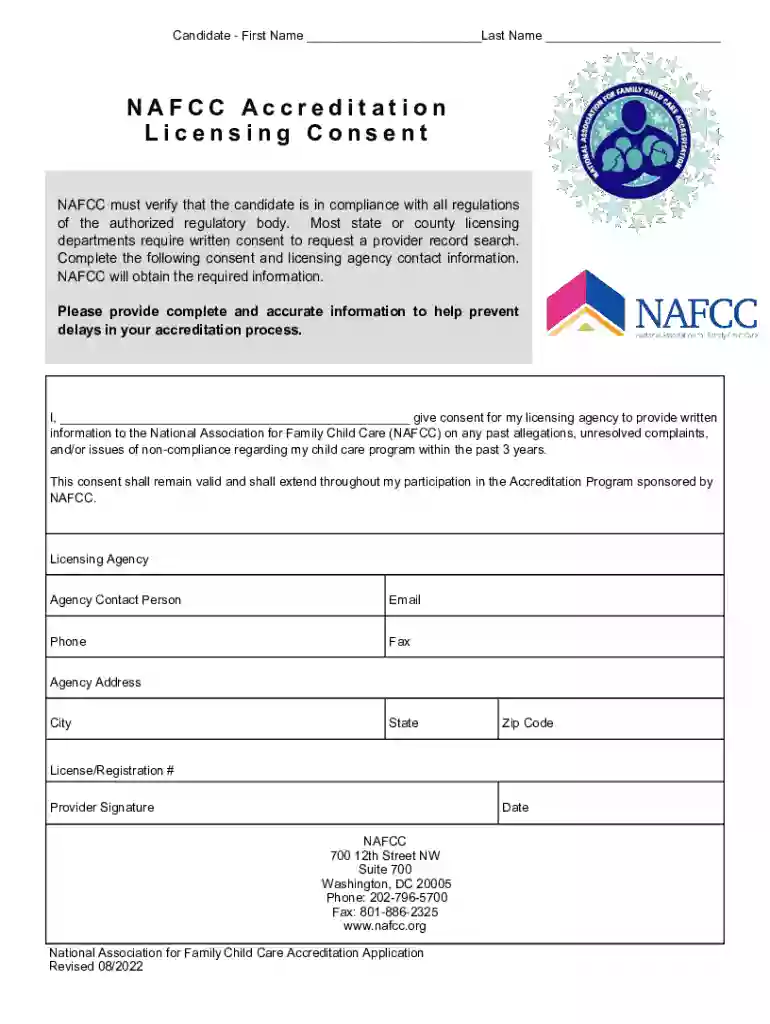
The National Association for Family Child Care Accreditation (NAFCC) is a credentialing program that assesses and recognizes family child care providers who demonstrate excellence in their practice. The NAFCC accreditation offers providers a structured pathway to achieving high standards in child care delivery through external evaluation. This process is designed to ensure that the provider meets specific criteria for quality care, safety, and educational development, with the goal of enhancing the standard of family child care operations.
Using the NAFCC accreditation involves understanding the standards set by the organization and integrating them into daily child care operations. Providers must regularly assess their practices and align them with the NAFCC's criteria, which cover various aspects like health, safety, and educational activities. Accredited providers benefit from recognition in their community, which can enhance their reputation and attract more clients. To maintain accreditation, providers need to engage in continuous improvement processes, which include incorporating feedback and adapting to any updates in guidelines.
Self-Assessment: Begin by conducting a thorough self-evaluation against the NAFCC standards. Use the self-study materials provided by the organization to identify areas of strength and improvement.
Application Submission: Complete and submit your application to the NAFCC. Ensure all required documentation, such as proof of certification and any relevant training completions, is included.
Site Visit Preparation: Prepare for the on-site assessment conducted by NAFCC evaluators. This involves organizing your environment to demonstrate adherence to accreditation standards.
On-Site Visit: An evaluator will visit your facility to observe practices, review records, and verify compliance with standards. Be open to answering questions and providing additional information as needed.
Feedback and Improvement: After the site visit, review any feedback provided by the evaluator and make necessary improvements to align better with the standards.
Final Decision and Award: The NAFCC will review all collected data to decide on your accreditation status. If awarded, you will receive official documentation recognizing your facility as accredited.
Achieving NAFCC accreditation signals to parents and the community that your family child care meets high standards of quality. This accreditation can differentiate your program from non-accredited providers, potentially increasing enrollment and trust among families seeking care. Furthermore, the accreditation process encourages ongoing professional development, ultimately enhancing the care and education you provide to children. It also establishes a framework for continuous improvement, keeping your program at the forefront of family child care excellence.
To be eligible for NAFCC accreditation, candidates must:


NAFCC accreditation not only enhances reputation but also provides legal safeguards. Accredited status might be referenced in contracts with parents to affirm compliance with recognized standards. It can also serve as a protective measure in legal disputes, as it provides a documented standard of care that the provider has been verified to meet. Moreover, having accreditation might satisfy certain state or local regulatory requirements connected to quality in child care provisioning.
The application process for NAFCC accreditation typically involves a series of steps, starting with a self-assessment and culminating in an on-site evaluation. From the initial application submission to the final approval, the process usually spans several months. However, the exact timeline can vary depending on factors like the promptness of documentation submission, scheduling of evaluations, and the current demand for site assessments. Applicants are advised to maintain communication with the NAFCC throughout the process to ensure timely updates and responses.
Combining these essential components with real-world examples and case studies provides a robust overview of what the National Association for Family Child Care Accreditation entails. It helps ensure every aspect of the accreditation process is thoroughly understood and effectively applied by aspiring and current providers.
We've got more versions of the National Association for Family Child Care Accreditation form. Select the right National Association for Family Child Care Accreditation version from the list and start editing it straight away!
At DocHub, your data security is our priority. We follow HIPAA, SOC2, GDPR, and other standards, so you can work on your documents with confidence.
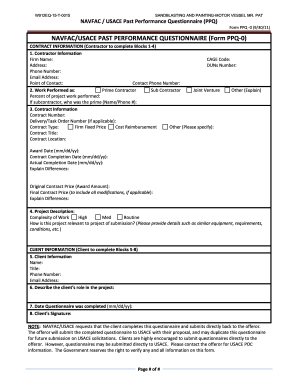
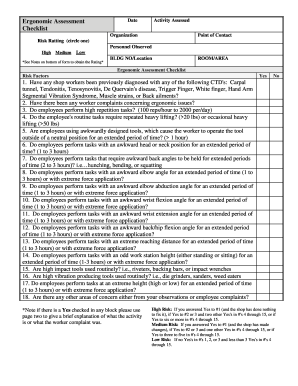





This page provides instructions on how to report the agencys accreditation level in the CDD-801A report.
Accreditation is awarded for family child care providers who meet the eligibility requirements and the Quality Standards for NAFCC Accreditation.


