
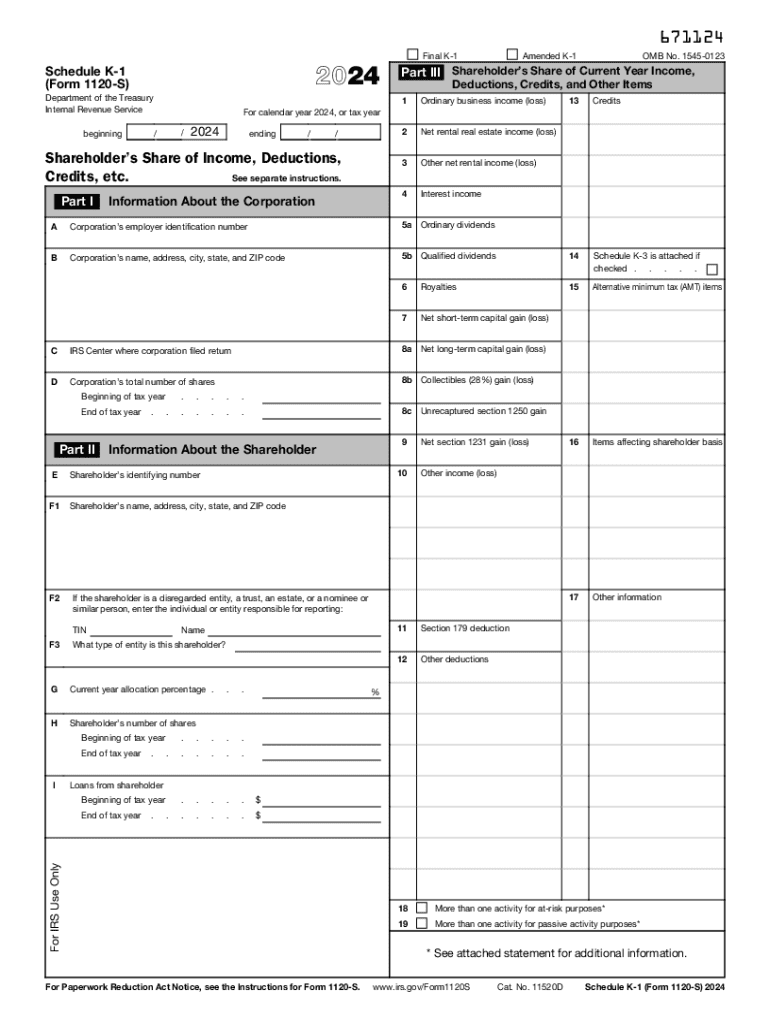







Definition & Meaning
Schedule K-1 (Form 1120-S) is an integral tax document used for S corporations. It reports each shareholder's share of income, deductions, credits, and other pertinent tax-related entries for the 2024 tax year. This form enables shareholders to understand their individual responsibilities for tax reporting. By dividing the corporation's income and expenses among its shareholders, the form delineates how profits and losses impact each shareholder’s personal tax obligations.
How to Use the 2024 Schedule K-1 (Form 1120-S) Shareholders Share of Income, Deductions, Credits, etc.
Using the Schedule K-1 requires detailed understanding of its components. Shareholders should first review the specifics section by section. Important details include:
- Ordinary Business Income/Loss: This section covers a shareholder's portion of the business profits or losses and is reported on their tax return.
- Capital Gains and Losses: Reported separately from ordinary income, these must be identified to apply the correct tax treatment.
- Deductions and Credits: Includes personal deductions that will affect a shareholder's tax liability, such as pass-through credits that can directly lower tax owed.
Accurate comprehension of each part ensures precise tax filing, reflecting individual financial contributions and benefits.
Steps to Complete the 2024 Schedule K-1 (Form 1120-S) Shareholders Share of Income, Deductions, Credits, etc.
Completing a Schedule K-1 involves several steps:
- Gather Required Information: Include income statements, balance sheets, and prior Schedule K-1s.
- Complete Business Income Section: Report all earned income.
- Calculate Taxable Deductions: Document applicable deductions.
- Report Shareholder-specific Credits: Include portions of any credits earned through S corporation activities.
- Verify Accuracy: Double-check entries to ensure all data reflects accurate financial reporting.
Each step requires precision to avoid discrepancies and IRS penalties.
Key Elements of the 2024 Schedule K-1 (Form 1120-S) Shareholders Share of Income, Deductions, Credits, etc.
Understanding the key elements on Schedule K-1 is crucial:
- EIN (Employer Identification Number): Identifies the S corporation.
- Shareholder's Percentage of Stock Ownership: Determines the share of income or loss.
- Adjustments and Preferences: Identify any items with specific tax treatment, such as AMT adjustments.
- Foreign Transactions: Report transactions involving foreign income or expenses.
Each element serves to ensure that shareholders accurately capture their tax obligations in relation to the corporation.
State-Specific Rules for the 2024 Schedule K-1 (Form 1120-S) Shareholders Share of Income, Deductions, Credits, etc.
States may have unique rules for completing and submitting K-1 forms. Shareholders should be aware of:
- State Income Tax Differences: Some states might tax S corporation income differently.
- State Deductions and Credits: Availability of state-specific deductions or rebates.
- Filing Requirements: Variability in deadlines and methods for managing state tax obligations.
Consulting with a tax advisor knowledgeable in state-specific regulations can help mitigate potential errors or overlook important regional compliance issues.
Legal Use of the 2024 Schedule K-1 (Form 1120-S) Shareholders Share of Income, Deductions, Credits, etc.
The legal use of Schedule K-1 involves:
- Transparency in Reporting: Ensures shareholders report their share of corporate income correctly.
- IRS Compliance: Proper use aligns with tax law and prevents audits or penalties.
- Proof of Income: Serves as substantiation for the shareholder’s reported income as required legally.
Adherence to these legal applications is critical for maintaining legitimacy and compliance within all facets of S corporation operations.
Software Compatibility (TurboTax, QuickBooks, etc.)
Many software platforms facilitate the preparation of Schedule K-1s, ensuring accuracy and efficiency:
- TurboTax and QuickBooks: These programs import K-1 data directly, helping calculate tax obligations seamlessly.
- Integration Benefits: Automatic generation and error-checking features reduce manual entry errors.
- Existing Features: Include wizards and guides tailored for tax preparers to handle complex calculations.
Choosing a compatible software tool can significantly simplify the tax filing process, particularly for those managing larger volumes of financial transactions.
Filing Deadlines / Important Dates
Timeliness in filing is crucial:
- March 15th: Due date for S corporations to file their tax returns, affecting when Schedule K-1s must be issued to shareholders.
- April 15th: General taxpayer deadline, by which shareholders must include their K-1 information on their personal tax returns.
- Extension Options: Both entities and individuals can file for an extension if more time is required.
Missing these deadlines can result in penalties, emphasizing the need for shareholders and corporations to manage their tax calendar carefully.


