




01. Edit your rdc research development tax online
Type text, add images, blackout confidential details, add comments, highlights and more.

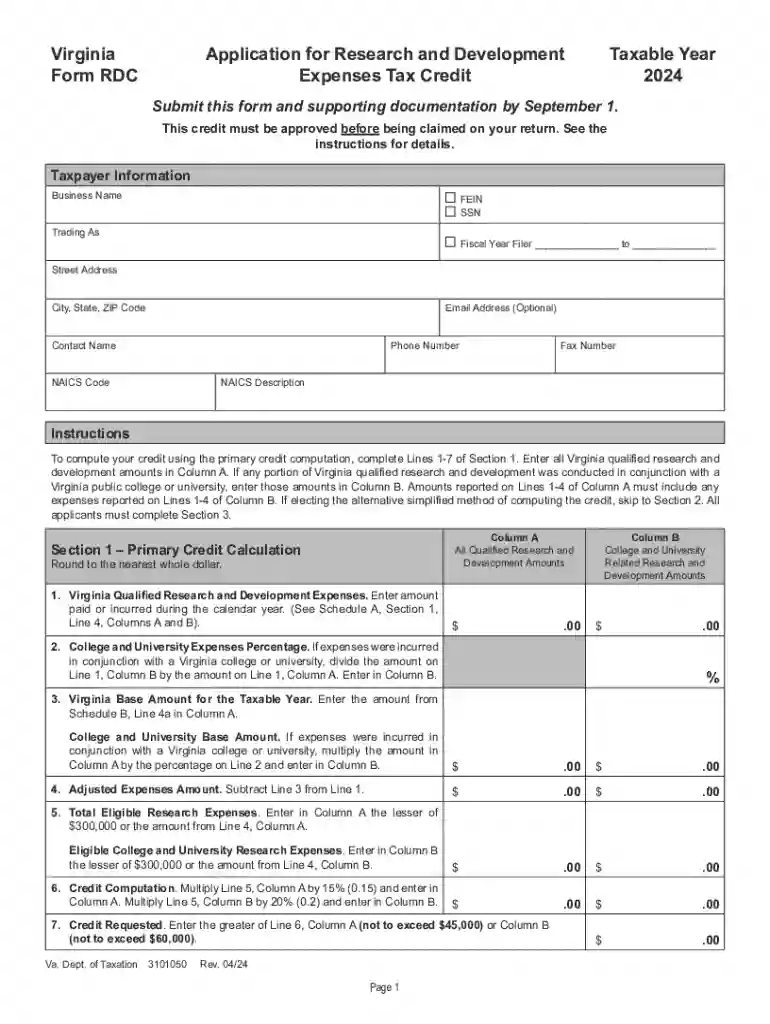
Type text, add images, blackout confidential details, add comments, highlights and more.

Draw your signature, type it, upload its image, or use your mobile device as a signature pad.

Send virginia form rdc research credit via email, link, or fax. You can also download it, export it or print it out.
The Research and Development Tax Credit, commonly referred to as the RDC Research Development Tax, is a government incentive designed to encourage businesses to invest in research and development activities. This tax credit is available to companies that incur qualified research expenses, which can include wages, supplies, and contract research costs related to the development of new or improved business components. It serves to alleviate the financial burden associated with innovation and technological advancement, ultimately promoting economic growth and competitiveness on both a national and global scale.
Eligibility for the RDC Research and Development Tax Credit is contingent upon meeting specific criteria. Businesses must engage in qualified research activities that satisfy the IRS' four-part test: (1) The research must be intended to develop or improve a business component, (2) it must be technological in nature, relying on principles of engineering, physics, or biology, (3) it must involve a process of experimentation to resolve scientific or technological uncertainty, and (4) it must be for a permitted purpose, namely to develop a new or improved function, performance, reliability, or quality of a business component. Eligibility also depends on the location of the research, as some credits are state-specific.


Several key terms are vital to understanding the RDC Research Development Tax Credit:
To apply for the RDC Research and Development Tax Credit, businesses must complete IRS Form 6765, "Credit for Increasing Research Activities." The application requires detailed records of expenses and activities to substantiate the claim. This includes a clear documentation of methodologies, processes of experimentation, and narratives to demonstrate the adherence to the IRS' four-part test. Processing time for the application may vary, but businesses should expect it to align with typical tax credit timelines, factoring in any additional state-level documentation requirements if applicable.
While the federal RDC Research Development Tax Credit is widely applicable, individual states may have additional or varying requirements. For instance, certain states offer supplemental credits or have unique rules regarding the calculation of qualified expenses. Some states may also offer the credit exclusively to select industries or limit eligibility based on the size of the business. Understanding state-specific regulations is critical to maximizing the available benefits, so companies should consult state tax authorities or experts familiar with regional requirements.
Timely filing is essential for the RDC Research Development Tax Credit. The credit must be claimed on the original return for the year in which the qualifying research expenses were incurred, with extensions available in certain cases. The federal tax filing deadline is typically April 15, but businesses should verify specific due dates each tax year to avoid penalties. State deadlines may differ, necessitating careful planning to ensure compliance across multiple jurisdictions.
Several real-world scenarios illustrate the application of the RDC Research Development Tax Credit:
Businesses across a wide array of industries can benefit from the RDC Research Development Tax Credit, but certain sectors tend to see the most significant advantages. These include:
By understanding and strategically applying the RDC Research Development Tax Credit, businesses can significantly offset costs related to innovation and development, fostering a more robust and competitive operating environment.
We've got more versions of the rdc research development tax form. Select the right rdc research development tax version from the list and start editing it straight away!
| Versions | Form popularity | Fillable & printable |
|---|---|---|
| 2024 | 4.8 Satisfied (31 Votes) | |
| 2023 | 4.3 Satisfied (26 Votes) | |
| 2022 | 4.1 Satisfied (37 Votes) | |
| 2021 | 4.9 Satisfied (38 Votes) | |
| 2020 | 4.3 Satisfied (206 Votes) | |
| 2019 | 4.4 Satisfied (91 Votes) | |
| 2018 | 4.3 Satisfied (96 Votes) | |
| 2015 | 4.2 Satisfied (71 Votes) | |
| 2014 | 3.8 Satisfied (38 Votes) | |
| 2012 | 4 Satisfied (38 Votes) |
At DocHub, your data security is our priority. We follow HIPAA, SOC2, GDPR, and other standards, so you can work on your documents with confidence.




Jun 5, 2023 the University of Illinois Research Development Community. I sat through a lot of school board meetings and wrote about property taxes.
Oct 10, 2025 - Research and Development RCCE. IP allows biotechnology companies to protect their research and development investments and protect
For the basic research RDC, the tax credit amount is 24 percent of the excess of current-year basic research expenses over the calculated base-period amount.Read more


