




01. Edit your form 1065 online
Type text, add images, blackout confidential details, add comments, highlights and more.

Type text, add images, blackout confidential details, add comments, highlights and more.

Draw your signature, type it, upload its image, or use your mobile device as a signature pad.

Send fillable 1065 via email, link, or fax. You can also download it, export it or print it out.
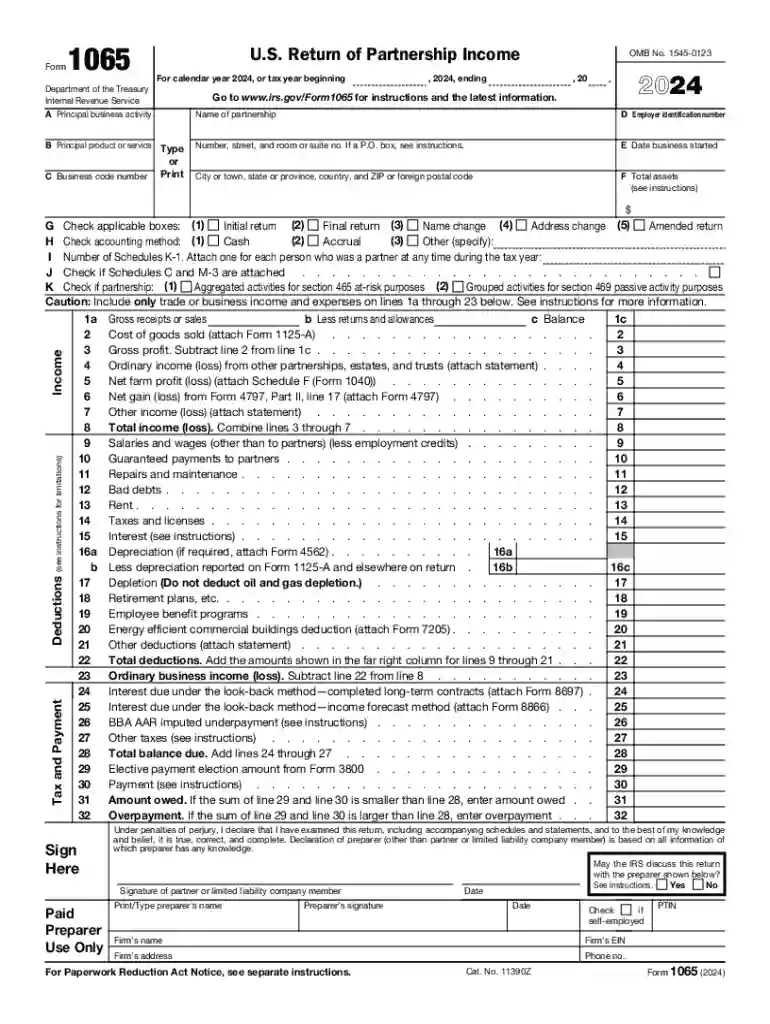
The "2024 Form 1065 U.S. Return of Partnership Income" is an official tax document issued by the Internal Revenue Service (IRS). It is designed specifically for partnerships to report their financial activities, including income, deductions, and distributions to partners for the tax year 2024. Unlike corporations, partnerships do not pay income tax; instead, they pass any profits or losses to their partners, who then include this information on their personal tax returns. This form is critical for ensuring compliance with U.S. tax regulations and for facilitating the transparent reporting of partnership revenues and expenses.
Partnerships, including limited liability companies (LLCs) classified as partnerships, are required to file Form 1065 if they conduct business within the United States or generate income from U.S. sources. The form captures various aspects of the partnership's financial activities and aids in IRS audits and analysis of partnership trends within the economy.
Using the 2024 Form 1065 involves several steps and requires careful attention to detail to ensure accuracy and compliance. Partnerships must use this form to:
Report Income: This includes all revenue streams, such as sales, service income, or rental revenue, amassed during the fiscal year.
Calculate Deductions: Partnerships can subtract expenses such as rent, utilities, salaries, and other legitimate business expenses from their income to determine taxable income.
Distribute Income or Loss: The form includes sections for splitting income or losses among partners according to the partnership agreement.
Complete Schedules: Attach relevant schedules that detail income from activities like interest or dividends and report information about foreign transactions or partners.
Each partner must receive a Schedule K-1, detailing their share of income, deductions, and credits, which they will report on their individual tax returns. This ensures that the IRS receives a comprehensive view of income as it flows from the partnership to individual partners.
Completing the 2024 Form 1065 requires systematic input of financial data:
Fill Out Basic Information: This includes the partnership's name, address, and tax identification number. Clearly specify the tax year being reported, which in this case is 2024.
Gather Required Schedules: Attach Schedule B to provide additional information about the nature of the partnership’s activities and Schedule K to summarize the total income and deduction items.
Report Income and Deductions in Part I: Include gross income generated from sales and subtract cost of goods sold to determine the gross profit. Deduct business expenses, such as advertising or interest, to get the net income.
Complete Schedule K-1 for Each Partner: Distribute the partnership's income or loss among partners. Ensure correct allocation according to each partner's share in the partnership agreement.
Review and Submit: Carefully review all entries for accuracy before filing the form with the IRS. Retain copies for personal records and for partner distribution.
Ensure proper documentation as the IRS may request proof or additional information during audits or inquiries.
Timely filing of the Form 1065 is crucial to comply with IRS regulations:
Usual Deadline: The standard deadline for filing the Form 1065 is March 15th following the close of the tax year. For the 2024 tax year, this means the deadline falls on March 15, 2025.
Extension Option: Partnerships can request a six-month extension, typically moving the due date to September 15th. To apply for an extension, partnerships must file Form 7004 by the original due date and ensure all required statements and documentation are accurate.
Staying on schedule helps avoid penalties and interest, promoting compliance and financial accuracy.
The 2024 Form 1065 comprises several critical sections:
General Information: This header section includes the partnership's identification and tax year details.
Income Details: The income statement captures taxable revenue and expenses to ascertain the net income of the partnership.
Deductions: Enumerate allowable business expenses. Accurate deduction reporting can significantly lower taxable income.
Schedule L (Balance Sheets): Presents a snapshot of the partnership’s financial status at the start and end of the tax year, including assets, liabilities, and partner capital accounts.
Schedule M-2: Specifies reconciliations of partner equity, reflecting contributions, distributions, and changes in capital accounts.
Understanding these elements ensures that partnerships accurately reflect their operations and adhere to tax obligations.
To fully understand and accurately complete the Form 1065, familiarity with related terms is essential:
Partnership Agreement: The legal document outlining the ownership structure and distribution shares of each partner.
Schedule K-1: The form issued to individual partners summarizing the partnership's income or loss allocated to them.
Ordinary Business Income: Net income from trade or business activities distinct from investment or passive activities.
Cost of Goods Sold (COGS): Costs directly associated with the production of goods sold by the partnership, which are subtracted to determine gross profit.
These terminologies frame the reporting process, guiding accurate information disclosure to the IRS.
The IRS provides comprehensive guidelines for completing and submitting Form 1065. Some crucial points include:
Accuracy: Ensure all info is factual and supported by proper documentation.
Form Changes: Remain aware of yearly updates or modifications to the form.
Record Retention: Partnerships should maintain all relevant financial records and tax returns for a minimum of seven years to aid in potential reviews.
Foreign Transactions: Any international dealings must be meticulously reported to avoid potential penalties.
Refer to the IRS publications and guidelines consistently to align with the latest compliance standards.
Non-compliance with Form 1065 filing requirements results in penalties:
Late Filing Penalty: Failure to file by the deadline incurs a penalty of $210 per month, per partner, until the return is filed or the penalty reaches a maximum.
Inaccurate Information: Filing incorrect or incomplete forms can lead to additional fines, emphasizing the importance of precision and verification prior to submission.
Failure to Furnish Schedule K-1: Each partner must receive their Schedule K-1 on time; failing this requirement also results in penalties.
Avoiding these penalties requires vigilant attention to deadlines, accuracy, and thoroughness in preparation and submission.
We've got more versions of the form 1065 form. Select the right form 1065 version from the list and start editing it straight away!
| Versions | Form popularity | Fillable & printable |
|---|---|---|
| 2025 | 4.6 Satisfied (56 Votes) | |
| 2024 | 4.3 Satisfied (48 Votes) | |
| 2023 | 4.4 Satisfied (52 Votes) | |
| 2022 | 4.9 Satisfied (24 Votes) | |
| 2021 | 4.8 Satisfied (81 Votes) | |
| 2020 | 4.3 Satisfied (145 Votes) | |
| 2019 | 4.4 Satisfied (171 Votes) | |
| 2018 | 4.3 Satisfied (138 Votes) | |
| 2017 | 4.3 Satisfied (233 Votes) | |
| 2016 | 4.4 Satisfied (678 Votes) | |
| 2015 | 4.2 Satisfied (57 Votes) | |
| 2014 | 4.1 Satisfied (30 Votes) | |
| 2013 | 4.3 Satisfied (36 Votes) | |
| 2012 | 4.2 Satisfied (30 Votes) | |
| 2011 | 4 Satisfied (42 Votes) |
At DocHub, your data security is our priority. We follow HIPAA, SOC2, GDPR, and other standards, so you can work on your documents with confidence.




Mar 11, 2024 Form 1065, U.S. Return of Partnership Income are due Friday, March 15. This form may be filed electronically with the IRS
Jun 27, 2026 Product Number Instruction 1065 Title Instructions for Form 1065, U.S. Return of Partnership Income, Revision Date 2024. Product NumberRead more


