




01. Edit your schedule b fillable form 2024 online
Type text, add images, blackout confidential details, add comments, highlights and more.

Type text, add images, blackout confidential details, add comments, highlights and more.

Draw your signature, type it, upload its image, or use your mobile device as a signature pad.

Send schedule b via email, link, or fax. You can also download it, export it or print it out.
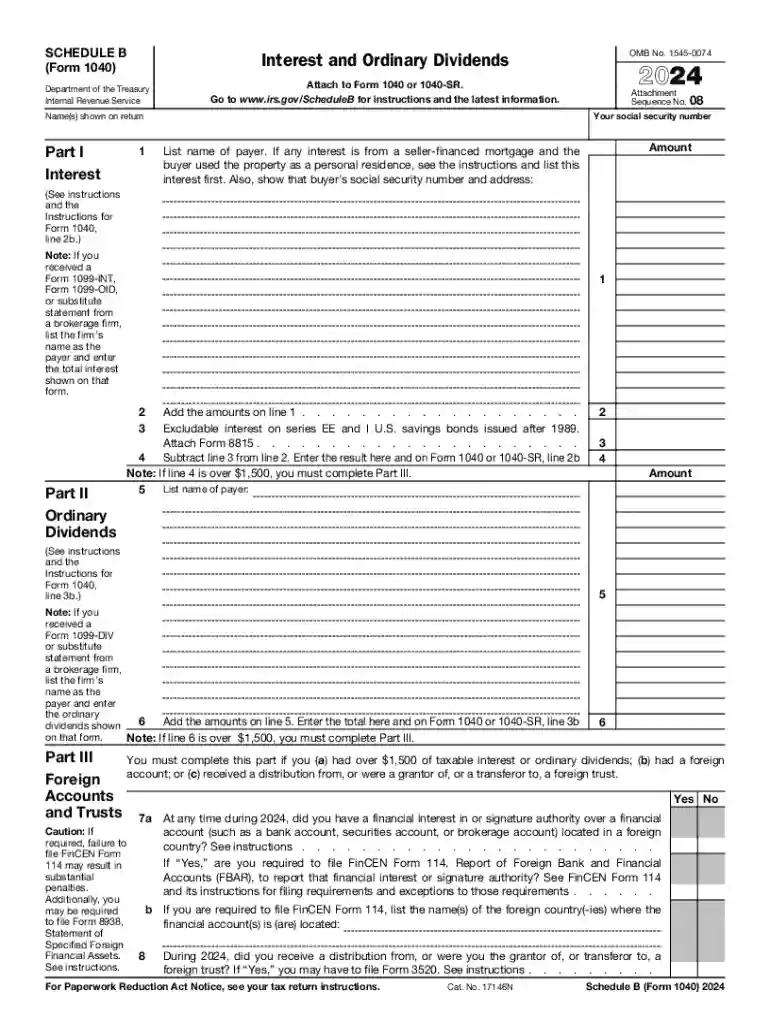
Schedule B (Form 1040) is an essential tax form used by individuals to report interest and ordinary dividends received throughout the tax year. It assists taxpayers in detailing the sources of their income specifically from interest and dividends, which is crucial for accurate financial record-keeping and tax computation. The form includes sections to list payers of interest and dividends, and it requires disclosure of any foreign financial accounts and trusts if certain conditions are met. For those dealing with numerous financial institutions or holding various investment portfolios, Schedule B becomes an indispensable tool for fulfilling federal tax obligations accurately.
Gather Financial Statements: Before beginning, collect all relevant financial documents, including 1099-INT and 1099-DIV forms received from financial institutions. These documents detail the interest and dividends that need reporting.
Part I - Interest Income: List each payer of interest income, including details such as the payer's name and the amount received. If the total exceeds $1,500, additional reporting is required.
Part II - Ordinary Dividends: Similar to interest income, record each dividend payer and the respective amounts received. Ensure to provide precise totals, which are necessary for accurate tax calculations.
Part III - Foreign Accounts and Trusts: If applicable, disclose any foreign accounts and trusts. Include the country where each account is held and provide any required additional details relating to the account as per IRS guidelines.
Review for Accuracy: Double-check all entries for accuracy before filing to prevent discrepancies that could delay processing or lead to audits.
Interest Payers: Comprehensive listing of all payers from whom interest has been received. This helps in consolidating total interest income for taxation.
Dividend Payers: Detailed reporting of all sources of dividends, which assists in determining the qualified and non-qualified portions, affecting overall tax rates.
Foreign Account Reporting: Explicit acknowledgment of foreign accounts and trusts, which is vital for compliance with international reporting standards and avoiding penalties.
1099-INT: A tax form used to report interest income paid by institutions like banks and savings accounts.
1099-DIV: A form reporting dividend income, capital gain distributions, and other financial transactions.
FinCEN Form 114: Known as the FBAR, it's required if you hold financial assets in foreign accounts exceeding $10,000.
Adhering to IRS guidelines is crucial when filling out Schedule B. Guidelines dictate the thresholds for interest and dividends that necessitate using the form, as well as specific instructions for reporting foreign financial assets. Compliance with these directives ensures your tax returns are precise and complete, helping to prevent the risk of audits and penalties.
The typical deadline for filing the Schedule B is aligned with the federal tax return deadline, usually April 15. However, it is vital to stay updated on any extensions or changes announced by the IRS, especially for taxpayers who may seek extensions for more time to organize their financial affairs.
Failure to accurately complete and submit the Schedule B by the deadline can result in significant penalties. These can include fines for under-reporting income or not disclosing foreign accounts. It is crucial to verify all information thoroughly to avoid such consequences.
The 2024 Schedule B can be accessed through the IRS website, where it is available for download. Alternatively, tax preparation software that complies with IRS standards also offers digital templates of Schedule B, streamlining the process for taxpayers leveraging technology to manage their tax affairs.
We've got more versions of the schedule b fillable form 2024 form. Select the right schedule b fillable form 2024 version from the list and start editing it straight away!
| Versions | Form popularity | Fillable & printable |
|---|---|---|
| 2025 | 4.7 Satisfied (22 Votes) | |
| 2024 | 4.4 Satisfied (20 Votes) | |
| 2023 | 4.3 Satisfied (51 Votes) | |
| 2022 | 4.9 Satisfied (29 Votes) | |
| 2021 | 4.9 Satisfied (55 Votes) | |
| 2020 | 4.1 Satisfied (63 Votes) | |
| 2019 | 4.4 Satisfied (53 Votes) | |
| 2018 | 4.1 Satisfied (73 Votes) | |
| 2017 | 4.4 Satisfied (126 Votes) | |
| 2016 | 4.4 Satisfied (682 Votes) | |
| 2015 | 4.2 Satisfied (58 Votes) | |
| 2014 | 4.2 Satisfied (39 Votes) | |
| 2013 | 4 Satisfied (34 Votes) | |
| 2012 | 4 Satisfied (45 Votes) | |
| 2011 | 4.3 Satisfied (60 Votes) |
At DocHub, your data security is our priority. We follow HIPAA, SOC2, GDPR, and other standards, so you can work on your documents with confidence.




2024 Interest and Ordinary Dividends. Attach to Form 1040 or 1040-SR. You must complete this part if you (a) had over $1,500 of taxable interest or ordinary
Jan 21, 2026 Schedule B Interest and Ordinary Dividends Instructions. You must file your return by Monday, April 15, 2024


