INFORMATIVE RETURN - PASS-THROUGH ENTITY 2026

Get Form
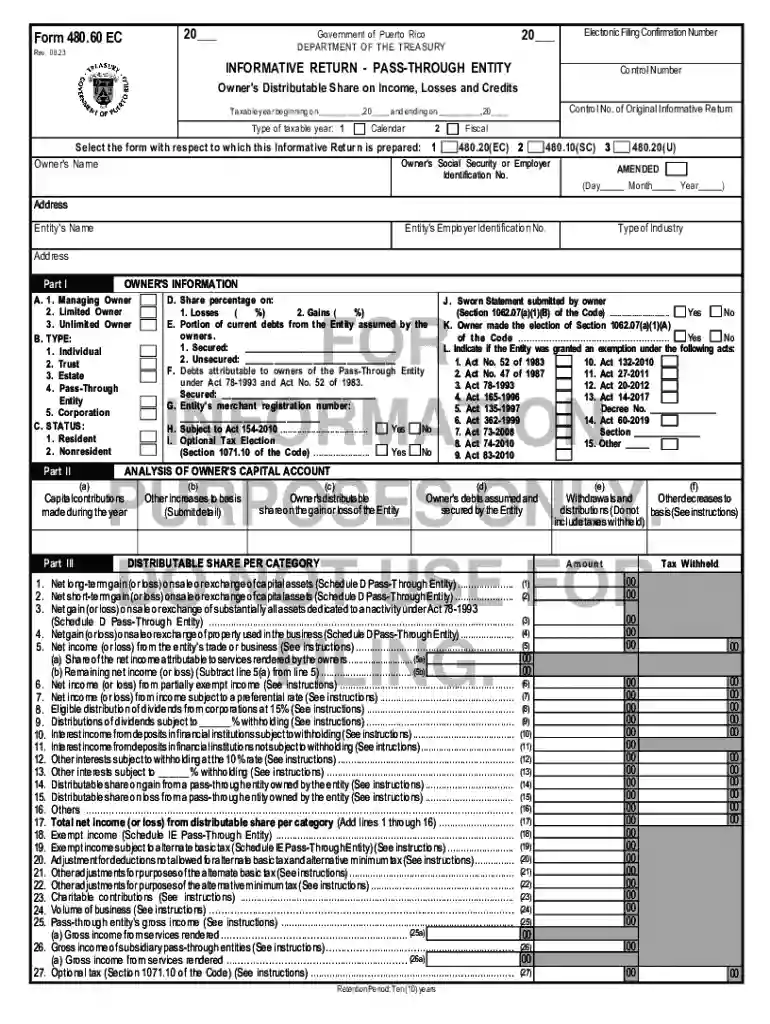
INFORMATIVE RETURN - PASS-THROUGH ENTITY Preview on Page 1

Here's how it works

01. Edit your form online
Type text, add images, blackout confidential details, add comments, highlights and more.

02. Sign it in a few clicks
Draw your signature, type it, upload its image, or use your mobile device as a signature pad.

03. Share your form with others
Send it via email, link, or fax. You can also download it, export it or print it out.

Definition and Purpose of the Informative Return - Pass-Through Entity

The Informative Return for Pass-Through Entities, commonly recognized as Form 480.60 EC, is issued by the Government of Puerto Rico's Department of the Treasury. This form is essential for pass-through entities such as partnerships, some types of limited liability companies, and S-corporations. It details the reporting requirements for the distributable share of income, losses, and credits allocated to each member or shareholder. By using this document, entities ensure compliance with Puerto Rican tax regulations.

  • Distributable Share: This refers to the portion of income, credits, or losses assigned to each participant in the entity, reflecting their respective share or agreement.
  • Compliance: Completing this form is crucial for adhering to legislative requirements and avoiding legal complications or penalties.

How to Obtain the Informative Return - Pass-Through Entity

Obtaining Form 480.60 EC can be accomplished through several methods to accommodate the needs of different users:

  1. Online Access: The simplest way is downloading it directly from the official website of Puerto Rico's Department of the Treasury.
  2. Tax Software: Many tax preparation software platforms, like TurboTax or QuickBooks, might integrate this form for easier access and completion.
  3. Tax Advisors: Consult with a professional tax advisor or accountant who can provide both the form and guidance on accurately completing it.

Steps to Complete the Informative Return - Pass-Through Entity

Completing Form 480.60 EC requires attention to detail to ensure accuracy:

  1. Gather Required Documents: Start with assembling partnership agreements, financial statements, and previous tax returns.
  2. Owner Information Section: Enter detailed participant data, including names, addresses, and social security or employer identification numbers.
  3. Capital Account Analysis: Provide an analysis of each owner's capital account, reflecting beginning balances, contributions, withdrawals, and ending balances.
  4. Income and Deductions: Accurately report the entity's income, deductions, and any passive losses allocated to each owner.
  5. Tax Credits and Withholding: Include applicable tax credits and any taxes withheld on behalf of owners.
  6. Final Review and Submission: Double-check for errors and file by the designated deadline.

Who Typically Uses the Informative Return - Pass-Through Entity

The primary users of this form are entities that elect to pass income through to owners, including:


  • Partnerships: Consisting of multiple partners who share income and liabilities.
  • LLCs: Those choosing to be taxed as pass-through entities under Puerto Rican law.
  • S-Corporations: Corporations opting to pass corporate income, losses, deductions, and credits through to their shareholders.
decoration image ratings of Dochub

Key Elements of the Informative Return - Pass-Through Entity

Ensure all sections of the form are thoroughly addressed:

  • Owner Information: Details of each partner or shareholder.
  • Income Distribution: How profits or losses are allocated among members.
  • Taxes Withheld: Information on any taxes withheld by the entity.
  • Applicable Credits: Identification of any credits that apply under specific acts.

Examples of Using the Informative Return - Pass-Through Entity

Consider practical scenarios where Form 480.60 EC is utilized:

  • A Partnership of Consultants: Three partners share profits based on an agreed ratio. They use this form to report their individual shares to align with Puerto Rican tax obligations.
  • An LLC with Multiple Investors: Allocates taxable income among various members according to ownership percentages, reflected in the annual filing.
  • S-Corporation Operations: Distributes shares of income and allowable deductions to avoid double taxation.

Filing Deadlines and Important Dates

Meeting deadlines is critical to avoid penalties:

  • Annual Submission: The form must be submitted by the 15th day of the fourth month following the entity's fiscal year-end, typically April 15 for calendar year filers.
  • Extensions: Entities needing more time may request an extension, though any taxes due must still be paid by the original deadline.

Penalties for Non-Compliance

Failure to properly complete and submit the Informative Return can result in:

  • Fines: Monetary penalties imposed per month of delay.
  • Accrued Interest: Interest on unpaid taxes accumulates over time.
  • Potential Legal Action: Continued non-compliance may lead to further legal complications.

Entities should prioritize accurate, timely submissions to ensure compliance with Puerto Rican tax laws and maintain good standing.

be ready to get more

Complete this form in 5 minutes or less

Get form

Got questions?

We have answers to the most popular questions from our customers. If you can't find an answer to your question, please contact us.
Contact us
A pass-through entity refers to a business that does not pay income tax of its own. Its income, losses, credits, and deductions pass-through to each business owners personal tax return, where the companys profits are taxed according to each owners individual income tax rate.
LLCs are considered pass-through entities because they are not subject to corporate income taxes. Instead, the owner(s) reports the proceeds as federal income for the business and is then taxed at the individual income tax rate.
The following individuals are not required to file income tax returns: An Individual earning purely compensation income whose taxable income does not exceed Two Hundred Fifty Thousand Pesos (Php250,000);
A pass-through business is a sole proprietorship, partnership, or S corporation that is not subject to the corporate income tax; instead, this business reports its income on the individual income tax returns of the owners and is taxed at individual income tax rates.
Pass-through taxation means that an LLC doesnt file a corporate income tax return with the IRS. Instead, once an LLC has paid its expenses and debts, the LLC owners or members pay tax on any remaining revenue.

Security and compliance

At DocHub, your data security is our priority. We follow HIPAA, SOC2, GDPR, and other standards, so you can work on your documents with confidence.
Learn more
ccpa2
pci-dss
gdpr-compliance
hipaa
soc-compliance
be ready to get more

Complete this form in 5 minutes or less

Get form

People also ask

What are the main benefits of pass-through taxation? The main benefit of pass-through taxation is that your business entity is not subject to double taxation. Meaning you dont pay tax twice (at the corporate and personal level) on the same source of income.

Related links