
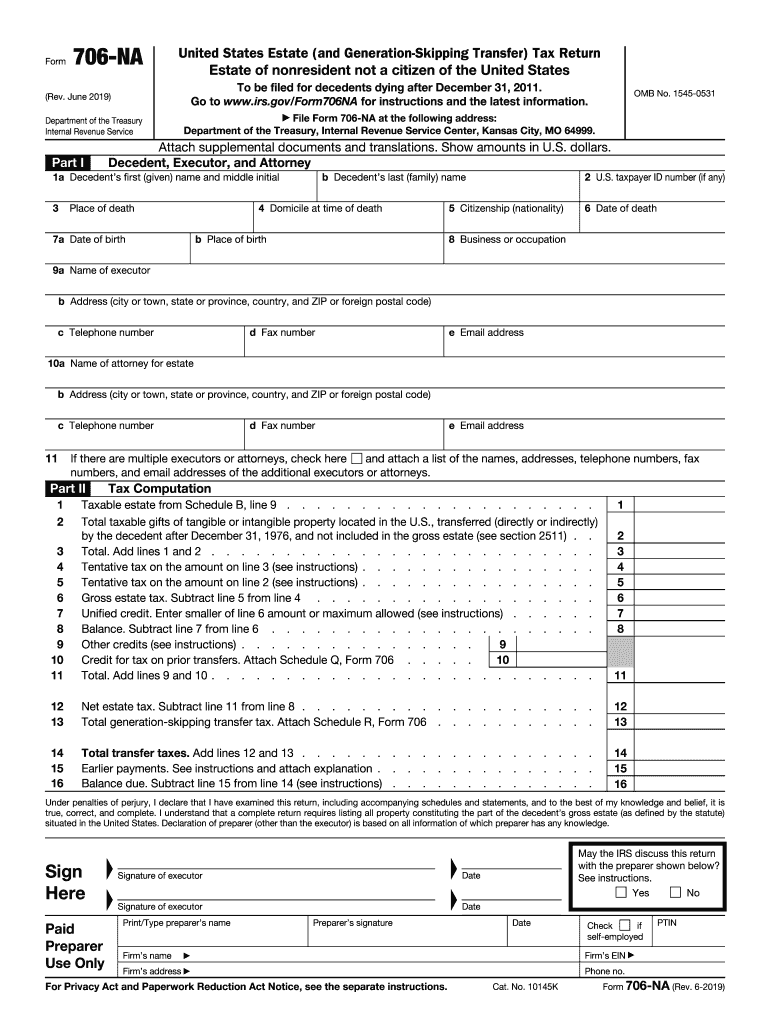







Definition and Meaning of IRS Form 706-NA
IRS Form 706-NA, also known as the United States Estate (and Generation-Skipping Transfer) Tax Return for nonresident decedents who are not U.S. citizens, is a specialized tax form. It is designed for estates of nonresident aliens who own U.S.-situated assets. This form assists in determining the estate tax imposed on the transfer of these assets at death. It covers essential components, such as the gross estate's value and allowable deductions, to calculate the tax liability accurately. The form is specifically required for individuals who died after December 31, 2011.
How to Use IRS Form 706-NA
To properly use IRS Form 706-NA, executors or estate administrators must gather comprehensive information about the decedent's U.S.-based assets. This includes real estate, tangible personal property, and certain financial interests. The form is a detailed record, requiring an accurate valuation of all listed assets as of the decedent's date of death. It further includes specific schedules and worksheets to itemize deductions, exemptions, and tax computations. Due diligence is needed to ensure that all sections are completed thoroughly before submission. An understanding of federal estate tax laws is pivotal when dealing with this form.
Steps to Complete IRS Form 706-NA
- Identify the Decedent: Collect the decedent's personal details, including legal name, address at death, and citizenship status.
- Gather Asset Information: Compile an inventory of all U.S.-situated assets with their fair market values.
- List Deductions and Exemptions: Identify allowable deductions such as funeral expenses and debts associated with U.S. assets.
- Complete the Schedules: Fill out necessary schedules to detail the types of assets and deductions accurately.
- Calculate Estate Tax: Use the provided worksheets to compute the taxable estate value and corresponding tax liability.
- Review and Sign: Double-check all the entered information for completeness and accuracy, then sign the form as the executor.
Important Terms Related to IRS Form 706-NA
Understanding specific terms related to IRS Form 706-NA is crucial for accurate completion:
- Nonresident Alien: A person who is not a U.S. citizen or resident alien but owns U.S.-situated property.
- Gross Estate: The total value of all U.S. assets before any deductions.
- Marital Deduction: An exemption applied to property passed to a surviving spouse.
- Unified Credit: A tax credit that protects a portion of the estate from taxation.
- Generation-Skipping Transfer Tax: An additional tax applied when assets skip a generation, such as being transferred from grandparent to grandchild.
Filing Deadlines and Important Dates
The filing deadline for IRS Form 706-NA is nine months after the decedent's date of death. If more time is needed, an extension request can be filed using Form 4768, but this does not extend the time for payment of the estate tax.
Required Documents for IRS Form 706-NA
When preparing IRS Form 706-NA, gather the following documents:
- Death Certificate: Proof of the decedent's death.
- Appraisals and Valuation Reports: For real estate and significant personal property.
- Financial Statements: Bank and investment account records showcasing balances at the date of death.
- Debts and Liabilities Documentation: Legal documents verifying any claims against the estate.
Legal Use of IRS Form 706-NA
IRS Form 706-NA is used legally to report the transfer of U.S. assets by a deceased nonresident alien, ensuring compliance with U.S. tax obligations. Accurate completion and timely submission help in settling the estate's tax liability, while also preventing potential legal disputes or penalties.
Penalties for Non-Compliance
Failure to file IRS Form 706-NA by the due date or to pay the estate tax can result in substantial penalties. These may include interest on unpaid taxes and additional fees for late filing, impacting the estate's beneficiaries adversely.
Who Typically Uses IRS Form 706-NA
Estate executors, typically appointed in a will or by a court, are responsible for using IRS Form 706-NA. These individuals may include family members or professional fiduciaries tasked with managing the decedent's estate. They must ensure compliance with all relevant guidelines and statutes during the estate management process.
Business Types Impacted
While IRS Form 706-NA is focused on individuals, businesses in which a decedent held interests may also be indirectly affected. For example, ownership stakes in U.S.-based companies or real estate investments need evaluation and reporting, with implications for business continuity and asset distribution among heirs.


