




01. Edit your form online
Type text, add images, blackout confidential details, add comments, highlights and more.

Type text, add images, blackout confidential details, add comments, highlights and more.

Draw your signature, type it, upload its image, or use your mobile device as a signature pad.

Send it via email, link, or fax. You can also download it, export it or print it out.
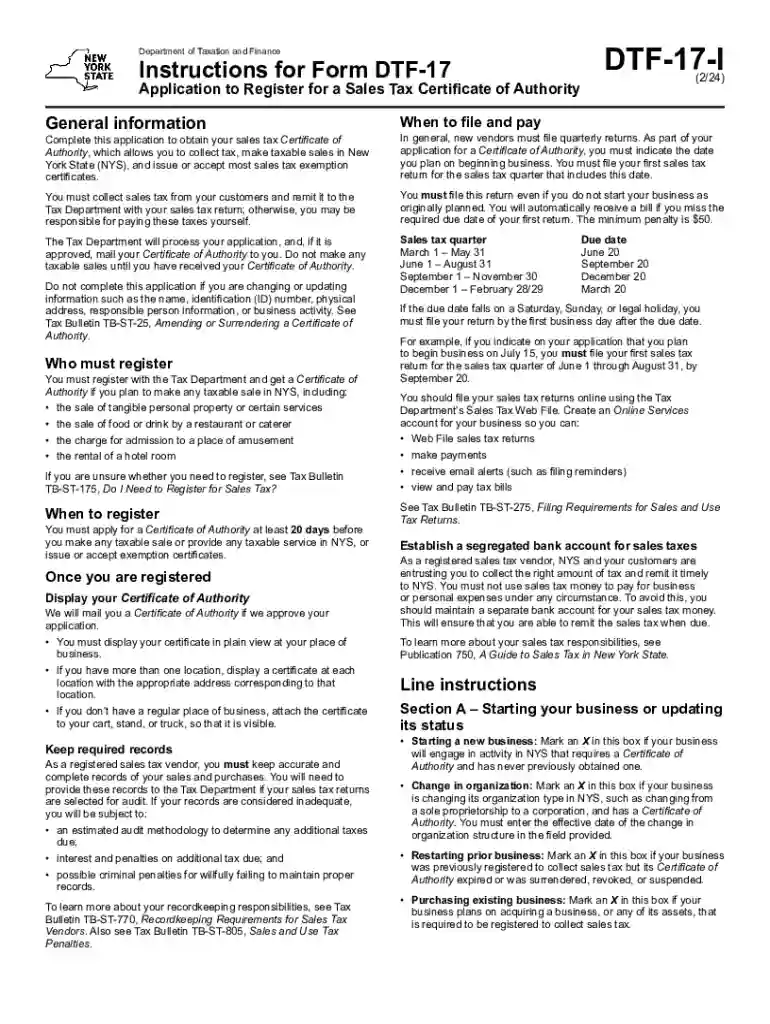
The DTF-17-I form is an essential document for businesses operating within New York State that plan to engage in taxable sales. Officially titled the "Application to Register for a Sales Tax Certificate of Authority," it is a crucial step in complying with state tax requirements. This form must be completed to obtain the Certificate of Authority, which is required before conducting any taxable transactions. The primary purpose of the DTF-17-I is to ensure businesses are registered for sales tax collection, which helps maintain compliance with New York State tax laws.
Gather Required Information: Ensure you have all necessary business details, including your federal Employer Identification Number (EIN), business name, address, and a description of the goods or services offered.
Fill Out Business Information Section: Provide the legal name of your business, d/b/a name if applicable, type of business entity, and detailed business address.
Detail Your Business Activities: Describe the nature of your business, types of products sold, and services offered. This helps determine the appropriate tax obligations.
Accurate Ownership Information: Include the names, addresses, and social security numbers (or EINs) of all owners, partners, or major stakeholders associated with the business.
Submit Additional Required Documents: Depending on your business type, supplemental documents such as business licenses or partnership agreements may be needed.
Review & Submit Form: Ensure all sections are accurately completed before submitting either online or via mail to the New York State Department of Taxation and Finance.
Failing to register for a Sales Tax Certificate of Authority before engaging in taxable sales can result in significant penalties. These may include fines, legal action, and the potential suspension of business activities until registration is completed. The New York State Department of Taxation and Finance enforces these penalties to ensure tax compliance and fair market practices.
New York State has unique requirements and exemptions relating to sales taxes that businesses must adhere to. For instance, certain goods and services might be exempt from sales tax, or specific regions within the state may have additional local sales taxes. Understanding these rules is vital for businesses to remain compliant and avoid unnecessary taxation errors.
Businesses can choose to submit the DTF-17-I online or via a paper form. The digital version offers convenience and faster processing times, as businesses can easily upload supporting documents. The paper version might be preferred by those who lack access to reliable digital services or who are more comfortable with traditional methods of submission. Both methods require the same comprehensive information and documentation.
Accurate and timely submission of the DTF-17-I is essential to prevent compliance issues. The application must be filed before the start of any taxable sales activities. Furthermore, businesses must remain aware of their sales tax filing deadlines, which could be monthly, quarterly, or annually, depending on the business's sales volume. Missing these deadlines can result in late fees and penalties.
Completing the DTF-17-I accurately and providing all necessary documentation ensures a smoother approval process. Generally, the New York State Department of Taxation and Finance processes applications within a few weeks. However, delays can occur if additional information is required or if the form is incomplete. Once approved, the Certificate of Authority is issued, allowing the business to legally conduct taxable sales.
The requirement to file a DTF-17-I extends to various business structures, including corporations, limited liability companies (LLCs), partnerships, and sole proprietorships. Each entity type must comply with the registration process to conduct sales legally within New York State. Understanding the specific obligations and nuances for each business type can help streamline the registration process and prevent potential issues.
Consider a retail corporation opening its first store in New York City. This business would need to file the DTF-17-I to register for a Sales Tax Certificate of Authority, allowing it to legally collect sales tax on the goods sold. Similarly, an online service provider offering taxable digital content to New York residents would also need to complete this form to comply with state tax laws. Through these practical examples, the importance of this form becomes evident, highlighting its role in maintaining tax compliance across diverse business operations.
We've got more versions of the DTF-17-I form. Select the right DTF-17-I version from the list and start editing it straight away!
At DocHub, your data security is our priority. We follow HIPAA, SOC2, GDPR, and other standards, so you can work on your documents with confidence.


Nov 7, 1988 This document has been approved for public release and sale; its distribution is unlimited. Destroy this report when it is no longer needed.Read more
Jul 25, 2025 Form DTF-17.1, Business Contact and Responsible Person Questionnaire instructions for the application for a sales tax Certificate of Authority


