




01. Edit your form online
Type text, add images, blackout confidential details, add comments, highlights and more.

Type text, add images, blackout confidential details, add comments, highlights and more.

Draw your signature, type it, upload its image, or use your mobile device as a signature pad.

Send it via email, link, or fax. You can also download it, export it or print it out.
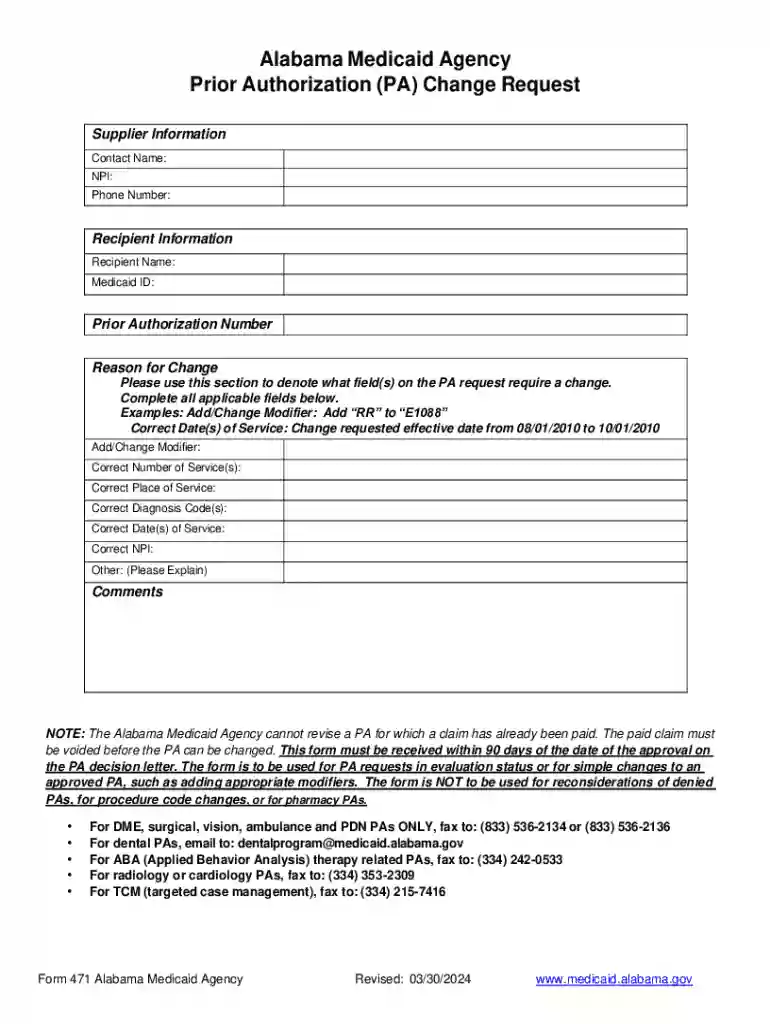
The Prior Authorization (PA) Change Request form is a critical document utilized primarily by healthcare suppliers to request modifications to existing prior authorizations. This form is essential when changes become necessary post-approval, such as altering service details, updating beneficiary information, or correcting specific entries. Such authorizations are often required by insurance providers or Medicaid agencies to ensure that the requested changes adhere to policy guidelines and are processed within stipulated timelines. Understanding the exact purpose of this form ensures that healthcare providers can efficiently manage the administrative aspects of patient care.
Completing the Prior Authorization Change Request involves several precise steps to ensure accuracy and compliance:
Gather Necessary Information: Before filling out the form, collect all relevant information, including current authorization details, the patient's identification number, and specifics about the requested changes.
Fill Out Supplier Information: Include the supplier's name, contact details, and any relevant identification numbers. Ensure that this section is complete and accurate to avoid processing delays.
Provide Recipient Details: Accurately provide the patient's information, including their full name, date of birth, and any patient-specific identification numbers crucial for identification.
Detail Requested Changes: Clearly describe the changes needed, such as adjustments in service dates, changes in service types, or modifications to treatment plans. Specify why these changes are necessary.
Review and Sign: Double-check the form for errors or omissions and sign as required. The signature signifies that all information is truthful and complete.
Submit the Form: Depending on the healthcare provider's protocols or the requirements of the overseeing agency, submit the form via mail, fax, or online through designated portals. Always retain a copy for your records.
The Prior Authorization Change Request contains several critical elements that ensure the necessary information is communicated effectively. These include:
Supplier and Recipient Information: Essential for linking the request to the correct parties, ensuring services match with appropriate providers and patients.
Explanation of Changes: This section is crucial for outlining what alterations need to be made to existing authorizations. It includes space for describing the nature and reason for the requested changes.
Instructional Guidelines: Detailed guidelines are often included to help complete and submit the form correctly, reducing the likelihood of rejection or need for resubmission.
Signature Field: A mandatory field for both the supplier and recipient or their representatives, indicating that all parties are aware and in agreement with the requested changes.
Different submission methods are available, depending on agency preferences and infrastructure capabilities:
Online Submission: Many agencies offer portals for direct submission, which speeds up processing times and provides immediate confirmation of receipt.
Mail Submission: For agencies that require physical copies, mailing the form is a reliable option. Ensure the form is sent via a trackable method to verify delivery.
Fax/email: Some agencies might accept fax or secure email, providing a middle ground between digital ease and traditional paper processing. Always confirm available methods directly with the agency.
Eligibility to use the Prior Authorization Change Request form generally involves specific conditions regarding the nature of the existing authorization:
Existing Authorization: Only those with a currently valid prior authorization are eligible to use this form for submitting change requests.
Timeliness: Changes must be submitted within set timeframes, typically no later than 90 days following the original authorization's approval.
Authorized Signatory: The individual completing the form should be either the healthcare provider or a designated representative with the authority to request changes.


Understanding real-world scenarios aids in conceptualizing the application of this form:
Service Date Modification: A supplier originally authorized for a service on a specific date needs to adjust the service to a new date due to unforeseen circumstances.
Beneficiary Information Update: A change in the recipient's insurance or personal information that necessitates an update to the existing authorization details to avoid denial of services.
Service Type Adjustment: Originally approved treatments or services require adjustments to accommodate changes in the patient's health condition or treatment plan.
While the Prior Authorization Change Request form is standardized in many respects, variations can exist based on state-specific regulations:
Submission Timeframes: Some states might have more stringent deadlines for submitting changes compared to others.
Form Variations: States may use slightly different versions of the form to cater to regional administrative needs or legislative requirements.
Specific Authorization Requirements: Ensure compliance with state-specific healthcare reimbursement policies, which might dictate different approval processes or additional documentation.
A firm grasp of specific terminology is crucial for effectively navigating and completing the form:
Authorization Number: A unique identifier for the original authorized service that must always be included when requesting changes.
Beneficiary: The individual receiving healthcare benefits under the authorization.
Supplier: The healthcare provider or entity authorized to deliver services or products to the beneficiary.
These foundational terms ensure clarity and precision when handling the form, contributing to accurate processing and approval of change requests.
We've got more versions of the Prior Authorization (PA) Change Request form. Select the right Prior Authorization (PA) Change Request version from the list and start editing it straight away!
At DocHub, your data security is our priority. We follow HIPAA, SOC2, GDPR, and other standards, so you can work on your documents with confidence.

Prior Authorization (approval in advance) is required for many procedures, services or supplies, including transportation. Form 471 Prior Authorization Change
by M Delatore 2023 Prior authorizations (PA) are frequently initiated days after the prescription is written, delaying prescription pick-up by at least 12 days


