




01. Edit your nys 100 form online
Type text, add images, blackout confidential details, add comments, highlights and more.

Type text, add images, blackout confidential details, add comments, highlights and more.

Draw your signature, type it, upload its image, or use your mobile device as a signature pad.

Send it via email, link, or fax. You can also download it, export it or print it out.
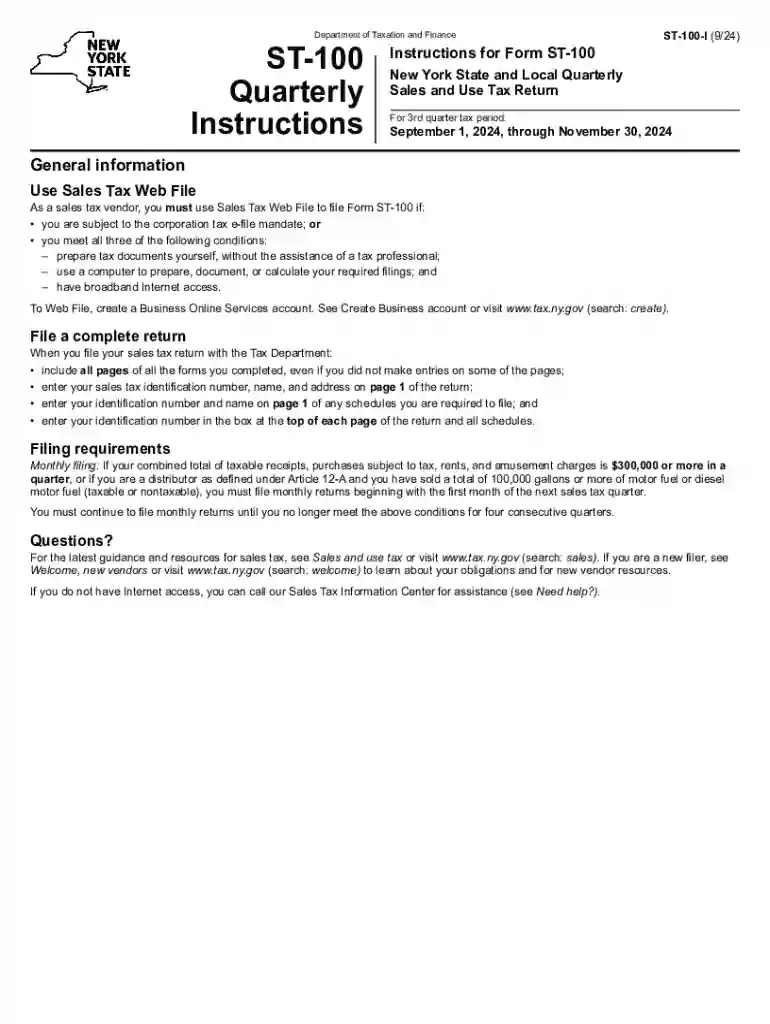
The New York State and Local Quarterly Sales and Use Tax Return, commonly referred to as Form ST-100, is a document businesses use to report their sales and the corresponding tax due to the government. This form is specifically for businesses engaged in retail sales within New York State. It captures taxable sales and purchases for the tax period and aligns with the state's regulatory requirements for sales tax collection. Understanding this form is crucial for businesses to comply with state tax obligations and avoid potential penalties.
Using the instructions for completing Form ST-100 involves a few straightforward steps. First, you should review your business's sales records for the reporting period. This includes itemized sales, exempt sales, and any sales tax collected. Follow the step-by-step guide provided, which details sections like filling in gross sales from New York State and entering any adjustments or credits. Utilize the given worksheets to calculate the exact tax amount due, ensuring compliance with the state's tax regulations.
Instructions for Form ST-100 can be acquired through several channels. These include downloading it from the official New York State Department of Taxation and Finance website or acquiring a physical copy through a regional tax office. For those who prefer digital methods, the form and its instructions can also be accessed through certified online tax preparation software. These platforms often offer additional tools to guide taxpayers through the process.
Following the provided instructions for Form ST-100 is vital to ensuring accurate tax reporting. Proper completion helps businesses avoid discrepancies that can lead to audits or penalties. Moreover, aligned reporting with state requirements ensures businesses remain compliant, enhancing their financial reputation. Failing to adhere to the instructions could result in fines or future legal challenges.
The primary users of Form ST-100 instructions are businesses operating in New York State that engage in taxable retail sales. This includes sole proprietorships, partnerships, corporations, and LLCs that have nexus in the state. Tax professionals and accountants also regularly use these instructions to assist their clients in completing and submitting the form accurately and efficiently.


New York State has specific regulations governing retail sales tax, and understanding these is crucial when completing Form ST-100. The instructions provide detailed guidance on current tax rates, exempt sales categories, and special requirements for different jurisdictions within the state. Businesses should review these thoroughly to ensure they apply the correct rates and exemptions.
Consider a retail store in New York City that sells both taxable and tax-exempt products. By carefully following the instructions, the store owner can differentiate and report exempt sales, like sales to qualified organizations or direct shipments out of state. The instructions guide the user through calculating the correct tax liability based on their specific sales scenario, applying credits accurately, and ensuring compliance.
We've got more versions of the nys 100 form form. Select the right nys 100 form version from the list and start editing it straight away!
At DocHub, your data security is our priority. We follow HIPAA, SOC2, GDPR, and other standards, so you can work on your documents with confidence.

Oct 1, 2010 the taxpayer must pay any sales or use tax owed by filing Form ST-140, Individual Purchasers Report of Sales and Use Tax,
Jul 29, 2026 Complete and submit Form ST-100-ATT, Quarterly Schedule CW, with this return. Complete Form AU-11, Application for Credit or Refund of Sales orRead more


