01. Edit your form st 100 nys sales tax online
Type text, add images, blackout confidential details, add comments, highlights and more.

Type text, add images, blackout confidential details, add comments, highlights and more.

Draw your signature, type it, upload its image, or use your mobile device as a signature pad.

Send new york state sales tax via email, link, or fax. You can also download it, export it or print it out.
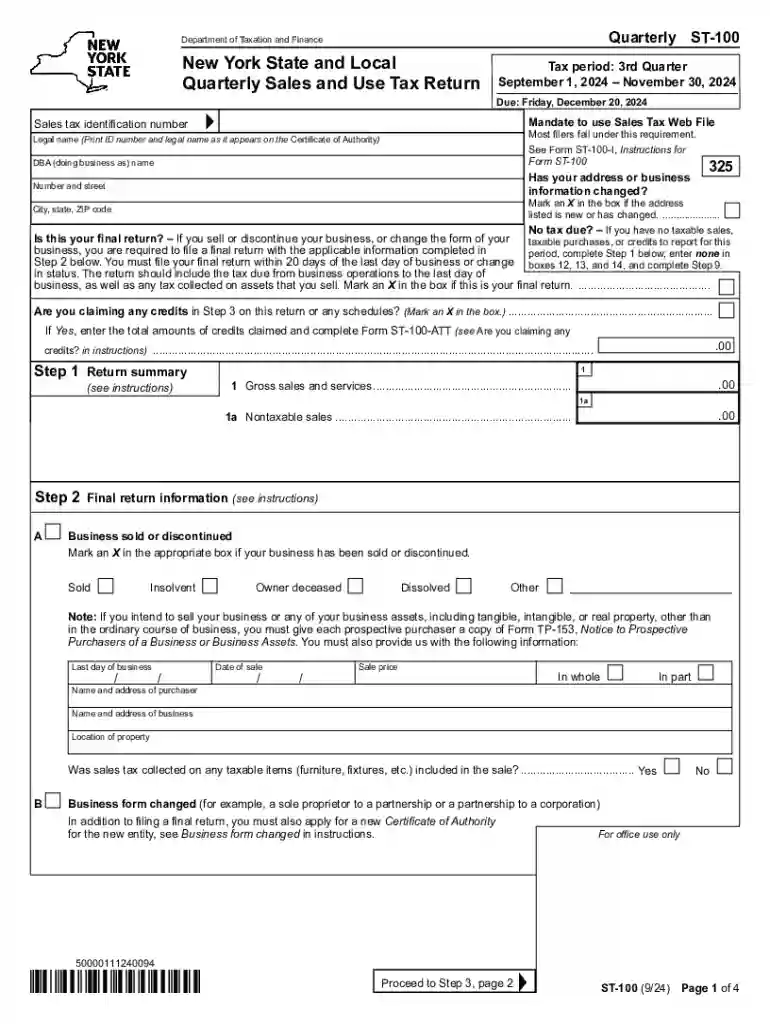
The Form ST-100, officially known as the "New York State and Local Quarterly Sales and Use Tax Return," is a critical document for businesses operating within New York state, requiring them to report their sales tax collections. This form has been revised as of September 24, 2024, to accommodate regulatory updates and ensure better accuracy in tax filings. It serves as a mechanism to reconcile the taxes collected from customers with those owed to the state, ensuring compliance and contributing to the state’s fiscal stability.
Businesses can acquire the Form ST-100 directly from the New York State Department of Taxation and Finance's official website. Downloads are available in digital format to enhance ease of access and prompt availability. Alternatively, physical copies can be requested through mail, especially useful for entities that prefer traditional filing methods. It is advisable for users to verify they have the most recent version, given periodic updates, to comply with the latest tax legislation.
Identify Business Information:
Report Sales Tax Collection:
Apply Deductions and Credits:
Calculate Total Tax Due:
Submit and Retain Copies:
The deadlines for submitting the Form ST-100 generally fall shortly after the quarter ends, with the due date for the third quarter of 2024 being December 20. These dates are statutory and non-negotiable, and late submissions may result in penalties. Businesses should mark their calendars and, if necessary, employ reminder systems to stay compliant.
Completing the Form ST-100 mandates accompanying documentation that provides proof of sales and tax collection. This typically includes:
Failure to file the Form ST-100 or inaccuracies in the reported data can result in significant penalties, including monetary fines and interest on unpaid taxes. Non-compliance may also warrant audits, adding administrative burdens. Continuous non-compliance could jeopardize the business’s tax standing and warrant stricter actions, emphasizing the importance of meticulous record-keeping and prompt filings.
For those opting to file electronically, the Form ST-100 supports compatibility with common financial software platforms like TurboTax and QuickBooks. This functionality streamlines the filing process by importing data directly into the required fields, minimizing manual entry errors and saving time for businesses engaged in high-volume sales.


In summation, the "New York State and Local Quarterly Sales and Use Tax Return" is essential for businesses operating in New York that engage in taxable activities. The structured guidance in completing this tax return ensures businesses meet state requirements, thereby facilitating adherence to legislative mandates and supporting the state’s revenue collection process.
We've got more versions of the form st 100 nys sales tax form. Select the right form st 100 nys sales tax version from the list and start editing it straight away!
| Versions | Form popularity | Fillable & printable |
|---|---|---|
| 2025 | 4.7 Satisfied (44 Votes) | |
| 2024 | 4.8 Satisfied (48 Votes) | |
| 2023 | 4.8 Satisfied (42 Votes) | |
| 2022 | 4.1 Satisfied (57 Votes) | |
| 2021 | 4.8 Satisfied (45 Votes) | |
| 2020 | 4.2 Satisfied (125 Votes) | |
| 2019 | 4.3 Satisfied (179 Votes) | |
| 2018 | 4.3 Satisfied (109 Votes) | |
| 2017 | 4.2 Satisfied (49 Votes) | |
| 2017 | 3.9 Satisfied (28 Votes) | |
| 2016 | 4.4 Satisfied (431 Votes) | |
| 2015 | 3.9 Satisfied (49 Votes) | |
| 2014 | 4 Satisfied (32 Votes) | |
| 2013 | 4 Satisfied (21 Votes) | |
| 2012 | 4 Satisfied (28 Votes) |
At DocHub, your data security is our priority. We follow HIPAA, SOC2, GDPR, and other standards, so you can work on your documents with confidence.