





Texas standardized credentialing application 2026

Get Form
tsca application Preview on Page 1

Here's how it works

01. Edit your tsca application online
Type text, add images, blackout confidential details, add comments, highlights and more.
02. Sign it in a few clicks
Draw your signature, type it, upload its image, or use your mobile device as a signature pad.
03. Share your form with others
Send texas standardized credentialing application via email, link, or fax. You can also download it, export it or print it out.

Definition and Purpose of the Texas Standardized Credentialing Application

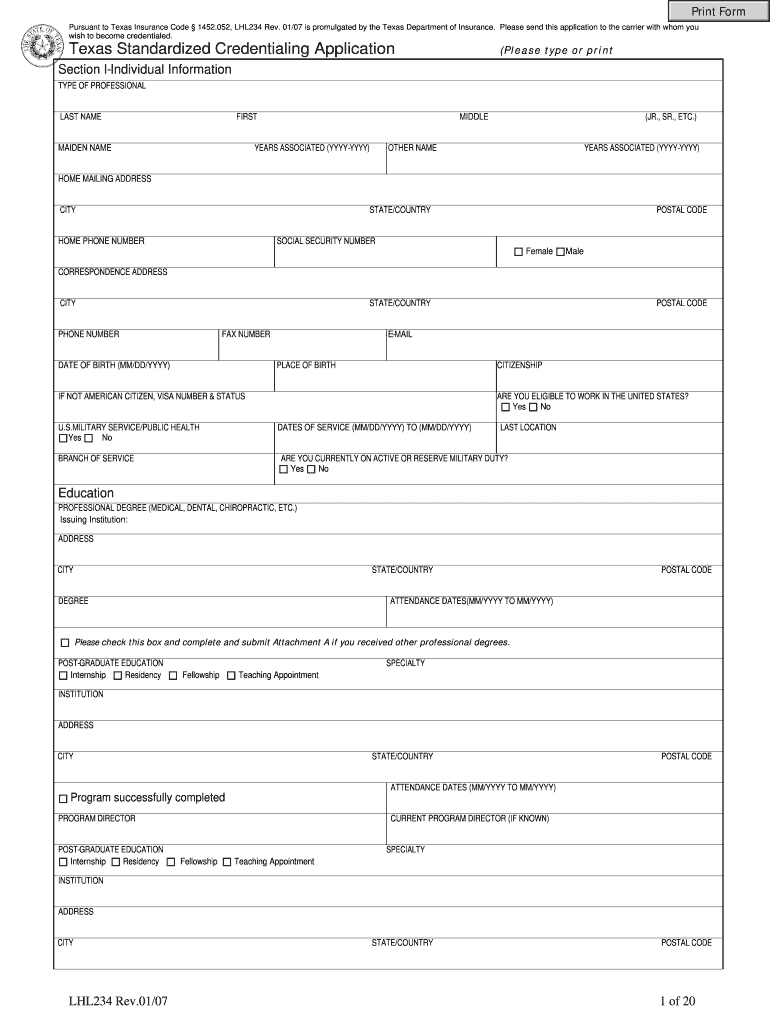
The Texas Standardized Credentialing Application is a mandated form used by the Texas Department of Insurance. It is essential for healthcare professionals seeking credentialing with insurance carriers across the state. The primary goal of this form is to collect comprehensive data to evaluate an applicant's qualifications and eligibility for participation in healthcare networks.

Key Elements of the Texas Standardized Credentialing Application

The application is divided into multiple sections covering crucial aspects of a healthcare professional’s background:

  • Personal Information: Full name, date of birth, and contact details.
  • Education: Details of medical education and training institutions attended.
  • Licenses: State licenses held by the healthcare provider.
  • Work History: Previous and current employment in the healthcare field.
  • Hospital Affiliations: Information on hospital privileges and affiliations.
  • References: Professional references who can vouch for the applicant's expertise and character.
  • Professional Liability Insurance: Coverage details to ensure accountability.
  • Practice Location: Office addresses and contact numbers for practice locations.

How to Use the Texas Standardized Credentialing Application

Using the application involves several steps, ensuring that each section is accurately completed. Here’s a step-by-step guide:

  1. Gather Necessary Information: Before starting the form, collect all required background details, such as license numbers, education certificates, and references.
  2. Download or Obtain the Form: Access the form from the Texas Department of Insurance website or other authorized sources.
  3. Complete Each Section: Enter information clearly and consistently, ensuring no sections are skipped.
  4. Review for Accuracy: Double-check all entries for correctness and completeness.
  5. Submit the Form: Follow the guidelines for submission, whether online, via mail, or in-person.

Steps to Complete the Texas Standardized Credentialing Application

Completing the application involves thorough documentation:

  • Compile Documentation: Assemble all supporting documents, such as transcripts, license verification, and proof of insurance.
  • Fill Out Personal Information: Ensure that all personal details are current.
  • Detail Education and Training: Document educational history with accuracy.
  • List Work and Practice History: Provide a complete employment history and practice locations.
  • Include References and Insurance: Specify references and liability coverage comprehensively.
  • Final Review: Conduct a final check for every section to prevent delays in processing.

Who Typically Uses the Texas Standardized Credentialing Application

The form is primarily used by a variety of healthcare providers:

  • Physicians who need to establish credentials with insurance companies.
  • Allied Health Professionals including nurses, physician assistants, and therapists.
  • Healthcare Administrators responsible for managing provider credentials within insurance networks.

decoration image ratings of Dochub

Legal Use and Compliance of the Texas Standardized Credentialing Application

The application is a legal document, and it ensures compliance with state regulations to maintain high standards within the healthcare system:

  • Verification of Credentials: Ensures all healthcare professionals meet the state-mandated qualifications.
  • Legal Disclosure: Confirms full compliance with legal obligations regarding licensure and any malpractice history.
  • State Regulation: Adherence to Texas laws governing healthcare credentialing.

Required Documents for the Texas Standardized Credentialing Application

Applicants need several key documents:

  • Copies of educational degrees and transcripts
  • Current state licenses and verifications
  • Professional liability insurance certificate
  • Letters of reference
  • Documentation of hospital privileges

Submission Methods for the Texas Standardized Credentialing Application

Different methods can be used to submit the application:

  • Online: Many find electronic submission most convenient and efficient.
  • Mail: Send completed forms to designated mailing addresses provided by the Texas Department of Insurance.
  • In-Person: Deliver directly to authorized offices for immediate processing.

By understanding and following these components and steps, healthcare professionals can ensure a smooth credentialing process with insurance carriers in Texas.

See more texas standardized credentialing application versions

We've got more versions of the texas standardized credentialing application form. Select the right texas standardized credentialing application version from the list and start editing it straight away!
Versions Form popularity Fillable & printable
2007 4.9 Satisfied (44 Votes)
be ready to get more

Complete this form in 5 minutes or less

Get form

Got questions?

We have answers to the most popular questions from our customers. If you can't find an answer to your question, please contact us.
Contact us

With DocHub, it’s quite simple. The service offers users an add-on called DocHub for Gmail, which you can locate in the Google Workspace Marketplace free of charge. Set it up and grant it access to your Google account. Open your email with your texas credentialing application pdf attached and click on the add-on button in the right-side panel. Log in to your DocHub account, and upload the file to our editor, where you can fill it out and sign.

You can easily edit and complete your texas standardized on any iOS gadget. Open an internet browser of your liking, visit the DocHub site, authorize or create a new account, add your file for editing, and make your desired alterations. Our service is mobile-friendly, so using its features on your smartphone will be a no-brainer, even on the first try.

Getting credentialed with Blue Cross Blue Shield (BCBS) typically takes 60 to 120 days, with many states averaging around 90 days, but it can be faster or slower depending on your provider type, location, completeness of your application, and the responsiveness of licensing boards. Delays often occur due to incomplete CAQH profiles, missing documents, or slow license verification, so ensuring everything is accurate and updated beforehand DocHubly speeds up the process. Typical Timeline Breakdown (Average): Application Review: 2-4 weeks for initial completeness check. Verification: 4-8 weeks for licenses, education, and background checks. Credentialing Committee Decision: 2-4 weeks. Contracting: An additional 1-2 weeks after approval. Factors Influencing the Timeline: Application Quality: Incomplete, inaccurate, or duplicate applications cause major delays. Provider Type: Physicians, mental health providers, and allied health professionals have different processing times. State Specialty: Different state BCBS plans and specific medical specialties can have unique requirements. CAQH Profile: Keeping your CAQH profile current and authorized for BCBS is crucial. To Speed Up the Process: Be Thorough: Fill out all forms completely and accurately. Update CAQH: Ensure your CAQH ProView is up-to-date and authorized for your specific BCBS plan. Gather Documents: Have all licenses, certifications, and other required documents ready. Respond Quickly: Respond promptly to any requests for additional information from BCBS. For financial advice, consult a professional. Credentialing Process for Office Based Physicians or Professional Upon receipt of a complete CAQH Provider Data Portal application with global or plan specific authorization to BCBSTX or a comBlue Cross and Blue Shield of TexasProvider Credentialing FAQs | BlueChoice HealthPlan of South CarolinaThe credentialing process for BlueCross BlueShield has a 90-day review period. The process may be prolonged if the application is BlueChoice HealthPlan of South Carolina
The general timeframe for healthcare providers to complete credentialing is between 90 to 120 days. However, this is an average estimate. Some payors may complete the process quicker, while others might take longer, especially for certain specialties.
Forms to apply for benefits Form to apply for Medicaid for the Elderly and People with Disabilities or Medicare Savings Program (H1200) Send by mail Download Form to apply for Medicaid for People with Disabilities who Work -- Medicaid Buy-In (H1200-MBI) Send by mail Download

Security and compliance

At DocHub, your data security is our priority. We follow HIPAA, SOC2, GDPR, and other standards, so you can work on your documents with confidence.

Learn more
ccpa2
pci-dss
gdpr-compliance
hipaa
soc-compliance

People also ask

The fastest medical licenses are often obtained through the Interstate Medical Licensure Compact (IMLC) or state-specific expedited pathways, with Colorado, Michigan, Florida, Ohio, and Indiana cited for quick processing (weeks to a couple of months) by leveraging existing credentials and streamlining verification, especially for already licensed physicians via the IMLC or endorsements. Using services like FCVS and being organized helps, but no state offers instant licensure; the timeline depends heavily on application completeness and board review. States Known for Faster Licensure Colorado: Offers an Expedited Application for a license within 30 days, says MedLicense.com. Michigan: Can process licenses for experienced physicians in about 3-6 weeks by verifying only state certifications, notes CompHealth and medtigo. Florida: Can complete processing in 4-6 weeks for well-prepared applicants, according to medtigo. Ohio: Can issue licenses in about 30 days through the IMLC, according to MedLicense.com. Indiana: Provides temporary permits in as little as two weeks with complete documentation, notes medicallicensing.com. How to Speed Up Your Application Join the IMLC: If youre licensed in a participating state, the IMLC provides a faster route to licensure in other member states (42 states and D.C. currently). Use FCVS: The Federation of State Medical Boards (FSMB) helps streamline credential verification. Apply via Endorsement: If you hold a current license, some states accept it as proof of meeting requirements (e.g., Maryland). Be Prepared: Have all documents (transcripts, exam scores, training verification) accurate, complete, and readily available. Key Factors Influencing Speed Application Accuracy: Errors DocHubly delay the process. Board Efficiency: States like Colorado prioritize speed through expedited pathways. Document Verification: Minimizing manual checks by using services like FCVS helps. AI can make mistakes, so double-check responsesFastest State Medical Licenses | MedLicense.com#1 - Colorado Medical Board. The Colorado Medical Board is able to issue a Physician Medical License within 30 days of filing an EMedLicense.comPhysician Licensure - Interstate Medical Licensure CompactA Faster Pathway to Physician Licensure. Introduction. Who developed the Compact? How does the Compact work? How does the Compact Interstate Medical Licensure Compact
Thorough Verification Requirements The exhaustive nature of the verification process is one of the main reasons why does credentialing take so long. Each aspect needs to be thoroughly validated and checked for a providers qualifications.Nov 11, 2024
Estimated Credentialing Timeline: 3 months for AL, AZ, MA, MI, TX Providers. 4 months for IL TN Providers. ~5 months for NC Providers.
180 days
The Texas Standardized Credentialing Application fulfills requirements of Senate Bill 544, Section 3 (77th Texas Leg, effective Sept. 1, 2001) and Texas Insurance Code Chapter 1452 providing for the Texas Insurance Commissioner to adopt a standardized form for verification of physician credentials.Apr 30, 2025

tx credentialing


