





Graphing quadratic functions in standard form worksheet answer key 2026

Get Form
quadratic graph questions and answers pdf Preview on Page 1

Here's how it works

01. Edit your quadratic graph questions and answers pdf online
Type text, add images, blackout confidential details, add comments, highlights and more.
02. Sign it in a few clicks
Draw your signature, type it, upload its image, or use your mobile device as a signature pad.
03. Share your form with others
Send graphing quadratic functions in standard form worksheet via email, link, or fax. You can also download it, export it or print it out.

Understanding Graphing Quadratic Functions in Standard Form Worksheet Answer Key

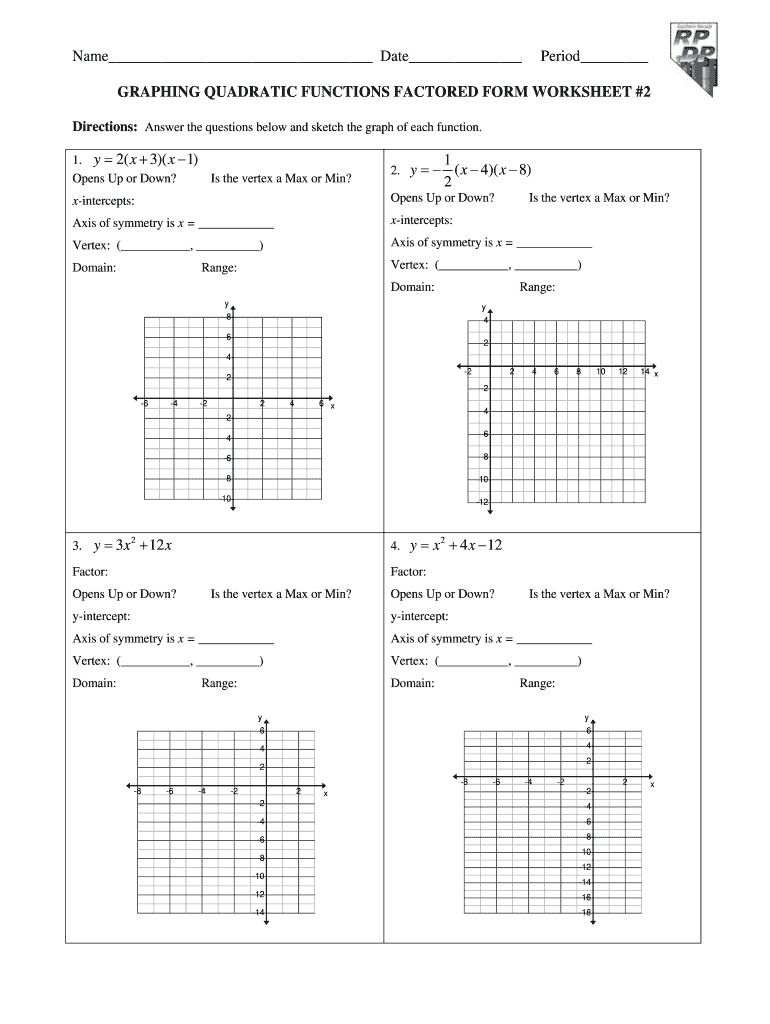
Graphing quadratic functions in standard form involves analyzing equations expressed as ( y = ax^2 + bx + c ), where ( a ), ( b ), and ( c ) are constants. These functions are crucial in various fields, including mathematics, engineering, and physics. The worksheet typically provides an array of quadratic equations for students to work through, emphasizing characteristics of parabolas, such as direction, vertex, x-intercepts, and more.

How to Use the Graphing Quadratic Functions Worksheet Answer Key

Using the answer key effectively requires familiarity with quadratic equations and the properties of the parabola. Here are the steps to consider:

  1. Analyze the Equation: Identify and understand the coefficients ( a ), ( b ), and ( c ) in the standard form of the quadratic equation.
  2. Determine Key Features: Using the answer key, students can check their work against the expected characteristics, such as:
    • The vertex, calculated as ( (-\frac{b}{2a}, f(-\frac{b}{2a})) )
    • The opening direction (upward for ( a > 0 ), downward for ( a < 0 ))
    • The axis of symmetry, which is ( x = -\frac{b}{2a} )
    • The x-intercepts and y-intercept.
  3. Check Answers: Compare individual solutions from the worksheet against the answer key to identify errors and confirm correct graphing techniques.

Steps to Complete the Graphing Quadratic Functions Worksheet

Completing a worksheet on graphing quadratic functions typically involves the following steps:

  1. Identify Standard Form Equations: Start with the equations provided, ensuring they are in the form ( y = ax^2 + bx + c ).
  2. Calculate Key Values: Find the vertex, x-intercepts (if any), and y-intercept.
  3. Sketch the Graph: Plot the vertex and intercepts on graph paper, then draw the parabola while noticing its direction based on the leading coefficient (( a )).
  4. Use the Answer Key: Verify each feature of the graph against the provided key to ensure accuracy.

Importance of Graphing Quadratic Functions Worksheets

Graphing quadratic functions is fundamental in making sense of quadratic relationships that appear in numerous practical scenarios, such as projectile motion and economic models. Worksheets enhance students' problem-solving skills by enabling them to practice and reinforce their understanding of key concepts.

Who Uses the Graphing Quadratic Functions Worksheet Answer Key

This worksheet and answer key are commonly utilized by:

  • Students: High school and college students learning algebra and calculus.
  • Teachers: Educators incorporating practical exercises into math curricula.
  • Tutors: Individuals providing extra help to students struggling with quadratic functions.
  • Parents: Parents assisting their children with homework to reinforce learning at home.

Key Terms Related to Graphing Quadratic Functions

Familiarity with specific terminology can enhance understanding of quadratic equations:

  • Vertex: The peak or lowest point of the parabola.
  • Axis of Symmetry: A vertical line that divides the parabola into two mirror-image halves.
  • Intercepts: Points where the graph crosses the x-axis (x-intercepts) and y-axis (y-intercept).

Examples of Using the Graphing Quadratic Functions Worksheet

Example problems may include:

  1. Given the equation ( y = 2x^2 + 4x - 6 ):

    • Calculate the vertex, which is at ( (-1, -8) ).
    • Find intercepts: x-intercepts can be calculated via the quadratic formula, while the y-intercept is at ( (0, -6) ).
  2. For the equation ( y = -x^2 + 3x + 5 ):

    • Identify that it opens downward since ( a < 0 ), find the vertex ( (1.5, 8.25) ), and calculate intercepts.

The answers provided in the key can confirm the accuracy of calculations and graph sketches, thereby enhancing learning outcomes.

See more graphing quadratic functions in standard form worksheet answer key versions

We've got more versions of the graphing quadratic functions in standard form worksheet answer key form. Select the right graphing quadratic functions in standard form worksheet answer key version from the list and start editing it straight away!
Versions Form popularity Fillable & printable
2016 4.7 Satisfied (33 Votes)
be ready to get more

Complete this form in 5 minutes or less

Get form

Got questions?

We have answers to the most popular questions from our customers. If you can't find an answer to your question, please contact us.
Contact us

With DocHub, you can quickly approve your graphing quadratic functions in standard form worksheet with answers or any other document on iOS, even without setting up extra applications. You can access your DocHub account from any web-connected browser and fill out and sign your document in any preferred method with just a couple of clicks.

In case your go-to email service is Gmail, it is simple to integrate your DocHub editor in your work. Edit your graphing quadratic functions worksheet with answer key with DocHub tools and connect it to your drafts in Gmail. See how straightforward it can be to exchange files and collaborate with a swift PDF editing solution at hand.

Quadratic Function Examples The quadratic function equation is f(x) = ax2 + bx + c, where a \u2260 0. Let us see a few examples of quadratic functions: f(x) = 2x2 + 4x - 5; Here a = 2, b = 4, c = -5. f(x) = 3x2 - 9; Here a = 3, b = 0, c = -9.
1:35 47:00 Graphing Quadratic Functions in Vertex & Standard Form - YouTube YouTube Start of suggested clip End of suggested clip The standard form looks like this ax squared plus bx plus c that's the standard form of a quadraticMoreThe standard form looks like this ax squared plus bx plus c that's the standard form of a quadratic equation. So let's say if we have a function that looks like this y is equal to x minus 1 squared.
The graph of a quadratic function is a curve called a parabola.
be ready to get more

Complete this form in 5 minutes or less

Get form

People also ask

0:41 6:07 Graphing a quadratic function in standard form - YouTube YouTube Start of suggested clip End of suggested clip So again when using now an equation in the form of y equals ax squared plus bx plus c the mainMoreSo again when using now an equation in the form of y equals ax squared plus bx plus c the main important thing is finding that axis of symmetry. So to find the axis of symmetry.
9:59 11:16 How to derive the quadratic formula from standard form. - YouTube YouTube Start of suggested clip End of suggested clip And there we have it the quadratic formula by symmetrically flip that it's simply X is equal toMoreAnd there we have it the quadratic formula by symmetrically flip that it's simply X is equal to negative b plus or minus the square root of b squared minus 4ac.
There is an easy way to tell whether the graph of a quadratic function opens upward or downward: if the leading coefficient is greater than zero, the parabola opens upward, and if the leading coefficient is less than zero, the parabola opens downward.
Quadratic graphs are graphs of quadratic functions \u2013 that is, any function which has x 2 x^2 x2 as its highest power. We can plot the graph of a quadratic function by drawing a table of values for the x and y coordinates, and then plotting these on a set of axes.
The graph of a quadratic function is called a parabola.

quadratic functions worksheet with answers pdf

