
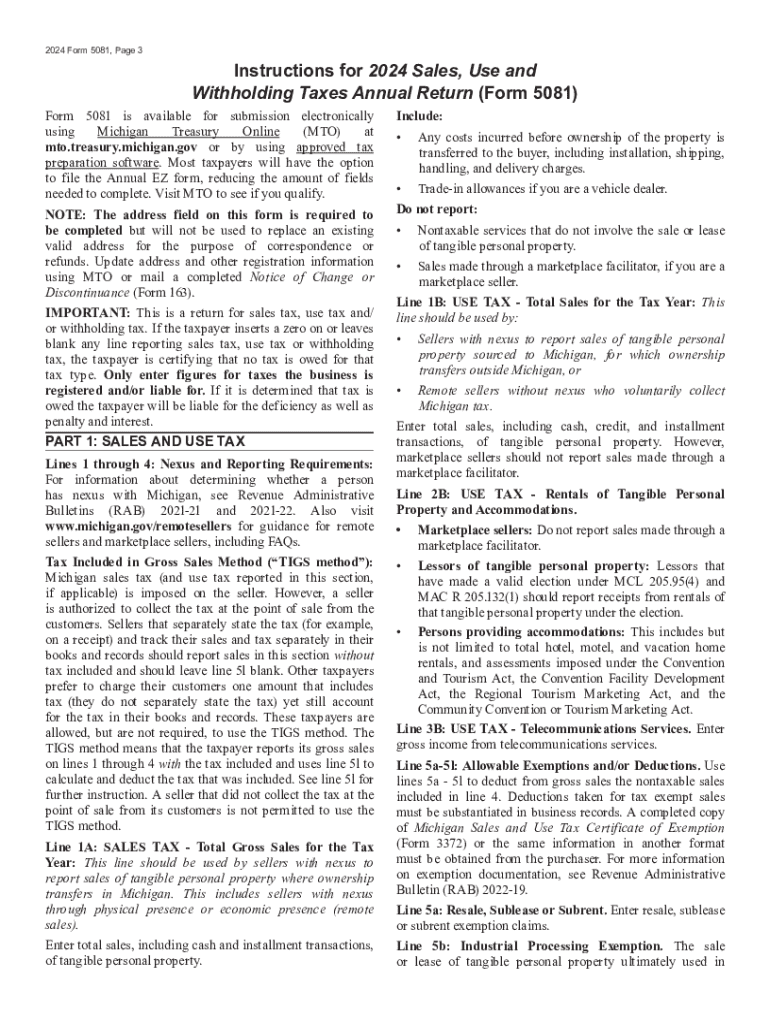







Definition & Meaning
The Mi Tax 5-2024 Form, also known as the Michigan Sales, Use, and Withholding Taxes Annual Return, is a critical document for businesses operating in Michigan. It captures detailed annual financial data related to sales, use, and withholding taxes. This form allows businesses to reconcile their annual tax liabilities and ensures compliance with state tax regulations. Proper understanding and accurate completion of this form are essential for avoiding future audits and penalties.
How to Use the Mi Tax 5-2024 Form
Using the Mi Tax 5081 Form involves a series of steps designed to capture and report relevant tax information accurately. Businesses need to:
- Gather accurate sales and use data, including any taxable and non-taxable transactions.
- Record withholding tax information comprehensively.
- Include any allowable deductions and exemptions to reduce the tax liability where applicable.
- Ensure all calculations align with Michigan tax laws to determine the correct amount owed or due for refund.
Steps to Complete the Mi Tax 5-2024 Form
Completing the form requires meticulous attention to detail:
- Gather Required Financial Data: Collect all relevant financial records, including sales receipts, exempt transaction proofs, and payroll records.
- Accurate Reporting of Sales and Use Tax: Enter total sales, taxable sales, and tax collected.
- Withholding Tax Calculations: Report total wages paid and tax withheld for employees.
- Determine Tax Dues or Refunds: Calculate total taxes due after considering any prepayments, credits, or exemptions.
- Ensure Accuracy: Double-check figures to prevent errors that could lead to fines or penalties.
- Submit Form: File electronically via Michigan's online portal for efficiency, or mail a paper copy if preferred.
Who Typically Uses the Mi Tax 5-2024 Form
The Mi Tax 5081 Form is primarily used by business entities operating within Michigan, including LLCs, corporations, and partnerships. These entities are required to file annual returns that consolidate their annual sales, use, and withholding tax information. It is essential for businesses that engage in taxable transactions in Michigan or have employees from whom they withhold state income tax.


Business Entity Types
- LLCs: Limited Liability Companies must report based on their specific organizational structure and tax filings.
- Corporations: They must account for corporate income and employee withholdings.
- Partnerships: Partnerships need to declare partnership income and distributions.
Filing Deadlines / Important Dates
Timely filing of the Mi Tax 5081 Form is crucial:
- Annual Filing Deadline: The form must be submitted by January 31 following the tax year in question.
- Extensions: Extensions may be available under exceptional circumstances, but the request must be filed before the original deadline.
- Penalties for Late Submission: Missing the deadline can result in penalties, including fines and interest on unpaid taxes.
Required Documents
To prepare the Mi Tax 5081 Form accurately, several documents are necessary:
- Sales Records and Receipts: To verify reported sales and taxable amounts.
- Payroll Records: For withholding tax calculations.
- Exemption Certificates: Documentation for any claimed exemptions.
- Prior Year Returns: Sometimes needed for comparison or clarification.
Penalties for Non-Compliance
Ignoring tax obligations associated with the Mi Tax 5081 Form can have serious consequences:
- Monetary Fines: Imposed for late filing or underpayment of taxes.
- Interest Charges: Accrue on unpaid balances.
- Legal Actions: In severe cases, persistent non-compliance can lead to legal proceedings.
- Business Licenses: Non-compliance can affect the standing of a business's operational licenses in Michigan.
State-Specific Rules for the Mi Tax 5-2024 Form
The Mi Tax 5081 form is specific to Michigan, and understanding state-specific rules is crucial:
- Exemptions and Deductions: Michigan offers state-specific exemptions which must be detailed in the form.
- Nexus Rules: Establish whether a business has sufficient physical or economic presence in Michigan to trigger tax obligations.
- Tax Rate Variations: Be aware of any tax rate adjustments specific to Michigan to ensure calculations are correct.
By addressing these elements in the comprehensive coverage of the Mi Tax 5-2024 Form, businesses can navigate their tax reporting processes more effectively and remain compliant with Michigan state tax requirements.




