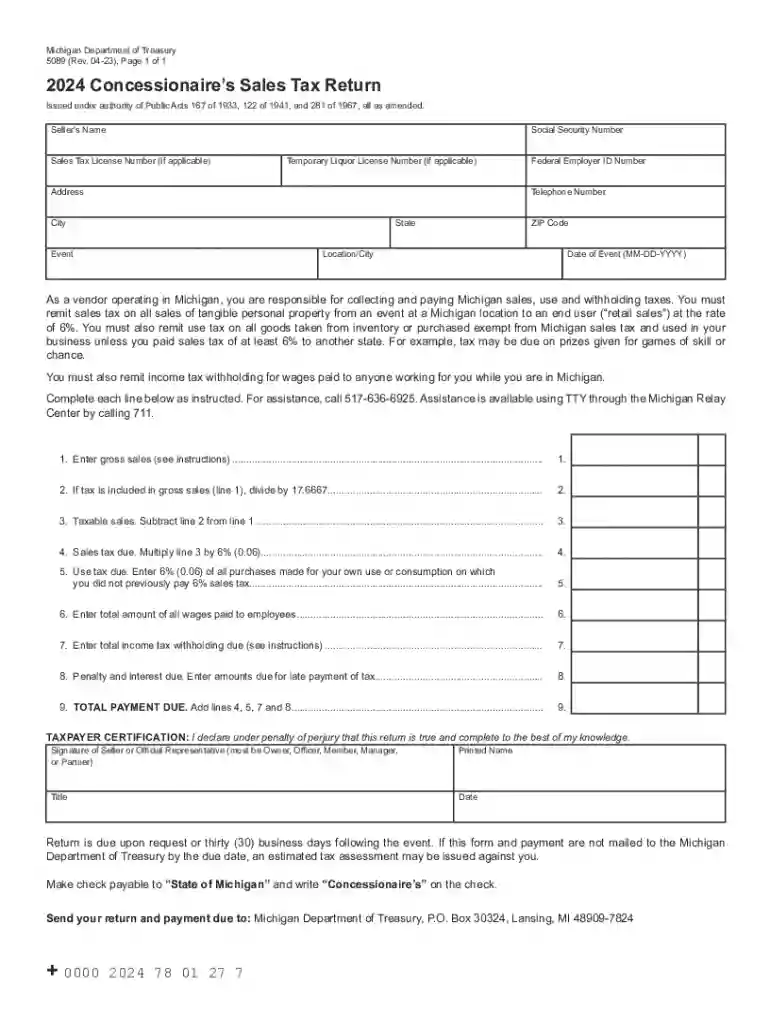
2271, Concessionaire's Sales Tax Return and Payment-2026

Get Form
2271, Concessionaire's Sales Tax Return and Payment Preview on Page 1

Here's how it works

01. Edit your form online
Type text, add images, blackout confidential details, add comments, highlights and more.

02. Sign it in a few clicks
Draw your signature, type it, upload its image, or use your mobile device as a signature pad.

03. Share your form with others
Send it via email, link, or fax. You can also download it, export it or print it out.

Definition & Meaning

The "2271, Concessionaire's Sales Tax Return and Payment" form is a specialized document used by concessionaires operating in Michigan. It serves as a tool for these vendors to report and remit sales, use, and withholding taxes to the Michigan Department of Treasury. This form ensures compliance with state tax regulations by detailing gross sales, taxable sales, and taxes due, helping vendors accurately calculate their tax obligations.

Key Elements of the Form

  • Gross Sales Calculation: This section requires vendors to report their total sales before any deductions, ensuring a comprehensive accounting of all commercial activities.
  • Taxable Sales: Concessionaires must determine which portion of their sales is subject to state taxes, as not all sales may qualify for taxation.
  • Sales Tax Due: This involves calculating the 6% sales tax on taxable sales, providing a precise understanding of liabilities.

How to Use the 2271, Concessionaire's Sales Tax Return and Payment

To accurately use this form, concessionaires should follow specific protocols:

  1. Gather Required Data: Collect all sales records, including receipts and invoices, to ensure a complete overview of all transactions.
  2. Calculate Sales and Taxes: Use these data points to compute gross and taxable sales, applying the proper tax rates to determine amounts due.
  3. Ensure Accuracy: Double-check all entries for errors to avoid discrepancies and penalties.

Steps to Complete the Form

  1. Complete the Vendor Information: Input basic details like the business name, address, and tax identification number.
  2. Enter Sales Figures: Provide detailed breakdowns of gross and taxable sales in the appropriate sections.
  3. Calculate Taxes: Using the worksheets provided, determine the sales and use tax amounts. Ensure the figures reflect the state’s 6% rate.

Why Use the 2271, Concessionaire's Sales Tax Return and Payment

Using this form is critical for several reasons:

  • Compliance: Adhering to state tax laws minimizes the risk of facing legal penalties and fines.
  • Financial Planning: Understanding and managing tax liabilities helps in making informed financial decisions.
  • Transparency: Proper documentation enhances accountability and transparency in business operations.

Penalties for Non-Compliance

Failing to submit the form or provide accurate information can result in:

  • Financial Penalties: These include fines for late submissions or inaccuracies in reported sales or taxes.
  • Estimated Tax Assessments: Non-filing can lead to the state estimating tax liabilities, often resulting in higher amounts than accurate reporting would produce.

Who Typically Uses the 2271, Concessionaire's Sales Tax Return and Payment

This form is specifically designed for concessionaires, which include:

  • Food Vendors: Those operating at events or markets.
  • Temporary Merchants: Businesses that occasionally set up to sell goods.
  • Service Providers: Vendors offering services at temporary locations.
decoration image ratings of Dochub

Business Types that Benefit Most

  • LLCs and Corporations: Structured enterprises with complex tax needs.
  • Partnerships: Entities where multiple members may need to consolidate sales data for tax purposes.

State-Specific Rules

The 2271 form is unique to Michigan; it aligns with the specific tax code and regulations of the state, which mandates:

  • 6% Sales Tax Rate: Uniformly applied across all taxable sales.
  • Timely Submission: Adhering to deadlines is crucial to avoid penalties and ensure compliance.

State-by-State Differences

While this form is specific to Michigan, other states have unique requirements which may include:

  • Varying Tax Rates: Different locales might impose different sales tax rates.
  • Diverse Compliance Rules: Each state may have distinct reporting and submission procedures.

Filing Deadlines / Important Dates

To stay compliant, it's essential to:

  • Know the Fiscal Year Cutoff: Understand the annual deadlines for submission. Michigan's tax calendar typically requires quarterly submissions.
  • Avoid Penalties: Submit your completed form by the deadline to prevent fines and interest on unpaid taxes.

Form Submission Methods

There are several ways to submit the form, including:

  • Online Platforms: Electronic submissions through the Michigan Department of Treasury’s website.
  • Mail: Sending completed forms via traditional postal services.
  • In-Person: Direct delivery to designated governmental offices.
be ready to get more

Complete this form in 5 minutes or less

Get form

Got questions?

We have answers to the most popular questions from our customers. If you can't find an answer to your question, please contact us.
Contact us
Every year, your refund is calculated as the amount withheld for federal income tax, minus your total federal income tax for the year. A large portion of the money being withheld from each of your paychecks does not actually go toward federal income tax.
Return on Sales Formula (ROS) Both the operating income and sales of a company can be found on the income statement. The formula for calculating the return on sales ratio consists of dividing operating profit by sales. In order to express the ratio as a percentage, the calculated amount must then be multiplied by 100.
Answer: Reverse sales is the process of determining the pre- amount from a total price that includes sales . It is calculated by dividing the total amount by (1 + sales rate). For example, if the total amount is $107.50 and the sales rate is 7.5%, the pre- amount is calculated as $107.50 / 1.075 $100.
Understanding Back Taxes If the taxpayer doesnt file a tax return, the failure to file penalty is 0.5% of the amount due. That penalty applies every month or part of a month until the tax is paid in full or until the penalty docHubes 25% of the tax owed. In addition, the IRS charges interest on the unpaid amount.
Some customers are exempt from paying sales tax under Michigan law. Examples include government agencies, some nonprofit organizations, and merchants purchasing goods for resale. Sellers are required to collect a valid exemption or resale certificate from buyers to validate each exempt transaction.

Security and compliance

At DocHub, your data security is our priority. We follow HIPAA, SOC2, GDPR, and other standards, so you can work on your documents with confidence.


Learn more
ccpa2
pci-dss
gdpr-compliance
hipaa
soc-compliance

People also ask

Record a sales tax payment Go to Taxes, then Sales tax (Take me there). From the Sales Tax Owed list, select the tax agency youre recording the payment for, then select Record Tax Payment.
What is a Sales Tax Decalculator? Step 1: take the total price and divide it by one plus the tax rate. Step 2: multiply the result from step one by the tax rate to get the dollars of tax. Step 3: subtract the dollars of tax from step 2 from the total price. Pre-Tax Price = TP [(TP / (1 + r) x r] TP = Total Price.
In Texas, sales tax is collected on the sale, lease, or rental of tangible goods and some services. The tax is collected by the seller and remitted to state and local tax authorities. The seller acts as a de facto tax collector.

Related links