
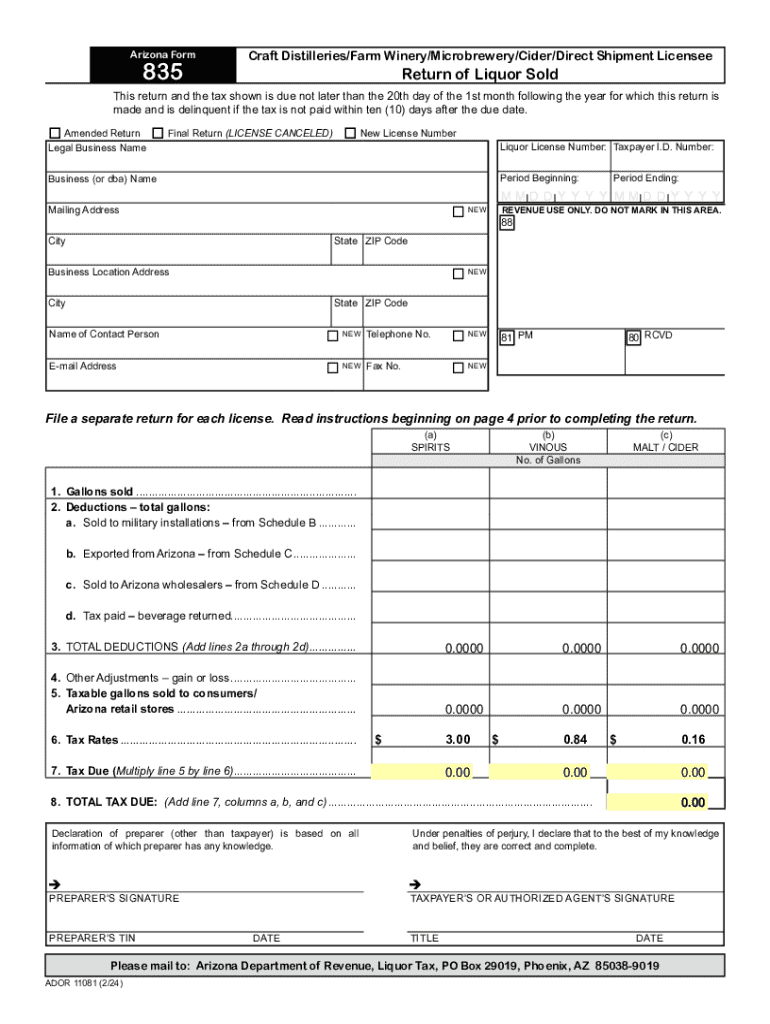







Definition & Purpose of Arizona Form 835
Arizona Form 835 is a specialized tax return document designed for craft distilleries, farm wineries, microbreweries, cider producers, and direct shipment licensees operating within Arizona. It is an essential form for these businesses to report liquor sales and pay taxes accordingly. The form includes sections for reporting the volume of liquor sold, along with any deductions for tax-exempt sales, ultimately facilitating the calculation of the total tax obligation.
Importance of Timely Submission
Timely submission of Arizona Form 835 is crucial for businesses involved in alcohol production and sales. Late submissions can result in penalties, thus financial planning should include scheduling enough time to complete and file the form before the due date. Understanding and adhering to the deadlines helps maintain compliance with state regulations and avoid unnecessary complications.
Steps to Complete Arizona Form 835
-
Gather Required Information: Begin by collecting all relevant data regarding your liquor sales and any applicable deductions.
-
Calculate Gallons Sold: Record the total volume of each type of liquor sold during the reporting period. This forms the basis for calculating taxable sales.
-
Report Tax-Free Deductions: Identify and list sales that are exempt from taxes, ensuring each deduction claim is substantiated with proper documentation.
-
Compute Tax Due: Utilize the form's sections to calculate the total tax by applying Arizona's tax rates to the net taxable gallons.
-
Review and Submit: Before submitting, ensure all entries are correct and double-check for any omissions or errors. Submit the completed form either electronically or via mail by the due date.
Common Mistakes to Avoid
- Failing to include all necessary supporting documentation for tax exemptions.
- Miscalculating the total gallons sold or deductions, which can result in incorrect tax computation.
- Overlooking the inclusion of certain license types when filling out relevant sections of the form.
Required Documents for Filing
To successfully complete Arizona Form 835, certain documents are required, including:
- Sales records covering the reporting period.
- Documentation supporting any claimed tax exemptions.
- Past submissions, if applicable, to ensure consistency in reporting.
Digital vs. Paper Submission
Businesses can choose to file Arizona Form 835 electronically for ease and efficiency or opt for traditional paper submission. Digital submissions may offer quicker processing times and immediate confirmation of receipt, while paper submissions might suit those more comfortable with a manual process.
Legal Use and Compliance
Completing Arizona Form 835 ensures compliance with state regulations governing the sale of liquor. Adherence to this legal requirement helps avoid penalties and potential audits. Businesses are advised to keep detailed records and documentation for all entries made on the form to substantiate their tax positions if questioned by the Department of Revenue.
Key Legal Considerations
- Ensuring all reported sales align with actual transaction records.
- Properly attributing tax-exempt sales with necessary documentation.
- Filing the form throughout the designated filing periods to maintain compliance.
Business Types Benefiting from Arizona Form 835
Arizona Form 835 is tailored for:
- Craft Distilleries: Small-scale operations producing spirits.
- Farm Wineries: Estates cultivating vines and producing wine.
- Microbreweries: Brewers creating small batches of beer.
- Cider Producers: Local producers focusing on cider beverages.
- Direct Shipment Licensees: Businesses licensed to ship liquor directly to consumers.
Scenarios for Specialized Uses
- Craft distilleries can utilize the form to precisely report small-batch sales.
- Cider producers benefit by clearly demarcating varying types of ciders for accurate tax calculations.
- Direct shipment licensees leverage the form to track and report non-retail transactions efficiently.
Penalties for Non-Compliance
Failure to properly complete and submit Arizona Form 835 can lead to several penalties:
- Financial Penalties: Fines for late submissions or incorrect tax computations.
- Increased Liability: Under-reporting can trigger additional audits and liabilities.
- License Revocation Risks: Persistent non-compliance could result in the loss of operating licenses.
Businesses are encouraged to maintain meticulous records and continuously review state updates on legislative changes impacting liquor taxation to avoid these repercussions.
Software Compatibility for Form Completion
Software such as TurboTax and QuickBooks can be useful tools for businesses to manage their finances and ensure accurate filing of Arizona Form 835. These platforms can:
- Streamline Data Management: Help businesses manage and organize all relevant financial data.
- Automate Calculations: Minimize errors when reporting taxable sales and deductions.
- Facilitate Integration: Sync sales data with tax reporting requirements for easy access during the completion of the form.
Benefits of Using Compatible Software
- Faster processing time with pre-filled fields.
- Enhanced accuracy through automated functions.
- Comprehensive audits of financial data to ensure compliance readiness.
Real-World Examples of Arizona Form 835 Use
For craft distilleries, using Arizona Form 835 represents compliance with state tax laws, allowing them to focus on expanding business operations without the looming threat of penalties. Microbreweries, facing tight operational budgets, use the form to accurately report sales and avoid financial distress caused by non-compliance. Larger operations, such as direct shipment licensees, rely on the detailed sections of the form to ensure each shipment aligns with state regulatory requirements, enhancing operational transparency and legal standing.
Nuances and Variations
- Seasonal operations may require specific attention to monthly variations in sales when completing the form.
- Certain promotions or sales events could necessitate additional exemptions or calculations.
- Changes in licensing laws may introduce new requirements for specific business types.




