




01. Edit your form online
Type text, add images, blackout confidential details, add comments, highlights and more.

Type text, add images, blackout confidential details, add comments, highlights and more.

Draw your signature, type it, upload its image, or use your mobile device as a signature pad.

Send it via email, link, or fax. You can also download it, export it or print it out.
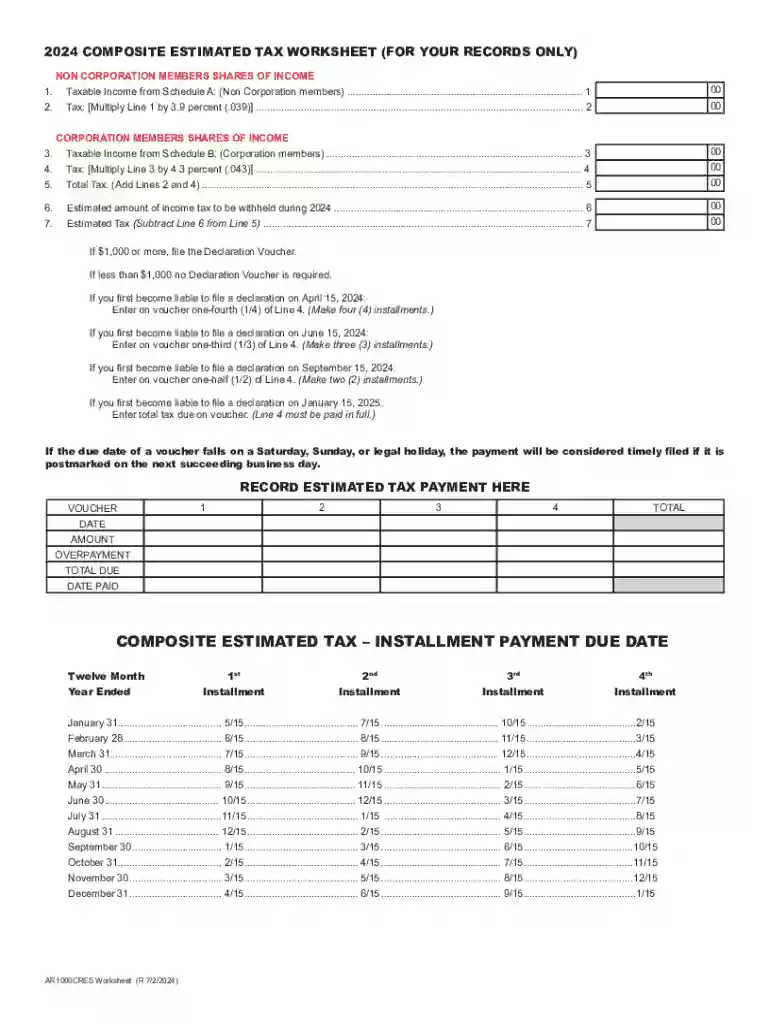
The "STATE OF ARKANSAS Composite Estimated Tax" refers to the tax obligations that specific businesses and entities must anticipate and plan for within Arkansas. This tax is primarily applicable to business entities such as partnerships and S-corporations, where shareholders or partners owe state taxes on their earnings. The goal of the composite estimated tax is to simplify tax reporting by allowing these businesses to aggregate individual tax liabilities into a single payment. This ensures compliance with Arkansas state tax laws while reducing administrative burdens.
Composite estimated taxes are prepayments on expected state taxes owed. These taxes are important for businesses functioning in Arkansas because they help manage cash flow and avoid unexpected tax liabilities. Businesses estimate their annual tax requirements and make quarterly payments in anticipation of their end-of-year tax burden.
Unlike individual or corporate taxes, composite estimated taxes bundle the liabilities of multiple partners or shareholders into a single payment. This helps reduce complexity, as individual tax responsibilities are managed collectively by the business on behalf of its members.
Determine Eligibility: Assess if your business, such as a partnership or S-corporation, qualifies to file a composite return. Individual members must be nonresidents or part-year residents to qualify for composite filing.
Gather Required Documents: Compile tax documents that show income distribution among members, projected earnings, and prior year taxes. Having these documents organized aids accurate calculation.
Calculate Estimated Tax: Utilize last year’s income records and current tax rates to forecast the tax liability. Ensure all income is categorized correctly according to Arkansas state law.
Complete Declaration Vouchers: Fill out the state's Composite Estimated Tax Declaration Vouchers accurately. Double-check for any errors in personal details or amounts.
File and Make Payments: Submit the completed forms along with payments via Arkansas Taxpayer Access Point (ATAP) or by mail. Ensure punctuality to avoid penalties.
Understanding the current tax rate applicable to nonresident members is crucial for accurate calculations. Adjust your projections as state tax laws and rates evolve.
Legally, the composite tax return is a methodical approach for business entities to unify their state tax obligations. It is legally required for those eligible entities operating in Arkansas to comply with these regulations to maintain good standing with the Arkansas Department of Finance and Administration.
Businesses must file their composite estimated tax declarations by April 15 of the tax year or align with their specific fiscal year schedule. Furthermore, payments are typically due quarterly, on or around April 15, June 15, September 15, and January 15 of the following year. Adhering to these deadlines ensures compliance and avoids penalties.
Paying taxes on time is crucial, as late payments can incur penalties and interest, potentially increasing the overall tax burden significantly. Regularly reviewing tax calendars keeps businesses aware of critical upcoming deadlines.
Ensure that all documents are accurately filled, clearly legible, and retained for at least several years in case of audits or inquiries by tax authorities.
Failing to make adequate estimated payments can result in penalties. Arkansas can impose interest on overdue taxes and apply additional fines for persistent non-compliance. Understanding and adhering to state mandates is essential for avoiding these financial penalties.
Primarily, partnerships and S-corporations file composite returns to manage the tax responsibilities of nonresident members. This simplifies financial burdens by filtering complex, individual tax obligations through the entity, fostering operational efficiency and compliance.


By consolidating multiple tax liabilities into one, businesses effectively reduce the risk of discrepancies and maintain smooth operations with consistent state tax compliance.
We've got more versions of the STATE OF ARKANSAS Composite Estimated Tax form. Select the right STATE OF ARKANSAS Composite Estimated Tax version from the list and start editing it straight away!
At DocHub, your data security is our priority. We follow HIPAA, SOC2, GDPR, and other standards, so you can work on your documents with confidence.


This manual presents the state of the art in the application of S/S for the remediation of contaminated land and treatment of waste.
Phone: (501) 682-4775. Composite Estimated Tax Vouchers for 2026. Share of Income, Deductions, Credits, Etc.
The total net taxable income in Arkansas must be reported on form AR1000. Tax will be computed at a flat 7% tax rate.


