




01. Edit your form online
Type text, add images, blackout confidential details, add comments, highlights and more.

Type text, add images, blackout confidential details, add comments, highlights and more.

Draw your signature, type it, upload its image, or use your mobile device as a signature pad.

Send it via email, link, or fax. You can also download it, export it or print it out.
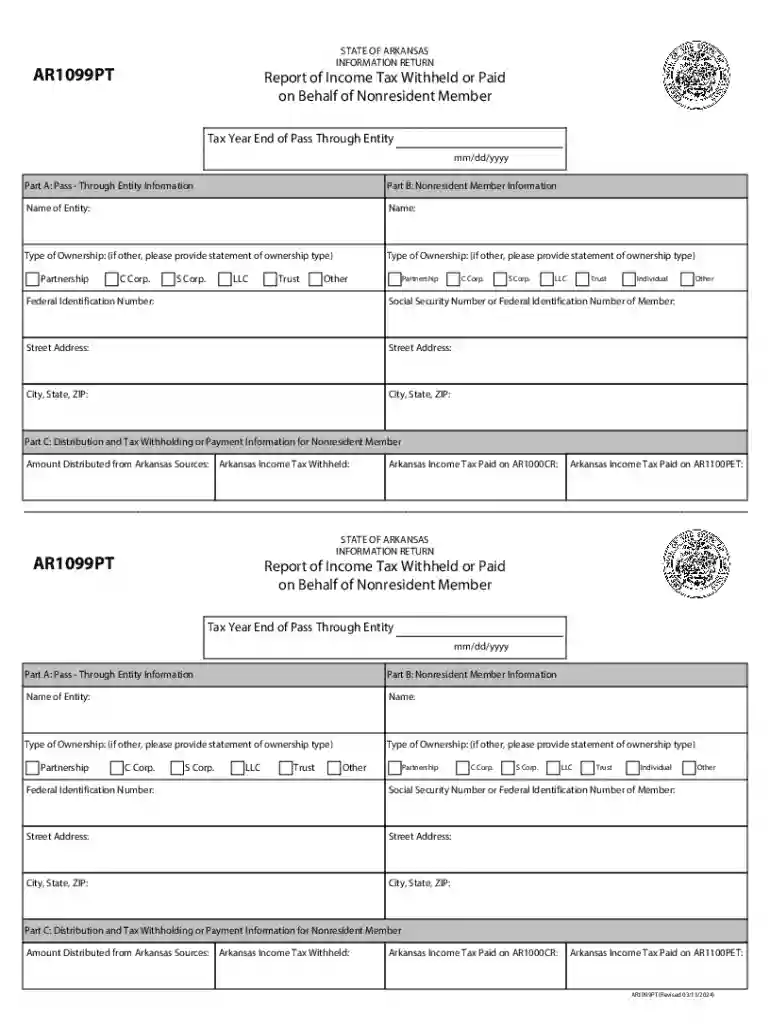
The Pass-through Entity TaxArkansas Department of Finance form, commonly referred to as AR1099PT, is a tax document used by pass-through entities in Arkansas. These entities include partnerships, S corporations, and certain LLCs that elect to be treated as corporations for tax purposes. The AR1099PT is essential for reporting income tax withheld or paid on behalf of nonresident members, ensuring compliance with state tax regulations. This form enables the Arkansas Department of Finance and Administration to track and verify the payment of taxes by entities that pass income through to their individual owners without first being subject to corporate income tax.
Gather Necessary Information: Before filling out the AR1099PT, collect all relevant data. This includes entity information, such as the federal employer identification number (FEIN) and mailing address, as well as member details like names, Social Security numbers, or taxpayer identification numbers.
Fill in Entity Information: Begin by entering the entity's name, address, and FEIN. Provide accurate information to avoid processing delays.
Member and Income Details: Input member information and the total amount of income distributed to each member for the tax period. Accurately document any tax withheld for nonresident members.
Calculate Tax Withholding: Utilize Arkansas state tax rates to determine the appropriate amount of tax withholding for nonresident members. Ensure calculations are precise to avoid potential penalties.
Review and Verify: Double-check all entries for accuracy, ensuring no fields are left incomplete. Confirm the calculations for member distributions and tax withholding to prevent errors.
Sign and Date: The form must be signed by an authorized representative of the pass-through entity. Ensure the form is dated to establish validity.
The primary purpose of the AR1099PT is to facilitate compliance with tax obligations in Arkansas for pass-through entities and their nonresident members. By reporting income and associated tax withholding, the form helps ensure that nonresident individuals pay their fair share of taxes on income earned within Arkansas. This process promotes transparent tax administration and contributes to state revenue, supporting public services and infrastructure.
Pass-through Entity: A business structure where income "passes through" to the individual members or owners, who then report it on their personal tax returns. Included are partnerships, S corps, and certain LLCs.
Nonresident Member: An individual or entity that receives income from a pass-through entity but does not reside in or is not primarily located in Arkansas.
Withholding Tax: Tax held back from payments made to nonresident members, intended to cover state tax liabilities.
Arkansas imposes specific rules for pass-through entities operating within its borders. Entities must carefully navigate these regulations to ensure compliance:
Withholding Requirements: Arkansas mandates that pass-through entities withhold state income tax on income distributed to nonresident members at the state tax rate.
Filing Deadline: The completed AR1099PT form must be filed by the entity’s return due date, typically March 15 for calendar-year filers. Extensions may be available under certain circumstances.
Penalties and Interest may apply for late or incorrect filings, underscoring the importance of timely and accurate submissions.
Entities can submit their AR1099PT forms via mail or electronically through the Arkansas Department of Finance and Administration's online portal:
Electronic Filing: Preferred for its speed and confirmation of receipt, electronic filing requires registration on the Arkansas DFA website.
Mail Submission: Physical forms can be mailed to the DFA. Ensure all requisite copies are included, and consider using certified mail to confirm delivery.
Strict adherence to Arkansas’s tax regulations is crucial for legal compliance. Pass-through entities must accurately report and withhold taxes, with serious consequences for negligence:
Compliance Failure Penalties: May include fines or additional interest charges for underreporting or failing to remit withheld taxes on time.
Audit Risks: Entities that fail to comply may be subject to audits, which can further compound financial liabilities.
The AR1099PT is relevant to various business entity types subject to pass-through taxation:
Partnerships: Must file to report income distributions and tax withholding for nonresident partners.
S Corporations: Required to submit the form to account for shareholders’ distributed income and withheld taxes.
LLCs: If electing corporate tax treatment and operating as a pass-through entity, they need to file this form for state tax compliance.
Consider a partnership with a nonresident member who resides in Texas but earns income from business activities in Arkansas. The entity must calculate Arkansas state tax withholding on the nonresident’s income and file the AR1099PT to report these amounts, ensuring the member's compliance with state tax obligations while minimizing potential penalties for the partnership.
We've got more versions of the Pass-through Entity TaxArkansas Department of Finance form. Select the right Pass-through Entity TaxArkansas Department of Finance version from the list and start editing it straight away!
At DocHub, your data security is our priority. We follow HIPAA, SOC2, GDPR, and other standards, so you can work on your documents with confidence.



The Elective Pass-Through Entity Tax or PET is effective for tax years beginning on or after January 1, 2022. It allows a partnership, Sub-S corporation orRead more
(a) An affected business entity shall file a Pass-Through Entity Tax Return with the Department. (1) An affected business entity shall annually file the


