




01. Edit your fae 170 2023 online
Type text, add images, blackout confidential details, add comments, highlights and more.

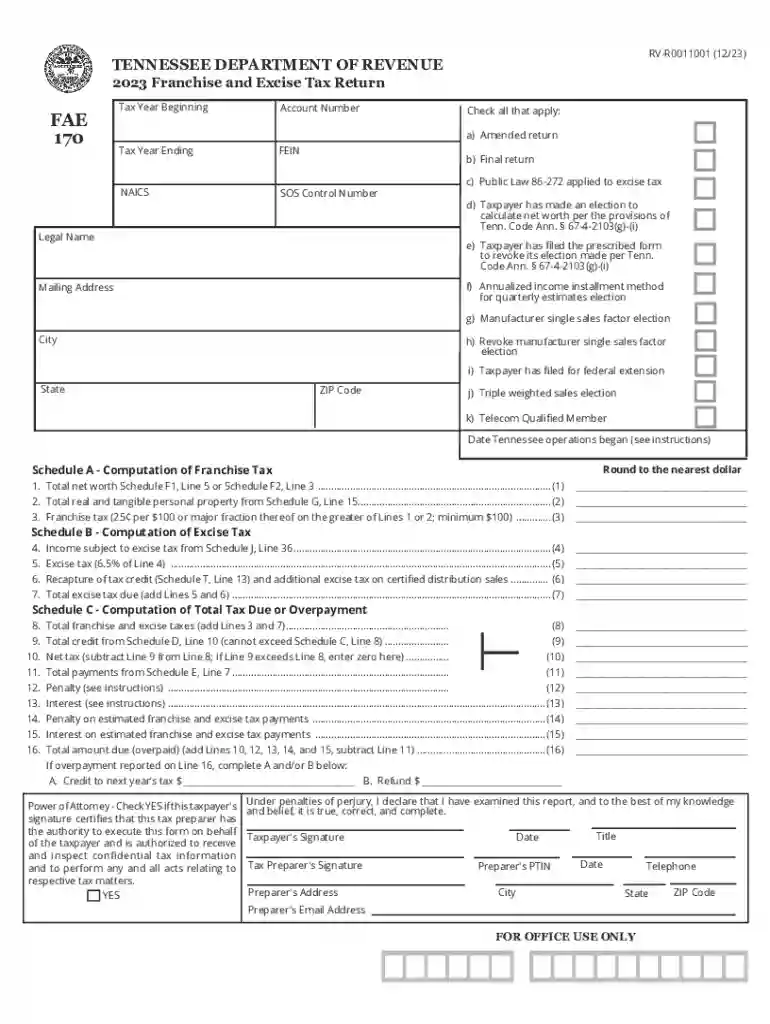
Type text, add images, blackout confidential details, add comments, highlights and more.

Draw your signature, type it, upload its image, or use your mobile device as a signature pad.

Send tn form fae 170 instructions 2023 via email, link, or fax. You can also download it, export it or print it out.
The 2023 Franchise and Excise Tax Return is a crucial document for businesses operating in Tennessee. It serves to calculate and report franchise and excise taxes due to the state's Department of Revenue. The form captures comprehensive details about a business's net worth and taxable income, helping to determine the total tax obligations. This return is composed of sections that gather taxpayer information, facilitate tax calculations, and outline deductions or credits applicable to distinct tax scenarios. Filing this form accurately is vital to ensure compliance with state taxation laws and to avoid potential penalties.
Filling out the 2023 Franchise and Excise Tax Return requires attention to several critical components:
These components collectively ensure that the taxpayer accurately reports taxes owed to the Tennessee Department of Revenue.
The form is predominantly used by:
These entities use the form to report and pay their franchise and excise taxes, maintaining compliance with Tennessee's tax requirements.


Adhering to these timelines is critical to prevent penalties that could result from late submissions.
Tennessee imposes unique regulations regarding the filing of the 2023 Franchise and Excise Tax Return:
Understanding these state-specific requirements aids taxpayers in optimizing their tax reporting.
To complete the 2023 Franchise and Excise Tax Return effectively, the following documents are typically required:
These documents ensure the accuracy and completeness of the submitted tax return.
Failure to comply with the 2023 Franchise and Excise Tax Return filing requirements may result in:
Understanding and adhering to filing obligations minimizes risks of incurring these penalties.
We've got more versions of the fae 170 2023 form. Select the right fae 170 2023 version from the list and start editing it straight away!
| Versions | Form popularity | Fillable & printable |
|---|---|---|
| 2024 | 4.6 Satisfied (38 Votes) | |
| 2023 | 4.3 Satisfied (49 Votes) | |
| 2022 | 4.2 Satisfied (31 Votes) | |
| 2020 | 4.8 Satisfied (90 Votes) | |
| 2019 | 4.3 Satisfied (91 Votes) | |
| 2017 | 4.4 Satisfied (231 Votes) | |
| 2014 | 4.3 Satisfied (166 Votes) | |
| 2010 | 4.4 Satisfied (231 Votes) | |
| 2009 | 4.4 Satisfied (148 Votes) | |
| 2008 | 4 Satisfied (46 Votes) | |
| 2008 | 4 Satisfied (23 Votes) |
At DocHub, your data security is our priority. We follow HIPAA, SOC2, GDPR, and other standards, so you can work on your documents with confidence.



by MS Freeman 2024 Tennessee enforces a franchise and excise tax filed on Form FAE 170 annually. The following article will help you and your clients understand
Nov 1, 2023 Review the comprehensive terms and conditions governing Adyens payment processing and related services updated November 2023.


