Definition & Meaning
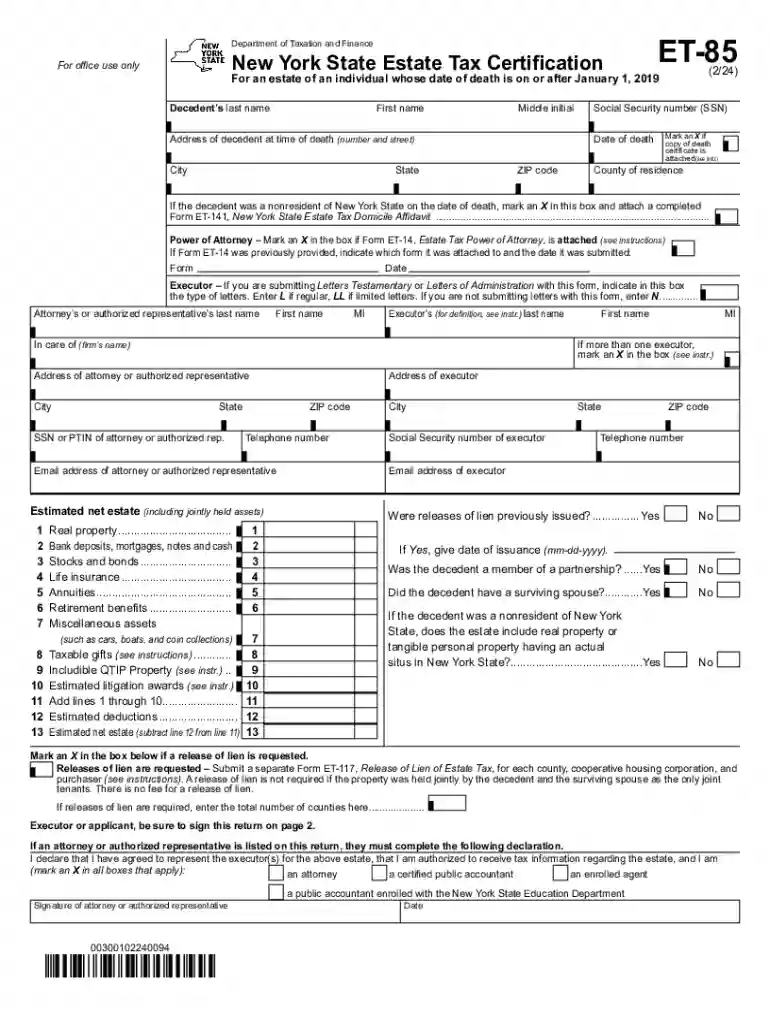
Form ET-85, also known as the New York State Estate Tax Certification, is specifically devised for estates of individuals who passed away on or after January 1, 2019. The form is vital for estate executors as it aids in capturing comprehensive details about the decedent's personal information, estate assets, and executor details. Beyond its main sections, the document requires critical supplementary attachments, such as death certificates and power of attorney documents. The form's essence lies in its function to facilitate the computation of the net estate value and thereafter seek releases of lien connected to estate tax obligations in New York State.
How to Use the Form ET-85 New York State Estate Tax Certification Revised 2
Gathering Essential Information
- Decedent Details: Begin with the decedent's personal information, including name, social security number, and date of death.
- Estate Assets: Itemize the estate's assets to provide an accurate representation of the estate's value.
- Attachments: Prepare required supplementations such as death certificates, necessary for validating the information.
Completing the Form
- Ensure all sections are filled accurately to avoid delays in processing.
- For the calculation of the net estate, review current New York tax laws and estate thresholds.
Submission
- After completion, Form ET-85 can be submitted to the New York State Department of Taxation and Finance as per the preferred submission method: online, mail, or in-person.
Steps to Complete the Form ET-85 New York State Estate Tax Certification Revised 2
Step 1: Initial Preparation
- Gather all necessary documentation that details the decedent's financial affairs.
- Have on hand any relevant accounting records that might impact estate valuation.
Step 2: Detailed Form Completion
- Personal Information:
- Accurately input the decedent’s information, ensuring no mistakes in crucial fields like social security number.
- Asset Inventory:
- List every asset, compiling documentation for each to back reported values.
- Executor Information:
- Provide the full details of the executor managing the estate, confirming authority through documentation if required.
Step 3: Review and Attach Required Documents
- Cross-verify all entered information against original documents.
- Attach mandatory documents, including death certificates and any relevant power of attorney.
Step 4: Submission and Follow-up
- Choose a submission route suited to personal preference and convenience.
- After submission, track the process to ensure no additional information is requested.
Typical Users
- Estate Executors: Individuals appointed to manage the decedent's estate.
- Legal Professionals: Attorneys facilitating estate management and tax obligations.
- Accountants: Financial advisors assisting in estate valuation and taxation.
Scenario-Based Users
- Family Members: Handling the estate independently without professional intermediary services.
- Trustees: Managing a trust with estate tax responsibilities in New York State.
Important Terms Related to Form ET-85
Key Terminology
- Decedent: The individual whose estate is being processed for taxation upon death.
- Executor: The person responsible for managing the estate and executing the decedent's will.
- Net Estate: The total value of the estate after liabilities and tax obligations are deducted.
- Lien Release: Formal release from a lien, typically associated with tax obligations on an estate.
Legal Use of the Form ET-85
Compliance and Regulations
- Tax Code Adherence: Ensures compliance with New York State Tax law requirements for estates over a certain value.
- Legal Documentation: Acts as a legal document used in probate proceedings to determine estate tax obligations.
Compliance Strategies
- Consulting with a tax professional ensures complete adherence to current estate tax laws and updates.
- Utilizing a structured checklist during form completion to minimize errors and omissions.
Key Elements of the Form ET-85
Essential Components
- Decedent and Executor Information: Basic identification and role-specific details.
- Asset Listing and Valuation: Detailed description and monetary value of estate contents.
- Statements and Certifications: Affirmations by the executor regarding the authenticity of the information provided.
Supporting Attachments
- Death Certificate: Verifies the decedent’s date and certificate of death.
- Power of Attorney: Confirms authority if the executor is acting on behalf of another legal representative.
Filing Deadlines / Important Dates
Critical Dates to Consider
- Filing Deadline: Usually nine months from the date of the decedent’s death.
- Extension Requests: Opportunity to apply for an extension if unable to meet the original deadline.
Importance of Timely Filing
- Ensures that penalties for late submission are avoided and any tax obligations are timely assessed, allowing the estate to be settled efficiently.
Essential Documents
- Death Certificate: Mandatory for submission to verify decedent’s information.
- Asset Documentation: Proof of ownership and value for all listed estate assets.
- Legal Executorship Proof: Documents confirming the executor’s legal right to act on behalf of the estate.
Examples of Supporting Documents
- Appraisals for real estate or personal property
- Bank account statements and investment records
- Documents detailing outstanding debts or liabilities
Available Submission Methods
- Online: Via the New York State Department of Taxation and Finance website.
- Mail: Physical submission using listed postal addresses.
- In-Person: Direct submission at designated state tax offices.
Process Overview
- Online submissions typically offer faster processing times.
- Ensure all necessary documents are in the correct format and fully completed prior to submission to avoid processing delays.