




01. Edit your form online
Type text, add images, blackout confidential details, add comments, highlights and more.

Type text, add images, blackout confidential details, add comments, highlights and more.

Draw your signature, type it, upload its image, or use your mobile device as a signature pad.

Send it via email, link, or fax. You can also download it, export it or print it out.
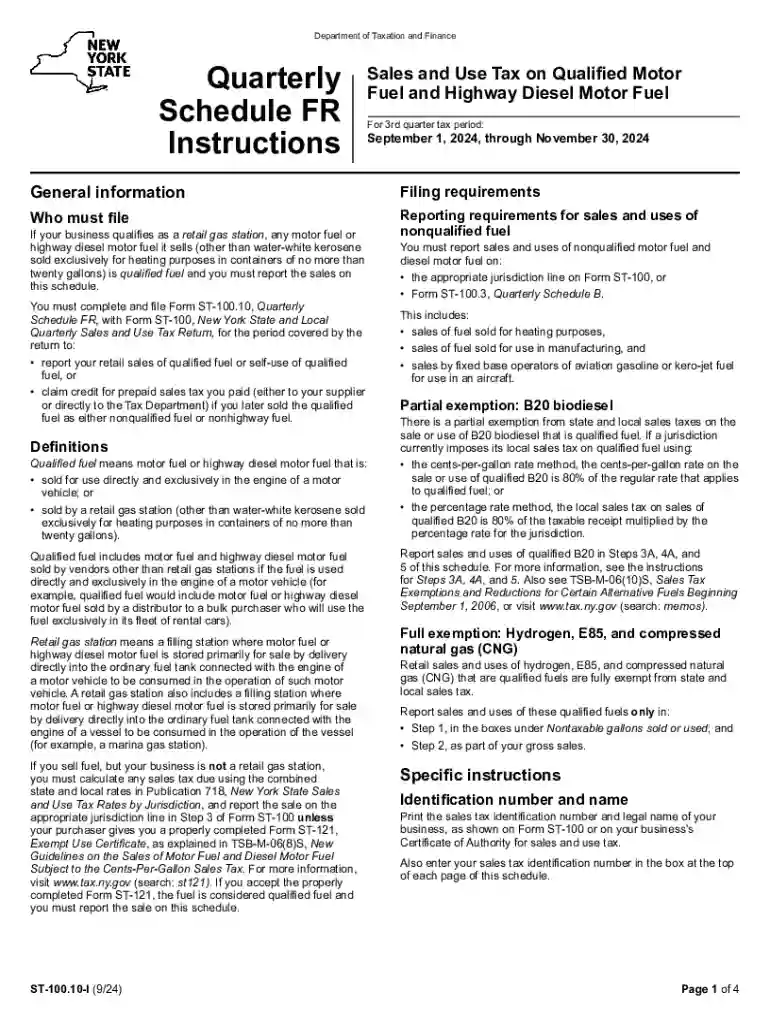
The Form ST-100 Quarterly Schedule FR is designed for businesses engaged in the sale or use of qualified motor fuels and highway diesel motor fuels in New York. It specifically addresses the calculation and reporting of sales and use taxes for the third quarter of the year 2024. The form's primary purpose is to ensure compliance with New York State tax regulations by providing a structured method for businesses to report their taxable transactions accurately.
Businesses can acquire the instructions for Form ST-100 Quarterly Schedule FR through several channels. The New York State Department of Taxation and Finance typically provides these documents on their official website. Additionally, businesses may request physical copies by contacting the department directly or by visiting local government offices that manage tax-related documents. Utilizing these instructions is crucial to avoid errors and ensure proper tax filing.
Gather Required Documents: Before filling out the form, collect all necessary documentation, including sales receipts, purchase records for fuels, and any exemption certificates.
Review the Instructions: Thoroughly read the instructions to understand each field on the form. Pay close attention to definitions of fuel types and tax exemptions.
Calculate Taxes Owed: Use provided guidelines to compute the correct amount of sales tax on your qualified and non-qualified fuel sales and uses.
Complete the Form: Enter all relevant data in the specified fields, following instructions precisely to avoid discrepancies.
Double-Check Entries: Verify that all information entered is correct and complete. Errors may lead to penalties or delayed processing.
Submit the Form: File the form by the specified deadline. Submissions can generally be made online via the New York State Department of Taxation and Finance website or by mailing the completed paper form to their office.
The form includes several crucial components that businesses must address:
Businesses should familiarize themselves with terms specific to the form, such as "qualified motor fuels," "highway diesel motor fuel," and "sales and use tax." Understanding these terms is essential for accurate reporting and compliance with tax laws.
New York has specific rules regarding sales and use tax for fuels. Non-compliance with these regulations can result in significant penalties. These include fines or interest on unpaid taxes. Staying informed of any state-specific changes or updates to tax laws is critical for each quarterly filing.
The form must be filed for the third quarter, which includes sales and purchases from July through September 2024. The deadline for this filing is typically the 20th day of the month following the quarter's end. Late submissions can result in penalties, emphasizing the importance of meeting all deadlines.
Businesses have several options for submitting the form. The preferred method is online submission through the New York State Department of Taxation and Finance website, offering a fast and reliable option. Alternatively, paper forms may be mailed. For those using software solutions like TurboTax or QuickBooks, ensure compatibility for ease of integration into existing accounting practices.
These scenarios illustrate different taxpayer situations and how compliance with Form ST-100 can impact businesses in the fuel industry.


Business types that benefit most from Form ST-100 include LLCs, corporations, and partnerships operating within the fuel distribution and retail industry in New York. Adhering to the form's requirements assists these entities in maintaining tax compliance and optimizing their fiscal operations.
We've got more versions of the Instructions for Form ST-100 10 Quarterly Schedule FR Instructions - Sales and Use Tax on Quailifed form. Select the right Instructions for Form ST-100 10 Quarterly Schedule FR Instructions - Sales and Use Tax on Quailifed version from the list and start editing it straight away!
| Versions | Form popularity | Fillable & printable |
|---|---|---|
| 2025 | 4.4 Satisfied (49 Votes) | |
| 2024 | 4.3 Satisfied (54 Votes) | |
| 2023 | 4.5 Satisfied (42 Votes) | |
| 2022 | 4.9 Satisfied (38 Votes) | |
| 2021 | 4.8 Satisfied (57 Votes) | |
| 2020 | 4.3 Satisfied (129 Votes) | |
| 2020 | 4.4 Satisfied (204 Votes) | |
| 2019 | 4.4 Satisfied (75 Votes) | |
| 2019 | 4.3 Satisfied (258 Votes) | |
| 2018 | 4 Satisfied (44 Votes) | |
| 2018 | 4.3 Satisfied (105 Votes) |
At DocHub, your data security is our priority. We follow HIPAA, SOC2, GDPR, and other standards, so you can work on your documents with confidence.


May 19, 2026 ST-100.10 ST-100.10-I (Instructions), Quarterly Schedule FR - Sales and Use Tax on Qualified Motor Fuel and Highway Diesel Motor Fuel. ST-Read more
Feb 2, 2024 File by the due date for filing your return. See instructions. For each Yes 10b below, describe the circumstances, processes, or changes on


