




01. Edit your schedule k1 instructions online
Type text, add images, blackout confidential details, add comments, highlights and more.

Type text, add images, blackout confidential details, add comments, highlights and more.

Draw your signature, type it, upload its image, or use your mobile device as a signature pad.

Send schedule k 1 form via email, link, or fax. You can also download it, export it or print it out.
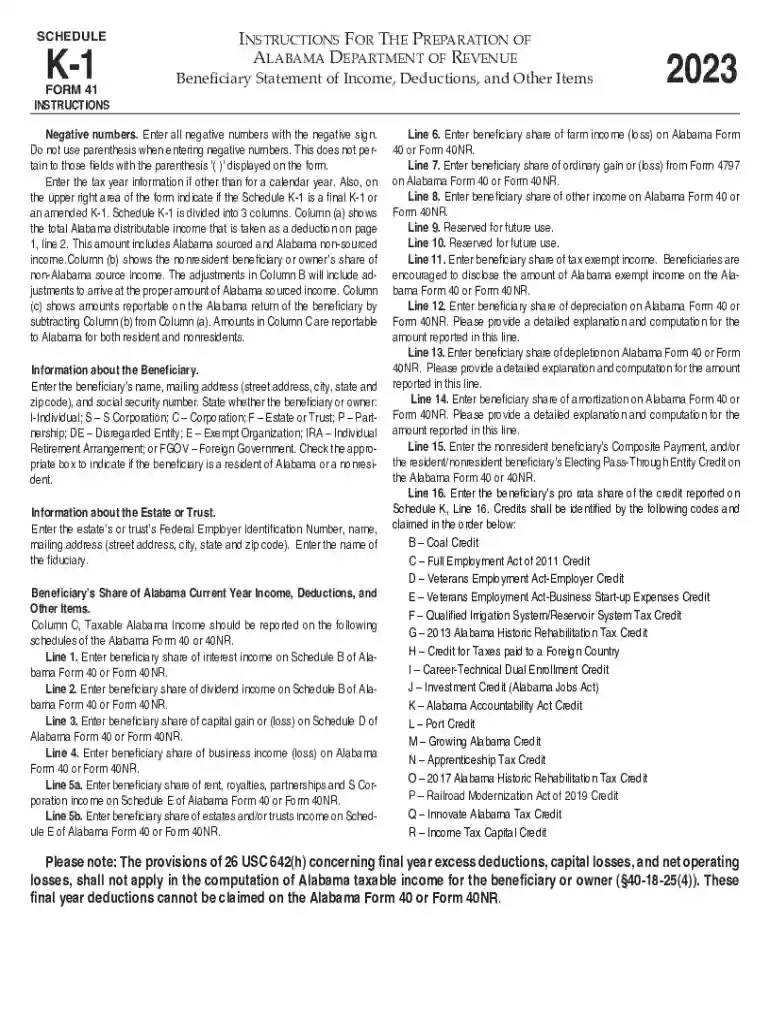
Schedule K-1 Form 41 Instructions TY 20231-19-24F are detailed guidelines provided by the Alabama Department of Revenue for correctly completing the Schedule K-1 form. This form is used by beneficiaries to report their share of income, deductions, and other financial items, particularly for income coming from trusts and estates. Understanding the instructions ensures compliance with tax requirements and facilitates accurate reporting.
Gather Necessary Information: Collect all relevant financial data, including your share of income, deductions, credits, and any specific trust or estate details.
Understand the Three Columns: The form includes columns to report Alabama distributable income, non-Alabama source income, and amounts that are reportable for both residents and nonresidents. Accurately categorize each income source.
Report Income and Deductions: Use the form to itemize each type of income and deduction. This includes dividends, interest, capital gains, and specific expenses.
Enter Tax Year Information: Ensure that you specify the tax year for which the form is applicable. This helps in maintaining chronological tax records.
Include Negative Numbers When Necessary: Some financial entries may require negative numbers, particularly if reporting losses. Follow the form’s guidance on where and how to input these values.
Finalize the Form: Double-check all entries for accuracy, ensuring that all necessary fields are completed before filing.
Beneficiary: An individual who receives income or benefits from a trust or estate.
Distributable Net Income (DNI): The maximum amount of income that a trust or estate can distribute to its beneficiaries, which must be reported on Schedule K-1.
Non-Alabama Source Income: Income generated outside the state of Alabama that must still be reported for state tax purposes.
Reportable Amounts: Financial figures required to be declared on tax returns, which vary for residents and nonresidents.
The Internal Revenue Service (IRS) does not directly issue the Schedule K-1 Form 41, as it is a state-specific document for Alabama. However, the form must align with federal tax principles, such as accurately reporting all income types and ensuring compliance with the ESIGN Act for electronic submissions.
The Schedule K-1 Form 41 generally aligns its filing deadlines with the federal tax filing date, typically April 15. It is crucial to adhere to these deadlines to avoid penalties. If an extension is required, ensure that applicable forms and requests are submitted timely to both state and federal authorities.
Finalized Schedule K-1 Form 41: Accurately completed following the instructions.
Supporting Financial Statements: Documentation that corroborates reported income and deductions, such as dividend statements or brokerage reports.
Trust or Estate Documents: Legal papers detailing the structure and beneficiaries of the trust or estate.
Online Submission: Utilizing platforms like DocHub offers a streamlined digital filing process, supporting electronic signatures and secure uploads.
Mail: Paper submissions should be sent to the designated address provided by the Alabama Department of Revenue, allowing for tracked delivery options.
In-Person: Physical drop-offs at local tax offices may be possible and beneficial for document verification and immediate confirmation of submission.
Failure to accurately report on Schedule K-1 Form 41, or missing deadlines, can result in penalties issued by the Alabama Department of Revenue. These may include fines based on the amount of unreported income or interest on late payments. To avoid these, adhere strictly to the form's guidelines and reporting requirements.
We've got more versions of the schedule k1 instructions form. Select the right schedule k1 instructions version from the list and start editing it straight away!
At DocHub, your data security is our priority. We follow HIPAA, SOC2, GDPR, and other standards, so you can work on your documents with confidence.


Sep 30, 2002 1. Social security, Medicare, and other retirement: These programs provide income support for the retired and disabled and medical care for theRead more
Jan 13, 2016 Schedule K-1 (Form 1065) includes only income from U.S. sources that you must report on Schedule NEC, lines 1 through 12. Report farm income


