Sc homestead exemption form 2026

Get Form
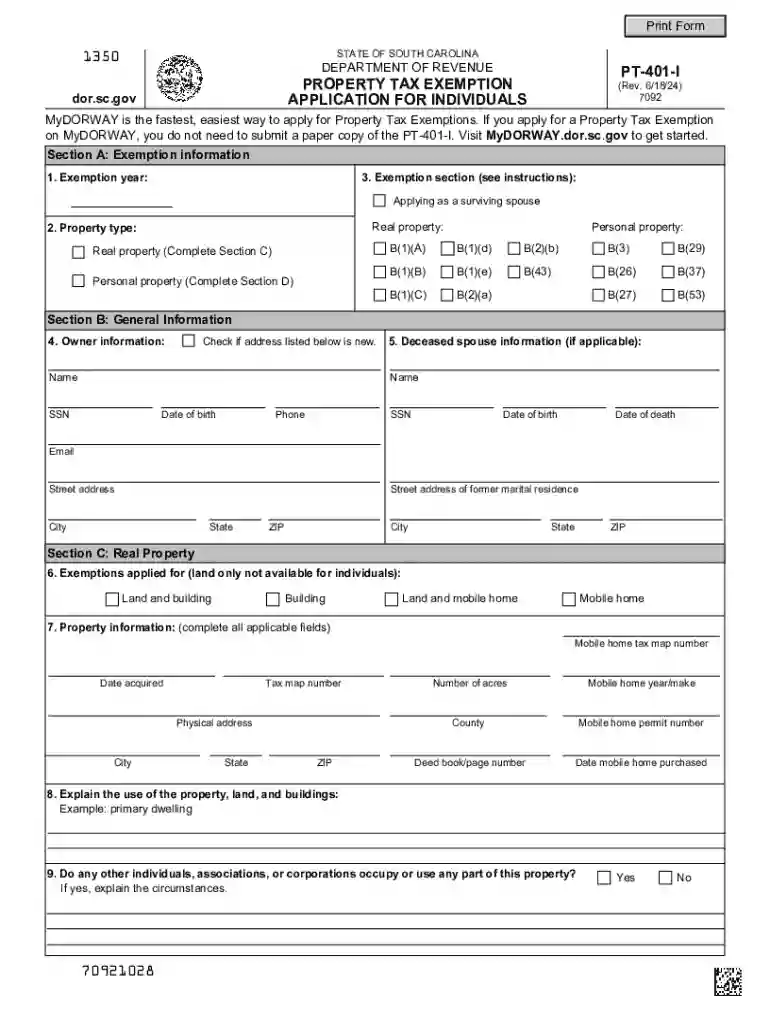
sc homestead exemption form Preview on Page 1

Here's how it works

01. Edit your sc homestead exemption form online
Type text, add images, blackout confidential details, add comments, highlights and more.

02. Sign it in a few clicks
Draw your signature, type it, upload its image, or use your mobile device as a signature pad.

03. Share your form with others
Send sc property tax exemption form via email, link, or fax. You can also download it, export it or print it out.

Definition and Purpose of the SC Homestead Exemption Form

The South Carolina Homestead Exemption Form, also known as the PT-401-I, serves as an application for property tax exemptions. Specifically targeted at South Carolina homeowners, this form provides relief on property taxes for eligible individuals, including seniors, disabled persons, and the surviving spouses of certain groups. The aim is to reduce the taxable value of a property, thus lowering the overall property tax owed. By offering these exemptions, the state supports individuals in maintaining homeownership, especially among vulnerable groups who might experience financial burdens.

Eligibility Criteria for the Homestead Exemption

To qualify for the homestead exemption in South Carolina, applicants must meet specific criteria. These generally include:


  • Being a legal resident of South Carolina for at least one year before applying.
  • Being 65 years of age or older, completely and permanently disabled, or legally blind.
  • Owning and occupying the property as your primary residence. Surviving spouses may also qualify if their deceased spouse was eligible for the exemption. Each of these criteria ensures that the benefit reaches the intended demographic effectively.
decoration image ratings of Dochub

Special Considerations

  • For disabled individuals, the disability must be certified by the Social Security Administration or a similar governmental entity.
  • Applicants claiming on behalf of a deceased spouse must provide appropriate documentation, such as a marriage certificate and the deceased spouse’s death certificate.

Obtaining and Accessing the SC Homestead Exemption Form

The SC Homestead Exemption Form can be acquired through several channels:

  • County Auditor’s Office: Visit in person to obtain the form or request it be mailed.
  • Online Access: Some county websites may offer downloadable versions of the form.
  • Third-party Document Services: Platforms like DocHub may facilitate access to the form for online completion and submission.

Important Notes

  • The form is often provided for free, but there might be fees related to notarization or mailing services.
  • Accessing the form via government websites ensures you receive the most current version.

Completing the SC Homestead Exemption Form: A Step-by-Step Guide

Filling out the SC Homestead Exemption Form requires precision and attention to detail. Follow these steps:

  1. Gather Necessary Documents:

    • Proof of age, disability, or blindness if applicable (e.g., birth certificate, Social Security documents).
    • Proof of residency and homeownership, such as a utility bill or deed.
  2. Fill in Personal Information:

    • Complete sections covering your name, address, and Social Security number.
  3. Detail Property Information:

    • Provide legal description and address of the property for which you are claiming the exemption.
  4. Eligibility Information:

    • Indicate the criteria under which you are claiming the exemption (age, disability, etc.).
  5. Signature and Notarization:

    • Sign the form in the presence of a notary public, where required.

Common Mistakes to Avoid

  • Omitting critical documentation can result in delays.
  • Failing to notarize the form when necessary may render it invalid.

Submission Methods and Application Process

After the form is completed, applicants have several submission options, depending on their county rules:

  • In-Person Submission: Deliver the completed form to your local County Auditor’s Office.
  • Mail Submission: Send the form via postal mail, ensuring all documentation is included.
  • Online Submission: Where supported, users can submit documents electronically, potentially through integrated platforms like MyDORWAY or DocHub.

Approval Time and Follow-Up

  • The processing time may vary, but applicants can generally expect a response within several weeks.
  • If additional information is needed, the auditor’s office will typically contact the applicant.

Important Terms Related to the SC Homestead Exemption Form

Understanding the jargon used within the form and related documentation can aid in correct completion:

  • Homestead: The applicant's primary residence eligible for consideration under the exemption.
  • Assessed Value: The property value used to calculate the amount of tax owed, before exemptions.
  • Eligible Individual: A person qualified under the specific categories laid out by the South Carolina legislation.

Legal Use and State-Specific Rules

Utilizing the SC Homestead Exemption Form involves compliance with legal stipulations unique to South Carolina:

  • This exemption cannot be applied retroactively to previous tax years.
  • Legal residence is established not only through ownership but also occupancy and intent to remain.

Enforcement and Compliance

  • Misuse or fraudulent claims regarding this exemption can lead to penalties, including fines and repayment of exempted taxes.

Required Documentation for the SC Homestead Exemption Application

Applicants must provide clear evidence supporting their eligibility:

  • Proof of Identity: Includes government-issued IDs that confirm age.
  • Disability Certification: Necessary documentation if claiming based on disability or blindness.
  • Proof of Residence and Ownership: Includes utility bills, deeds, or other documents substantiating claim of primary residence.

By ensuring all documentation is complete and accurate, applicants can help secure the benefits they are entitled to under state law.

Examples and Scenarios of Using the SC Homestead Exemption Form

Real-world applications demonstrate the practical benefits of completing this form:

  • Seniors on Fixed Incomes: A senior living on Social Security income reduces tax liability, allowing more budget flexibility.
  • Disabled Veterans: Veterans who are disabled may use the exemption to make homeownership more sustainable.
  • Surviving Spouses: A widowed spouse maintains financial stability through property tax reduction following the passing of an eligible partner.

These scenarios underscore the form's role in empowering property owners with financial relief, upholding the intent of South Carolina's Homestead Exemption legislation.

be ready to get more

Complete this form in 5 minutes or less

Get form

Got questions?

We have answers to the most popular questions from our customers. If you can't find an answer to your question, please contact us.
Contact us
You must live in the home to qualify for the tax break. Some states exempt a certain percentage of a homes value from property taxes, while other states exempt a set dollar amount. If your state uses a percentage method, the exemption will be more valuable to homeowners with more valuable homes.
Eligibility requirements for a homestead exemption vary by state. One of the key requirements is occupancy status homestead exemptions are typically only available for primary residences. Some other factors that may impact eligibility include your age and income, as well as your marital, veteran or disability status.
In 1972, the S.C. General Assembly passed the Homestead Exemption Law which provides real estate property tax relief for South Carolinians who are age 65 and over, totally and permanently disabled, or legally blind.
To qualify for the Homestead Exemption, statements 1,2 and 3 must be true. You hold complete fee simple title to your primary legal residence or life estate to your primary legal residence or you are the beneficiary of a trust that holds title to your primary legal residence.
(1) The bona fide homestead, consisting of a tract of land or two or more tracts of land even if the land is classified and assessed at use value pursuant to Article VII, Section 18(C) of this constitution, with a residence on one tract and a field with or without timber on it, pasture, or garden on the other tract or

Security and compliance

At DocHub, your data security is our priority. We follow HIPAA, SOC2, GDPR, and other standards, so you can work on your documents with confidence.
Learn more
ccpa2
pci-dss
gdpr-compliance
hipaa
soc-compliance

People also ask

The program exempts the first $50,000 fair market value of primary residence from all property taxes.
The Homestead Tax Credit (HTC) limits the increase in taxable assessment each year to a fixed percentage. Every county and municipality in Maryland is required to limit taxable assessment increases to no more than 10% per year, and the State also limits the taxable assessment for the State portion of the tax to 10%.

sc pt 401