




01. Edit your form online
Type text, add images, blackout confidential details, add comments, highlights and more.

Type text, add images, blackout confidential details, add comments, highlights and more.

Draw your signature, type it, upload its image, or use your mobile device as a signature pad.

Send it via email, link, or fax. You can also download it, export it or print it out.
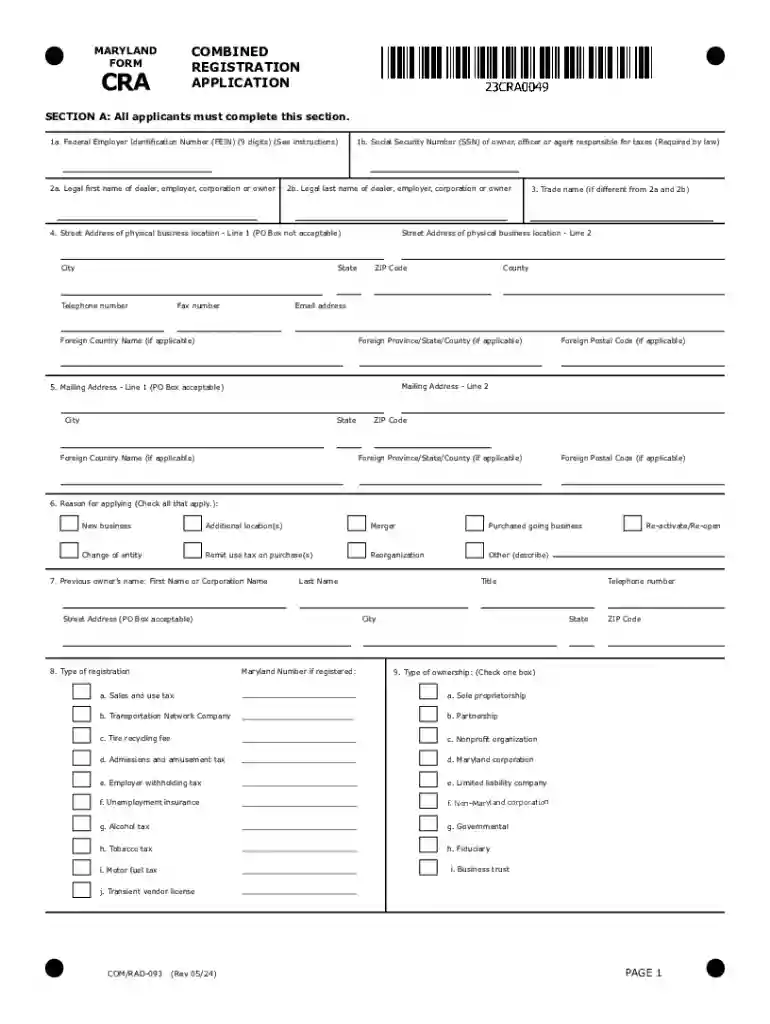
The Maryland Form CRA, or Combined Registration Application, is a pivotal document for businesses operating in Maryland. This form is integral for registering various tax accounts, such as sales and use tax, withholding tax, and unemployment insurance, among others. The primary purpose of this form is to streamline the registration process by consolidating multiple tax registration requirements into a single application. By submitting this application, businesses can efficiently establish their tax obligations and ensure compliance with Maryland state laws.
Multiple sections within the form require specific information, including business details, ownership structures, and intended business activities. Understanding the scope and intent of each section is crucial for accurate completion. For example, the sales and use tax registration pertains to businesses that sell goods or provide services within Maryland, necessitating meticulous data entry to avoid discrepancies.
Completing the Maryland Form CRA can seem daunting due to its comprehensive nature, but following a systematic approach can simplify the process. Below are the primary steps:
Gather Required Information: Before starting, collect necessary details about your business, including the federal employer identification number (FEIN), social security numbers for owners, and business activity descriptions.
Fill in Business Information: Input the basic details of your business such as name, address, and contact information. Ensure accuracy to prevent processing delays.
Select Applicable Tax Accounts: Identify which tax accounts your business needs. This can include sales and use tax, unemployment insurance, or employer withholding tax.
Complete Ownership Details: Provide information about the business' ownership structure. This includes details about partners or corporate officers, ensuring transparency in business control.
Answer Specific Tax-Related Inquiries: Respond to questions about taxable activities and business operations. This is crucial for appropriate tax categorization.
Review and Verify Entries: Carefully review all entries for accuracy. Mistakes can lead to delayed processing or regulatory issues.
Submit the Application: Depending on preference, submit the form electronically or send it via mail to the Maryland Comptroller’s Office.
Errors or omissions can result in penalties or additional administrative requirements, emphasizing the importance of thoroughness during completion.
Understanding the terminology used within Maryland Form CRA is essential for accurate completion. Here are some key terms:
Each of these terms plays a critical role in the context of tax registration and ensuring that businesses are correctly categorized and compliant with tax laws.
The Maryland Form CRA is utilized by a broad spectrum of entity types operating within Maryland. Common users include:
The form serves as a foundational step for any business looking to legally operate in Maryland, ensuring all necessary tax obligations are met.


The legal foundation of the Maryland Form CRA is to ensure businesses comply with state tax laws. This compliance is vital for maintaining the legal integrity of business operations in Maryland. The form is used to:
Failing to adhere to the application requirements can result in fines and impede business operations, highlighting the necessity for careful legal compliance.
Several critical components form the backbone of the Maryland Form CRA:
Each element plays a necessary role in ensuring that businesses are appropriately registered to handle their tax responsibilities.
Maryland’s state-specific rules impact how the Form CRA is completed and submitted. Businesses must be aware of:
Understanding these state-specific nuances is crucial for ensuring timely and compliant registration.
Meeting filing deadlines is paramount for businesses to avoid penalties and ensure continuous compliance. Specific deadlines may include:
Being vigilant about these timelines helps maintain business operations without interruptions due to compliance issues.
We've got more versions of the Maryland Form CRA Combined Registration Application form. Select the right Maryland Form CRA Combined Registration Application version from the list and start editing it straight away!
| Versions | Form popularity | Fillable & printable |
|---|---|---|
| 2024 | 4.1 Satisfied (21 Votes) | |
| 2023 | 4.5 Satisfied (40 Votes) | |
| 2023 | 4.2 Satisfied (26 Votes) | |
| 2022 | 4.6 Satisfied (55 Votes) | |
| 2021 | 4.9 Satisfied (30 Votes) | |
| 2020 | 4.1 Satisfied (39 Votes) | |
| 2019 | 4.3 Satisfied (168 Votes) | |
| 2018 | 4.4 Satisfied (140 Votes) | |
| 2017 | 4.3 Satisfied (165 Votes) | |
| 2016 | 4.3 Satisfied (100 Votes) | |
| 2015 | 4 Satisfied (51 Votes) | |
| 2010 | 4 Satisfied (51 Votes) |
At DocHub, your data security is our priority. We follow HIPAA, SOC2, GDPR, and other standards, so you can work on your documents with confidence.


You may download the paper application here. Please fax the completed application to (410)260-7908. The last day this application will be available is January
Nov 15, 2016 All employers are required to register with the Revenue Administration Division by filing a Combined Registration Application Form CRA.


