01. Edit your form online
Type text, add images, blackout confidential details, add comments, highlights and more.

Type text, add images, blackout confidential details, add comments, highlights and more.

Draw your signature, type it, upload its image, or use your mobile device as a signature pad.

Send it via email, link, or fax. You can also download it, export it or print it out.
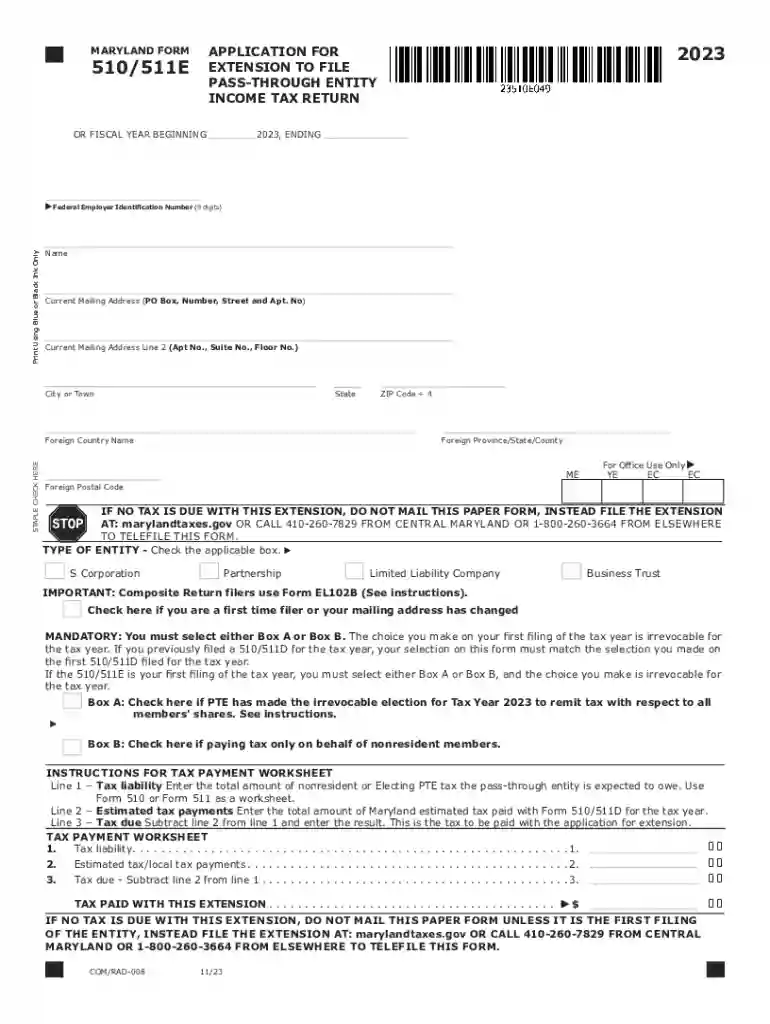
The Tax Year 2023 Form 510/511E Application for Extension to File Pass-Through Entity Income Tax Return is a critical document for pass-through entities, such as S Corporations, Partnerships, and Limited Liability Companies (LLCs), operating in the United States. This form is specifically designed to request an extension for filing income tax returns for these entities. It includes the necessary instructions and guidelines entities must follow to ensure their request for an extension is processed correctly and on time. The form caters to entities that might be unable to file their income tax returns by the original due date, providing them with additional time to prepare and submit the required documentation.
Gather Necessary Information: Before you start filling out the form, collect all relevant information, including the Entity Identification Number (EIN), mailing address, and estimated tax liability.
Fill Out Part I: This section requires details such as the entity name, EIN, and address. Accurate information here is vital for processing the extension request.
Complete Part II: Here, you'll declare the amount of tax liability for the previous tax year and calculate any payments made towards this liability. Accurate calculations are crucial for avoiding penalties.
Calculate Extension Payment If Applicable: If additional payment is needed to cover the estimated tax liabilities, the amount must be calculated and paid to avoid interest and penalties.
Sign and Date the Form: An authorized representative of the entity must sign the form to validate the extension request.
Submit the Form: The completed form can be submitted electronically or via mail, as per the instructions provided. Choosing electronic submission can expedite processing.
Entity Information: This includes the name, address, and EIN of the entity requesting the extension. Accurate input is essential for correct identification.
Tax Liability Estimate: Estimation of the tax amount the entity is liable for the tax year is crucial in determining if additional payments are necessary.
Payment Details: If the current payments are less than the estimated tax liability, details include additional amounts that need to be paid to avoid any penalties.
Signatures: The form must be signed by an authorized individual representing the entity to validate the application for an extension.
Original Due Date: All entities must file their income tax returns by the 15th day of the third month following the end of the tax year.
Extension Request Deadline: The application for an extension must be submitted on or before the original due date of the return.
Extended Deadline: Once approved, the extension generally provides an additional six months to file the tax return.
The Form 510/511E is specifically applicable to pass-through entities, which include:
S Corporations: These entities pass corporate income directly to shareholders and are subject to personal tax rates.
Partnerships: Income is passed to the partners, who then report it on their personal tax returns.
Limited Liability Companies (LLCs): Can be taxed as either partnerships or S Corporations and often opt for pass-through taxation benefits.
IRS guidelines stipulate that while an extension to file can be granted through this form, it is essential to note it does not extend the time to pay any taxes owed. The taxes are still due by the original filing date, and failure to pay them can result in interest and penalties.
Failure to accurately complete and submit the Form 510/511E by the specified deadlines or inaccuracies in the estimated tax liabilities may result in the following:
Late Filing Penalties: A penalty is typically imposed for each month (or part of a month) tax return is late.
Interest on Unpaid Taxes: Interest accrues on any unpaid taxes from the original due date of the return until the tax is paid.
It's important to note that specific states may have their own requirements and additional forms for requesting an extension. Entities conducting business in multiple states should review each state's regulations to ensure compliance with both federal and state-level requirements.
We've got more versions of the Tax Year 2023 Form 510 511E Application for Extension to File Pass-Through Entity Income Tax Return form. Select the right Tax Year 2023 Form 510 511E Application for Extension to File Pass-Through Entity Income Tax Return version from the list and start editing it straight away!
At DocHub, your data security is our priority. We follow HIPAA, SOC2, GDPR, and other standards, so you can work on your documents with confidence.