




01. Edit your form online
Type text, add images, blackout confidential details, add comments, highlights and more.

Type text, add images, blackout confidential details, add comments, highlights and more.

Draw your signature, type it, upload its image, or use your mobile device as a signature pad.

Send it via email, link, or fax. You can also download it, export it or print it out.
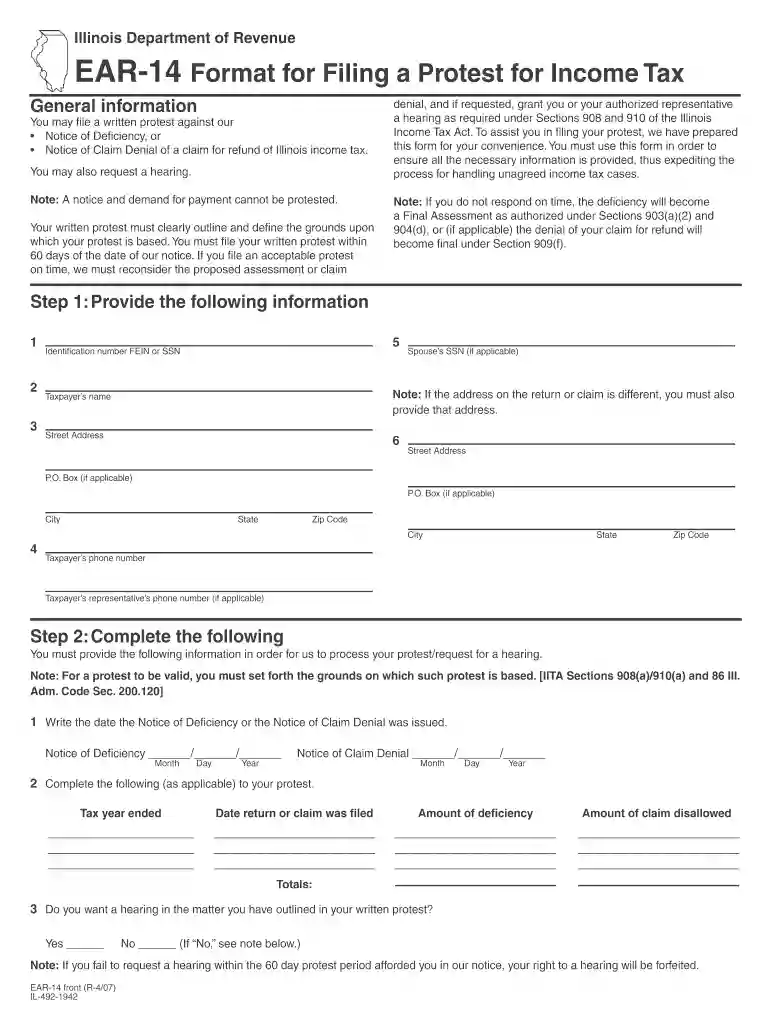
An income tax protest in Illinois is a formal written objection filed by taxpayers against a Notice of Deficiency or Notice of Claim Denial regarding their state income tax. The primary aim of this protest is to dispute the state's tax assessment and potentially rectify perceived inaccuracies. By filing a protest, taxpayers can request a reconsideration of the assessment and a hearing if required. This process is crucial for taxpayers who believe there's an error in the tax deficiency notice. Without this formal protest, the assessed amount may become final, leading to enforcement actions or penalties.
Receive and Review the Notice: Upon receiving a Notice of Deficiency or Claim Denial, thoroughly review it to understand the specific reasons cited for the tax adjustment.
Prepare Your Protest: Draft a written statement detailing the grounds for your protest. Clearly articulate why you disagree with the assessment and provide supporting documentation.
Include Personal Information: Ensure your protest includes your full name, address, and taxpayer identification number. This information is vital for accurately processing your protest.
State Your Desired Outcome: Specify whether you request a hearing. This statement should outline the specific outcome you seek, such as the reassessment of taxes.
File Within Deadline: Submit the protest within the 60-day period from the date of notice receipt. If not filed within this timeframe, the assessed amount may become conclusive.
Filing an income tax protest in Illinois is a legal right granted to taxpayers. It serves to ensure fair treatment by enabling taxpayers to challenge discrepancies in tax assessments. Legally, the protest must be responded to by the Illinois Department of Revenue, providing taxpayers an avenue to reconcile differences amicably. The protest must adhere to guidelines, ensuring all necessary information and documentation are provided, facilitating a legitimate review process.
Online Submission: The most efficient method involves submitting the protest through the Illinois Department of Revenue's online portal. Ensure that all documents are in the acceptable digital format.
Mail Submission: If opting for post, send your documents via certified mail to ensure delivery tracking.
In-Person Submission: You can also submit your protest at designated Illinois Department of Revenue offices. This method provides immediate confirmation of receipt.
The IRS guidelines affect state income tax protests by ensuring standard procedures are followed for filing objections. Although state regulations govern the protest process, adherence to IRS principles can influence the outcome, particularly when federal tax issues intertwine with state assessments.
Failure to file a timely protest can result in the imposition of additional fees, interest, and the initiation of collection actions by the state. Once the assessment becomes final, options for contesting the deficiency become severely limited, emphasizing the necessity of timely and accurate filing within the 60-day deadline.
By focusing on these essential aspects and following a structured approach, you can adeptly navigate the process of filing an income tax protest in Illinois, providing the best chance for a favorable outcome.
We've got more versions of the How to File an Income Tax Protest in Illinois form. Select the right How to File an Income Tax Protest in Illinois version from the list and start editing it straight away!
At DocHub, your data security is our priority. We follow HIPAA, SOC2, GDPR, and other standards, so you can work on your documents with confidence.



Income tax protests ─ Form EAR-14, Format for Filing a Protest for Income Tax All other. Form AH-4, Protest and Request for Administrative Hearing with the
American Electric Power received a tax rebate of $545 million and made $5.899 billion in US profits, meaning it paid a tax rate of -9%.


