




01. Edit your 2021 form 2290 online
Type text, add images, blackout confidential details, add comments, highlights and more.

Type text, add images, blackout confidential details, add comments, highlights and more.

Draw your signature, type it, upload its image, or use your mobile device as a signature pad.

Send 2290 form 2021 via email, link, or fax. You can also download it, export it or print it out.
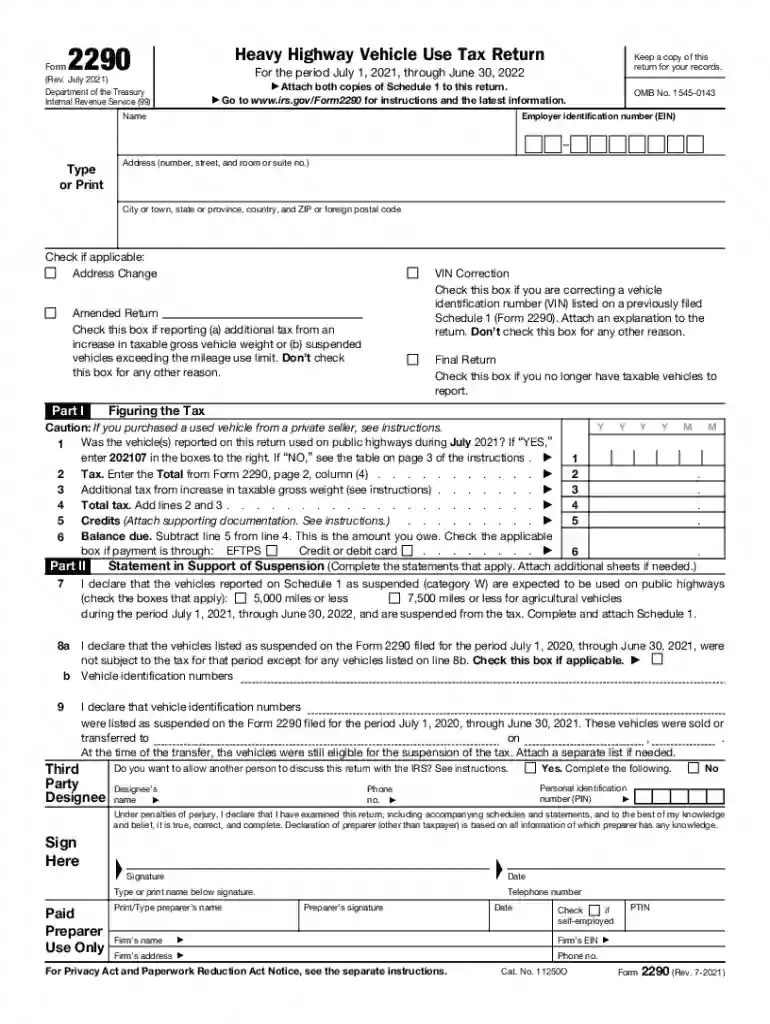
Form 2290, also known as the Heavy Highway Vehicle Use Tax Return, is an IRS form used to report and pay the annual tax for highway motor vehicles with a taxable gross weight of 55,000 pounds or more. The tax revenue is utilized for maintaining and constructing the nation’s roads and highways. This form is crucial for owners of heavy vehicles who wish to operate legally and avoid penalties. A key aspect of Form 2290 is its requirement for vehicles that fall within a particular weight class, ensuring that those contributing significantly to road wear are contributing to maintenance costs.
Utilizing Form 2290 involves several specific steps to ensure compliance with IRS requirements. Vehicle owners must first determine if their vehicle's weight meets the minimum threshold for taxation. Once confirmed, they need to accurately calculate the tax based on the number of vehicles owned and their respective weights. Submission of Form 2290 must occur within the designated period to avoid late fees. Upon completion, vehicle owners receive a stamped Schedule 1, which they must present as proof of payment to register their vehicle with the state Department of Motor Vehicles.
Owners must be aware that the Form 2290 is due annually by August 31 for vehicles that were in use during the prior taxable period beginning July 1. For newly acquired or first-used vehicles, the filing must occur by the end of the month following the vehicle's first use month. Timely filing is critical to avoid penalties and ensure uninterrupted operation of your vehicles.
Form 2290 provides multiple filing methods. E-filing is recommended for faster processing, especially for owners with 25 or more vehicles, providing convenience and a quicker receipt of Schedule 1. Alternatively, paper submissions via mail are accepted, albeit with a longer processing time. In-person submission is not an option for Form 2290, and vehicle owners should utilize e-filing or mail submission methods to comply with IRS guidelines.
Failure to file Form 2290 by the due date or incorrect payment can lead to penalties and interest accruals. The IRS may apply a penalty of 4.5% of the total tax due if filing is late, accruing monthly until rectified. Late payment incurs an additional penalty of 0.5% per month, compounded with daily interest. Ensuring timely and correct filing prevents additional financial burden and legal complications. Ensuring adherence to these regulations and deadlines helps maintain compliance and avoids unnecessary penalties.
We've got more versions of the 2021 form 2290 form. Select the right 2021 form 2290 version from the list and start editing it straight away!
| Versions | Form popularity | Fillable & printable |
|---|---|---|
| 2025 | 4.2 Satisfied (37 Votes) | |
| 2024 | 4.8 Satisfied (56 Votes) | |
| 2023 | 3.2 Satisfied (48 Votes) | |
| 2022 | 4.4 Satisfied (60 Votes) | |
| 2021 | 4.8 Satisfied (181 Votes) | |
| 2020 | 4.4 Satisfied (108 Votes) | |
| 2019 | 4.3 Satisfied (93 Votes) | |
| 2018 | 4.3 Satisfied (63 Votes) | |
| 2017 | 4.2 Satisfied (130 Votes) | |
| 2016 | 4.2 Satisfied (65 Votes) | |
| 2015 | 4.4 Satisfied (50 Votes) | |
| 2014 | 4 Satisfied (43 Votes) | |
| 2013 | 4 Satisfied (27 Votes) | |
| 2012 | 3.7 Satisfied (35 Votes) | |
| 2011 | 4 Satisfied (52 Votes) |
At DocHub, your data security is our priority. We follow HIPAA, SOC2, GDPR, and other standards, so you can work on your documents with confidence.
IRS Heavy Vehicle Use Tax Form 2290 in the title holders name. Personal property tax receipt or waiver. Secretary of State business filing certificateRead more
Form 2290, heavy highway vehicle use tax return. French (Online). Formulaire 2290(FR), dclaration dimpt sur utilisation des vhicles lourds sur les routes.Read more
Use Form 2290 to: Figure and pay the tax due on highway motor vehicles used during the period with a taxable gross weight of 55,000 pounds or more;Read more


