




01. Edit your form online
Type text, add images, blackout confidential details, add comments, highlights and more.

Type text, add images, blackout confidential details, add comments, highlights and more.

Draw your signature, type it, upload its image, or use your mobile device as a signature pad.

Send it via email, link, or fax. You can also download it, export it or print it out.
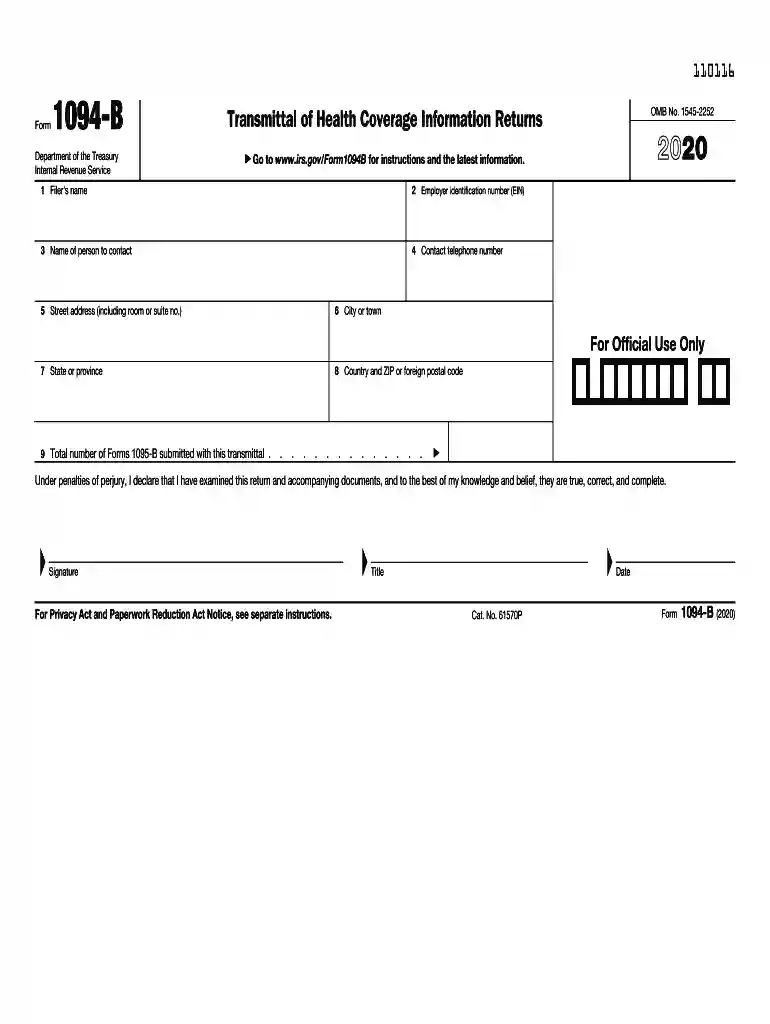
Form 1094, officially recognized as IRS Form 1094-B or 1094-C, is a transmittal form used to report information about health coverage to the IRS. This form acts as a cover sheet for employers or insurance providers, detailing the name and number of attached Forms 1095-B or 1095-C, which report specific health coverage information for individuals. It plays a crucial role in adhering to the Affordable Care Act (ACA) requirements by helping the IRS ensure compliance with health insurance mandates.
Using Form 1094 involves gathering accurate data related to health coverage and preparing it for submission to the IRS. It's essential to determine which version of the form applies to your organization, as 1094-B is generally used by small employers or insurance issuers, while 1094-C is for applicable large employers (ALEs). After selecting the appropriate form, compile data on the coverage offered, ensure that all information matches what is reported on corresponding Forms 1095, and verify employer-specific details to avoid discrepancies. Employers should carefully review all inputs given the legal implications of reporting inaccuracies.
Gather Necessary Information: Compile data about employer and health coverage specifics, including the number of employees and details from individual 1095 forms.
Fill in Basic Information: Start with employer identification, including name, address, and Employer Identification Number (EIN).
IRS Control Number: Assign a distinct control number, if desired, for tracking and organizing forms.
Part I Completion: Detail the total number of Forms 1095-B or 1095-C submitted with this transmittal form.
Part II & III Completion: Depending on form version, fill in additional employer health coverage information, such as the number of full-time employees and all ALE members.
Review and Submit: Ensure all entries are accurate, consistent, and in line with IRS guidelines before submitting the forms electronically or by mail.
ALE (Applicable Large Employer): An employer with 50 or more full-time employees or equivalents, applicable primarily for Form 1094-C.
Transmittal Form: A cover sheet that accompanies related documents (Forms 1095) to provide a summary to the IRS.
Full-Time Employee: For ACA purposes, an employee who works, on average, at least 30 hours per week.
ACA Compliance: Adherence to the Affordable Care Act's requirements, including the reporting of health coverage information.
Organizations need to prepare and organize several key documents when dealing with Form 1094:
Having these documents in order is crucial to ensure consistency and accuracy across all submitted forms.
Compliance with IRS filing deadlines is critical:
For Employers: Typically, Forms 1094 and 1095 must be submitted by February 28 if filed on paper, or March 31 if filed electronically.
Distribution to Employees: Employers must furnish copies of Form 1095 to employees by January 31.
Missing these deadlines can result in penalties, making it important to have a clear plan for timely submission and distribution.
Electronic Submission: The IRS mandates electronic submission for employers filing 250 or more forms. Electronic submission is handled through the IRS's ACA Information Return system, which is efficient for managing large volumes.
Mail: Paper submissions are accepted for fewer than 250 forms. They must be sent to the designated IRS address based on the employer's location.
In-Person Submission: Not applicable for Form 1094 as IRS does not support walk-in submissions for these forms.
Failure to accurately complete and submit Form 1094 can lead to significant penalties:
Non-filing or Late Filing Penalties: Charges for each late or non-submitted form, which can accumulate rapidly, increase based on the delay's duration.
Incorrect Information Penalties: Fines imposed for incorrect or incomplete information on submitted forms. Correction of forms promptly upon discovering errors can mitigate penalties.
Failure to Provide Employee Copies: Employers must furnish correct copies to employees on time to avoid additional fines.
Understanding these penalties highlights the importance of meticulous management and submission of Form 1094 and related documents.
We've got more versions of the form 1094 form form. Select the right form 1094 form version from the list and start editing it straight away!
| Versions | Form popularity | Fillable & printable |
|---|---|---|
| 2025 | 4.4 Satisfied (33 Votes) | |
| 2024 | 4.2 Satisfied (32 Votes) | |
| 2023 | 4.8 Satisfied (39 Votes) | |
| 2022 | 4.7 Satisfied (47 Votes) | |
| 2021 | 4.8 Satisfied (71 Votes) | |
| 2020 | 4.2 Satisfied (104 Votes) | |
| 2019 | 4.2 Satisfied (27 Votes) | |
| 2018 | 4.3 Satisfied (152 Votes) | |
| 2017 | 4.4 Satisfied (146 Votes) | |
| 2016 | 4.4 Satisfied (317 Votes) | |
| 2015 | 4 Satisfied (28 Votes) | |
| 2014 | 4 Satisfied (24 Votes) |
At DocHub, your data security is our priority. We follow HIPAA, SOC2, GDPR, and other standards, so you can work on your documents with confidence.
Under penalties of perjury, I declare that I have examined this return and accompanying documents, and to the best of my knowledge andRead more
Nov 11, 2015 Employers that offer employer-sponsored self-insured health coverage to non-employees who enroll in the coverage may use Forms 1094-B and 1095-BRead more
Feb 23, 2018 1,094. Net cash flow used for investing activities. (1,429). (1,252). (1,066). Net cash flow provided by financing activities. 316. 198. 4. NetRead more


