







Definition and Meaning
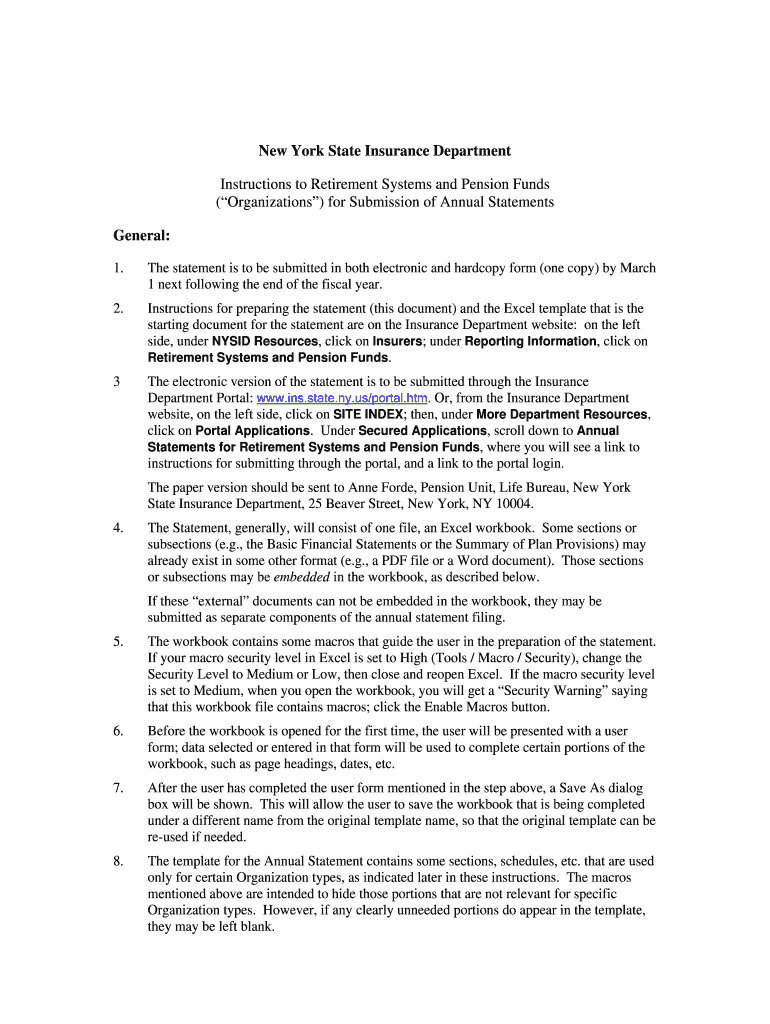
The "Instructions to Retirement Systems and Pension Funds (Organizations) for Submission of 2010 Annual Statements" is a regulatory document that provides guidance to retirement systems and pension funds regarding the preparation and submission of their annual financial reports. This document outlines the requirements set by the New York State Insurance Department, focusing on both electronic and physical submissions. Key components within the document include guidelines for financial reporting, actuarial information, and investment schedules, ensuring compliance with generally accepted accounting principles.
Key Elements and Purpose
- Financial Reporting: Detailed requirements for the presentation of financial positions, including balance sheets, income statements, and cash flow statements.
- Actuarial Information: Standards for presenting actuarial data, which helps in assessing the financial health and sustainability of pension plans.
- Investment Schedules: Instructions on how to report investment activities, types of investments held, and returns on those investments.
- Adherence to Principles: Emphasis on compliance with generally accepted accounting principles to ensure uniformity and accuracy in financial reporting.
Steps to Complete the Submission
To successfully submit the annual statements as per the instructions, organizations should follow these steps:
- Review Guidelines: Carefully study the submission requirements and guidelines, focusing on both electronic and paper submission protocols.
- Prepare Financial Reports: Compile and organize necessary financial documents and data aligning with stipulated formats and contents.
- Data Entry in Templates: Use the Excel workbook template provided in the instructions for data entry, ensuring accuracy and compliance.
- Submission: Submit the completed documents through the specified preferred method, which could be online, via mail, or in-person.
- Confirmation of Receipt: After submission, verify the receipt of documents and maintain copies for organizational records.
Important Aspects to Consider
- Deadlines: Make note of submission deadlines to avoid penalties.
- Required Attachments: Ensure all appendices, such as actuarial reports and investment schedules, are properly attached.
- Verification Process: Prior to submission, review all data entered to minimize errors.
Filing Deadlines / Important Dates
Meeting filing deadlines is crucial to avoid penalties and ensure compliance with regulatory requirements:
- Standard Deadline: Annual statements are typically due within a specific period following the fiscal year-end. It is important to consult the instructions for the exact date.
- Extensions: In certain circumstances, extensions may be granted upon request. Organizations must apply for these extensions before the original deadline and provide justification.
Penalties for Late Submission
- Fines: Non-compliance with filing deadlines can result in monetary penalties imposed by the regulatory body.
- Audits: Late or incorrect filings may trigger detailed audits or reviews by the state authority.
Form Submission Methods
Understanding the submission options available can streamline the process:
- Online Submission: Organizations may often submit their annual reports electronically through a designated portal, which provides immediate confirmation of receipt.
- Mail or In-Person: Traditional methods involve sending physical copies of documents via certified mail or delivering them in-person to the designated office.
Advantages of Online Submission
- Efficiency: Faster processing and fewer administrative burdens than paper submissions.
- Tracking: Easier to track the submission status and receive timely updates.
Required Documents
The "Instructions to Retirement Systems and Pension Funds" outlines the essential documents needed for a complete submission:
- Financial Statements: Including balance sheets and income statements.
- Actuarial Reports: Detailed actuarial valuations and assumptions used.
- Investment Schedules: Comprehensive listing and valuation of investments.
Supporting Documentation
- Plan Provisions: Information on the structure and feature of the pension plans.
- Supplementary Information: Additional schedules and notes providing context and clarification to the financial statements.
Examples of Instructions in Use
To illustrate the application of the instructions, consider these scenarios:
- State Pension Fund: An organization uses the instructions to submit its complete financial statements, ensuring adherence to all required formats and content sections.
- Corporate Pension System: A private entity applies the guidelines to its end-of-year financial report, focusing on accurate actuarial data reporting.
Software Compatibility and Integration
Utilizing compatible software can facilitate efficient preparation and submission of documents:
- Spreadsheet Applications: Programs like Microsoft Excel can be used for data entry and calculations according to the provided workbook template.
- Document Management Systems: Software like DocHub enhances document preparation and submission through document editing, collaboration, and secure signing functionalities.
Seamless Integration
- Cloud Storage Services: Integration with services such as Google Drive can simplify the submission process by allowing easy access, editing, and backup of documents.
- Compatibility Checks: Ensure that all software used is compatible with formatting and submission requirements outlined in the instructions.
Who Typically Uses These Instructions
These guidelines are primarily used by:
- State and Local Retirement Systems: To maintain compliance with regulatory requirements and provide transparency on financial health.
- Corporate Pension Fund Managers: In ensuring that corporate retirement benefits are accurately reported and aligned with financial regulations.


Role of Regulators
- Regulatory Bodies: Such as the New York State Insurance Department, which uses these submissions to monitor financial soundness and compliance.
By focusing on these key areas, organizations can effectively use the "Instructions to Retirement Systems and Pension Funds (Organizations) for Submission of 2010 Annual Statements" to ensure precise and punctual financial reporting.




