




01. Edit your form online
Type text, add images, blackout confidential details, add comments, highlights and more.

Type text, add images, blackout confidential details, add comments, highlights and more.

Draw your signature, type it, upload its image, or use your mobile device as a signature pad.

Send it via email, link, or fax. You can also download it, export it or print it out.
The Paycheck Protection Program (PPP) loans were developed to provide financial assistance to small businesses affected by the economic downturn due to the COVID-19 pandemic. These loans aim to help businesses maintain their workforce by covering payroll costs and other eligible expenses. Borrowers benefit from potential loan forgiveness if they adhere to certain conditions, emphasizing their utility in supporting business continuity during challenging times.
Collect Necessary Information: Before filling out the application, gather essential documents such as payroll records, tax forms, and financial statements. These will be vital for calculating the loan amount and verifying eligibility.
Complete the Application Form: Ensure all sections of the PPP loan application form are accurately filled. This includes personal details, business information, and details of your payroll expenses.
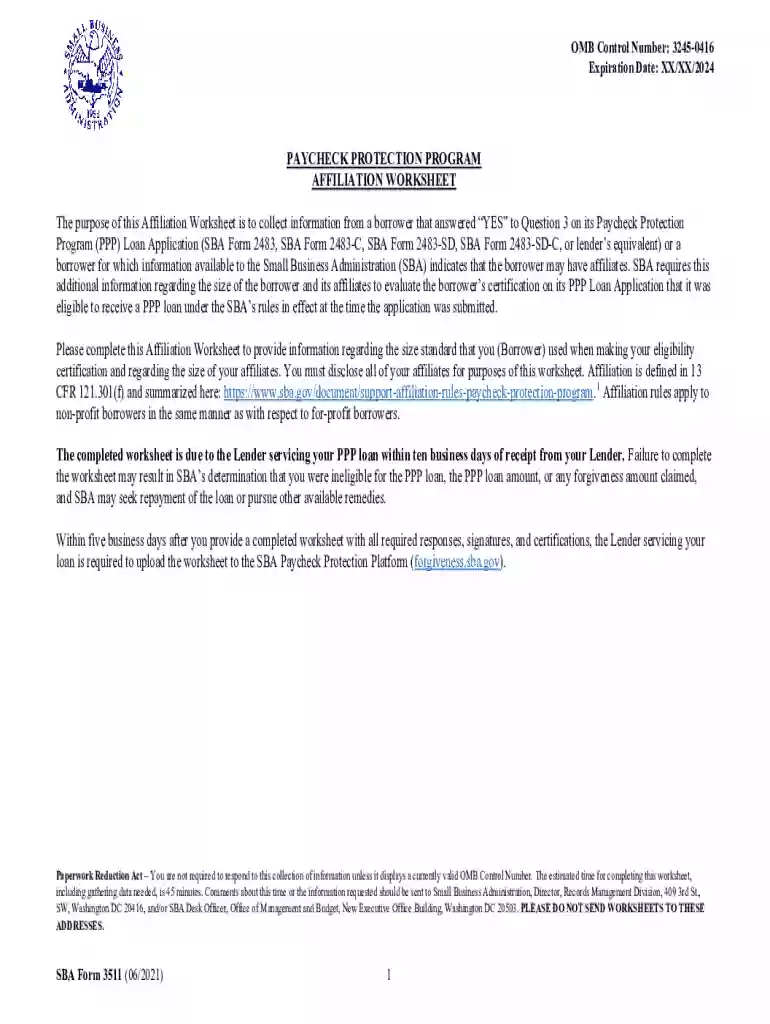
Affiliation Worksheet: If applicable, complete the Affiliation Worksheet to disclose any affiliates and provide the necessary information that impacts loan eligibility, such as size standards.
Certifications and Information Disclosure: Certify the accuracy of the provided information and acknowledge the eligibility criteria. This step includes attesting to the economic need for the loan and the intent to use the funds appropriately.
Submit to a Lender: Finally, once the application is thoroughly completed, submit it to an approved lender for review and processing.
PPP loans are targeted primarily at small businesses, including non-profits, veterans' organizations, and tribal businesses with fewer than 500 employees. Sole proprietors, independent contractors, and self-employed individuals are also eligible. Applicants must demonstrate that the current economic environment is impacting their business adversely to qualify for the loan. A critical factor includes the necessity to retain employees.


When completing the PPP loan application, several key elements ensure a smooth process. First, accuracy in payroll calculations is crucial as it affects the loan amount. Proper completion of the Affiliation Worksheet, where applicable, is necessary to provide a complete picture of business affiliations. Certifying the eligibility and use of funds, and ensuring all documents are in order before submission, are also pivotal.
Non-compliance with the terms of the PPP loan can lead to several penalties, including repayment of the loan amount if the forgiveness criteria are not met. Moreover, providing false or misleading information on the application or failing to use the funds for eligible expenses can result in legal consequences, including sanctions or fines.
Borrowers can submit their completed PPP loan applications through various methods, depending on their lender's preferences. Most applications are submitted online through the lender's portal for a streamlined process, although some lenders may offer mail or in-person submissions. The submission method should be confirmed directly with the specific lender chosen for the application.
Businesses can use various accounting and tax software to assist with the PPP application process. Programs like QuickBooks and TurboTax offer features to import necessary financial data smoothly, ensuring calculations are accurate and complete. These integrations help streamline both application completion and loan management during the covered period, facilitating compliance and tracking of funds.
We've got more versions of the Client Alert: Paycheck Protection Program Loans form. Select the right Client Alert: Paycheck Protection Program Loans version from the list and start editing it straight away!
At DocHub, your data security is our priority. We follow HIPAA, SOC2, GDPR, and other standards, so you can work on your documents with confidence.



by S Park 2021 Cited by 2 The PPP allowed small businesses, to apply for low-interest loans to pay for payroll and other operating costs. Firms could borrow approximately 2.5 times
The COVID-19 EIDL program provided loans and advances to help businesses recover from the economic impacts of the pandemic. Learn about COVID-19 EIDL. PaycheckRead more


