01. Edit your form online
Type text, add images, blackout confidential details, add comments, highlights and more.

Type text, add images, blackout confidential details, add comments, highlights and more.

Draw your signature, type it, upload its image, or use your mobile device as a signature pad.

Send it via email, link, or fax. You can also download it, export it or print it out.
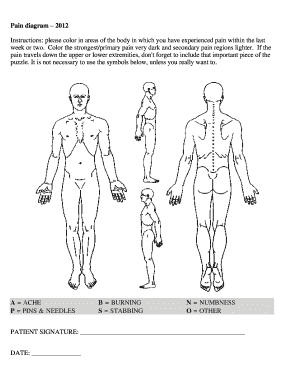
The Pain Outcomes Questionnaire Short Form (POQ-SF) is a specialized assessment tool developed by Dr. Michael E. Clark and Dr. Ronald J. Gironda. Its primary purpose is to evaluate the pain levels and associated effects on individuals undergoing treatment at the Chronic Pain Rehabilitation Program at the James A. Haley Veterans Affairs Hospital in Tampa, Florida. This questionnaire provides a comprehensive measure of pain's impact on daily living, considering facets like physical activity, emotional health, and cognitive functions. By understanding these factors, healthcare providers can tailor treatment plans effectively to address the unique needs of each patient.
This form comprises various sections, each targeting specific aspects of pain management. It involves questions that delve into:
These factors collectively aid in forming a holistic view of a patient's pain experience and guide clinicians in making informed decisions about treatment pathways.
Healthcare professionals use the POQ-SF to gather baseline data and track changes over time in response to treatment interventions. The process involves administering the questionnaire before initiating any intervention and periodically throughout the treatment cycle. This consistent tracking helps in assessing the effectiveness and adjusting the treatment as needed.
Completing the POQ-SF requires attention to detail, ensuring that all responses reflect the participant's current condition accurately. Here’s a structured approach:
The POQ-SF includes several key sections aimed at garnering a comprehensive understanding of the patient’s condition:
The primary users of the POQ-SF are healthcare providers within specialized pain management programs, like those at Veterans Affairs hospitals, aiming to deliver personalized patient care. The questionnaire is particularly beneficial for:


The POQ-SF is used legally within the scope of clinical assessments to enhance patient care. Compliance with relevant regulatory standards ensures the questionnaire's use aligns with patient privacy laws, such as the Health Insurance Portability and Accountability Act (HIPAA) in the United States. Healthcare providers use it as a part of medical records, which are maintained with the utmost confidentiality.
While the POQ-SF is widely utilized in specific clinical settings, other versions or pain assessment tools may be available based on different methodologies or intended use cases:
Understanding key terms related to pain assessment can enhance the effective use of the POQ-SF:
These terms form the foundation for a clear comprehension of the questionnaire and its applications in clinical practice.
At DocHub, your data security is our priority. We follow HIPAA, SOC2, GDPR, and other standards, so you can work on your documents with confidence.