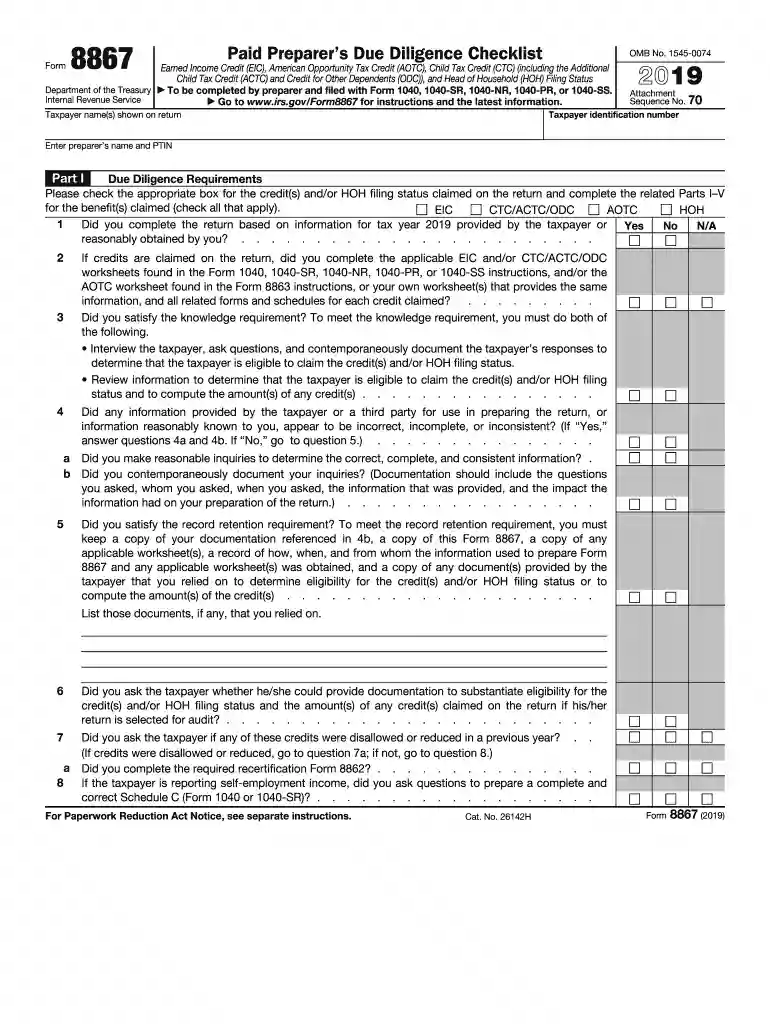
Part 111 form 8867 2019-2026

Get Form
formulario 8867 en español Preview on Page 1

Here's how it works

01. Edit your formulario 8867 en español online
Type text, add images, blackout confidential details, add comments, highlights and more.

02. Sign it in a few clicks
Draw your signature, type it, upload its image, or use your mobile device as a signature pad.

03. Share your form with others
Send form 8867 en espanol via email, link, or fax. You can also download it, export it or print it out.

Definition and Purpose of Part 111 Form 8867 (2019)

The part 111 form 8867, formally known as the Paid Preparer’s Due Diligence Checklist, is a crucial document mandated by the IRS for tax preparers. Its primary role is to ensure that preparers perform due diligence when claiming various tax credits, particularly the Earned Income Tax Credit (EITC), American Opportunity Tax Credit (AOTC), Child Tax Credit (CTC), and Head of Household (HOH) filing status. This form is vital for maintaining compliance and safeguarding against potential audits.

Tax preparers must use Form 8867 to document their assumptions and verify the eligibility of taxpayers for the credits claimed on their returns. The form includes various sections that provide a checklist format, guiding preparers through the necessary steps to ensure all due diligence requirements are met meticulously.

How to Use Part 111 Form 8867 (2019)

To effectively utilize the part 111 form 8867, tax preparers should follow these essential steps:

  1. Assess Eligibility: Start by reviewing the criteria for the credits claimed. This involves verifying the taxpayer's qualifying conditions based on their income, filing status, and dependent information.

  2. Complete the Checklist: Fill out the form according to the specific questions and sections related to the credits sought. Each section targets different aspects of the due diligence process.

  3. Maintain Records: Retain records that substantiate the claims made by the taxpayer. The form requires documentation of eligibility, inquiries made, and responses received.

  4. Review and Sign: After completing the form, preparers must sign it, affirming that all due diligence measures have been followed during the preparation of the tax return.

  5. Submit with Tax Return: The completed part 111 form 8867 should accompany the tax return filed with the IRS.

These steps are designed to ensure a thorough approach to claiming tax credits, mitigating the risk of penalties that may arise from non-compliance or erroneous filings.

Key Elements of Part 111 Form 8867 (2019)

The part 111 form 8867 contains several critical elements that tax preparers must understand. Here are the key components:

  • Taxpayer Information: This section requires the preparer to provide details about the taxpayer, including name, Social Security number, and other relevant identifiers.

  • Credit-Specific Questions: Each credit has associated questions aimed at verifying eligibility. For instance, questions related to the EITC may include queries about income levels and family size.

  • Due Diligence Documentation: The form emphasizes the importance of documenting inquiries made about the taxpayer’s eligibility, which should include the type of verification and evidence collected.

  • Signature and Date: Preparer certification at the end of the document confirms all information provided is accurate and comprehensive.

Understanding these elements is crucial for ensuring compliance and effectively leveraging the benefits of the form in tax preparation.

IRS Guidelines for Part 111 Form 8867 (2019)

The IRS has outlined specific guidelines that govern the accurate completion and submission of part 111 form 8867. Key guidelines include:

  • Filing Requirements: Tax preparers are mandated to submit the form with any tax return that claims the credits listed previously. Failure to include the form where necessary can result in penalties.

  • Document Retention: The IRS mandates that preparers maintain supporting documentation for a minimum of three years after the filing date. This is vital should the IRS require verification.

  • Amendments and Corrections: If a preparer discovers inaccuracies after filing, they must initiate amendments to rectify these discrepancies with the form.

  • Review and Compliance: The IRS encourages periodic reviews of the process and thorough compliance to mitigate issues with future filings.

Awareness of these guidelines ensures that preparers are prepared for audits and other compliance measures that may arise.

Common Penalties for Non-Compliance with Part 111 Form 8867 (2019)

Failing to comply with part 111 form 8867 can lead to severe penalties for tax preparers. Understanding these penalties can help motivate adherence to guidelines:

  • Financial Penalties: The IRS imposes a monetary penalty for each failure to meet due diligence standards which can accumulate significantly over multiple claims.

  • Increased Scrutiny: Non-compliant preparers may face increased scrutiny from the IRS, leading to detailed audits of tax returns and practices.

  • Legal Consequences: In severe cases, a pattern of negligence can result in the loss of the ability to charge for tax preparation or, in extreme instances, lead to legal action against the preparer.

Being aware of these potential consequences emphasizes the importance of proper use and knowledge of the part 111 form 8867, encouraging tax preparers to exercise caution and diligence in their work.

Examples and Scenarios Involving Part 111 Form 8867 (2019)

Real-world scenarios often illustrate common situations tax preparers encounter with part 111 form 8867. Here are illustrative examples:

  • Example One: A taxpayer claims the EITC based on having three qualifying children. The preparer reviews the taxpayer’s eligibility based on income level and relationship tests. After confirming eligibility through pay stubs and school enrollment documentation, the preparer completes the form diligently to reflect this verification.

  • Example Two: A client is unsure if they qualify for the AOTC due to part-time enrollment in college. The preparer consults the IRS guidelines about qualifying educational institutions and independent status. After gathering the necessary transcripts and financial records, the preparer completes the form, ensuring all necessary information is related to the specific educational requirements for the AOTC.

These examples depict the application of the part 111 form 8867 in practical situations, illustrating the due diligence process in various contexts.

See more part 111 form 8867 2019 versions

We've got more versions of the part 111 form 8867 2019 form. Select the right part 111 form 8867 2019 version from the list and start editing it straight away!
Versions Form popularity Fillable & printable
2023 4.9 Satisfied (25 Votes)
2022 4.6 Satisfied (58 Votes)
2021 4.8 Satisfied (90 Votes)
2020 4.4 Satisfied (83 Votes)
2019 4.3 Satisfied (54 Votes)
2018 4.3 Satisfied (151 Votes)
2017 4.4 Satisfied (88 Votes)
2016 4.3 Satisfied (117 Votes)
2015 4.1 Satisfied (67 Votes)
2014 4.3 Satisfied (38 Votes)
2013 3.9 Satisfied (35 Votes)
2011 4.1 Satisfied (38 Votes)
be ready to get more

Complete this form in 5 minutes or less

Get form

Got questions?

We have answers to the most popular questions from our customers. If you can't find an answer to your question, please contact us.
Contact us
Although these changes were scheduled to expire at the end of 2025, the 2025 reconciliation law (P.L. 119-21) made them permanent. That law also temporarily increased the maximum child tax credit from $2,000 per child to $2,200 per child for tax years 2025-2028.
Record Retention Guide for Individuals RecordRetention Period Bank statements 7 years Charitable contribution documentation 7 years Credit card statements 7 years Receipts, diaries, logs pertaining to tax returns 7 years21 more rows
Form 8867 serves as the Paid Preparers Due Diligence Checklist to ensure that tax return preparers gather and document the necessary information to support claims for certain tax credits.
Keep records for 3 years from the date you filed your original return or 2 years from the date you paid the tax, whichever is later, if you file a claim for credit or refund after you file your return.
6 years - If you dont report income that you should have reported, and its more than 25% of the gross income shown on the return, or its attributable to foreign financial assets and is more than $5,000, the time to assess tax is 6 years from the date you filed the return.
be ready to get more

Complete this form in 5 minutes or less

Get form

People also ask

Keep records for 3 years from the date you filed your original return or 2 years from the date you paid the tax, whichever is later, if you file a claim for credit or refund after you file your return. Keep records for 7 years if you file a claim for a loss from worthless securities or bad debt deduction.
Multiple Forms 8867 for one return. Form 8867 must be completed by a paid tax return preparer responsible for a taxpayers claim of the EIC, the CTC/ACTC/ODC, the AOTC, and/or HOH filing status; therefore, there may be multiple Forms 8867 for one return or amended return.
A tax preparer should not only keep copies of written information (receipts, prior tax returns, emails, etc.), but also document and retain copies of all oral information and advice received. This includes conversations with the client and other related parties.

forma 8867 en español